



The Depository Trust & Clearing Corporation list now shows 21Shares’ proposed Dogecoin fund under the ticker TDOG, a procedural step that wires market plumbing for potential trading. This appearance enables broker-dealers to prepare settlement and clearing in advance. It does not, by itself, authorize public trading.
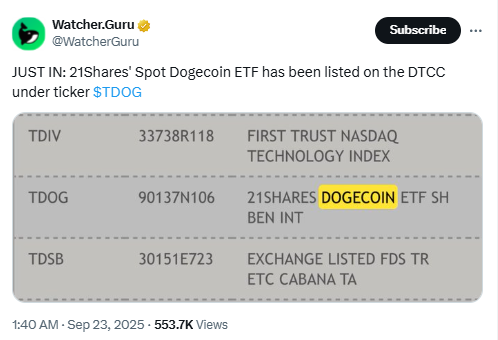
Industry coverage today frames the DTCC entry as an operational milestone rather than an approval. Outlets note that DTCC listing helps firms test ticker set-ups and readiness while the product remains subject to regulatory review. Therefore, the fund stays in the pre-launch stage until a separate decision lands.
21Shares has not announced an exchange start date for TDOG. The current status keeps attention on the United States Securities and Exchange Commission process, while back-office systems continue to line up.
What the DTCC step means—and what it does not
A DTCC listing signals clearing eligibility preparation. It allows market makers and brokers to connect workflows before any first trade. This step is common for pending exchange-traded products across asset classes.
However, DTCC inclusion does not equal regulatory approval. The Securities and Exchange Commission must still permit exchange trading. Until then, TDOG remains a proposed product despite its presence on the settlement roster.
Coverage reiterates this distinction to avoid confusion between operational readiness and legal authorization. Today’s update stays inside the infrastructure lane and leaves pricing aside.
Context: a DOGE ETF already trades in the U.S.
Separately, the REX-Osprey DOGE ETF (DOJE) began trading on Cboe BZX on September 18, 2025. Company and exchange materials confirm the launch details, giving a recent reference point for live U.S. Dogecoin ETF exposure․
Major financial publications also reported the debut last week, describing it as the first U.S. Dogecoin ETF to reach the market. These accounts provide independent confirmation of the September 18 start.
Today’s non-price focus is therefore twofold: TDOG advances through DTCC’s plumbing, while DOJE continues to trade under existing approvals. Both items concern structure and permissions, not intraday quotations.
Analyst flags Wyckoff accumulation on Dogecoin one hour chart
Trader Tardigrade shared a Dogecoin one hour chart that maps the classic Wyckoff Accumulation structure. The layout marks phases A through E with labels such as preliminary support, selling climax, automatic rally, and secondary tests. It also shows a spring below the range low followed by a projected recovery path.
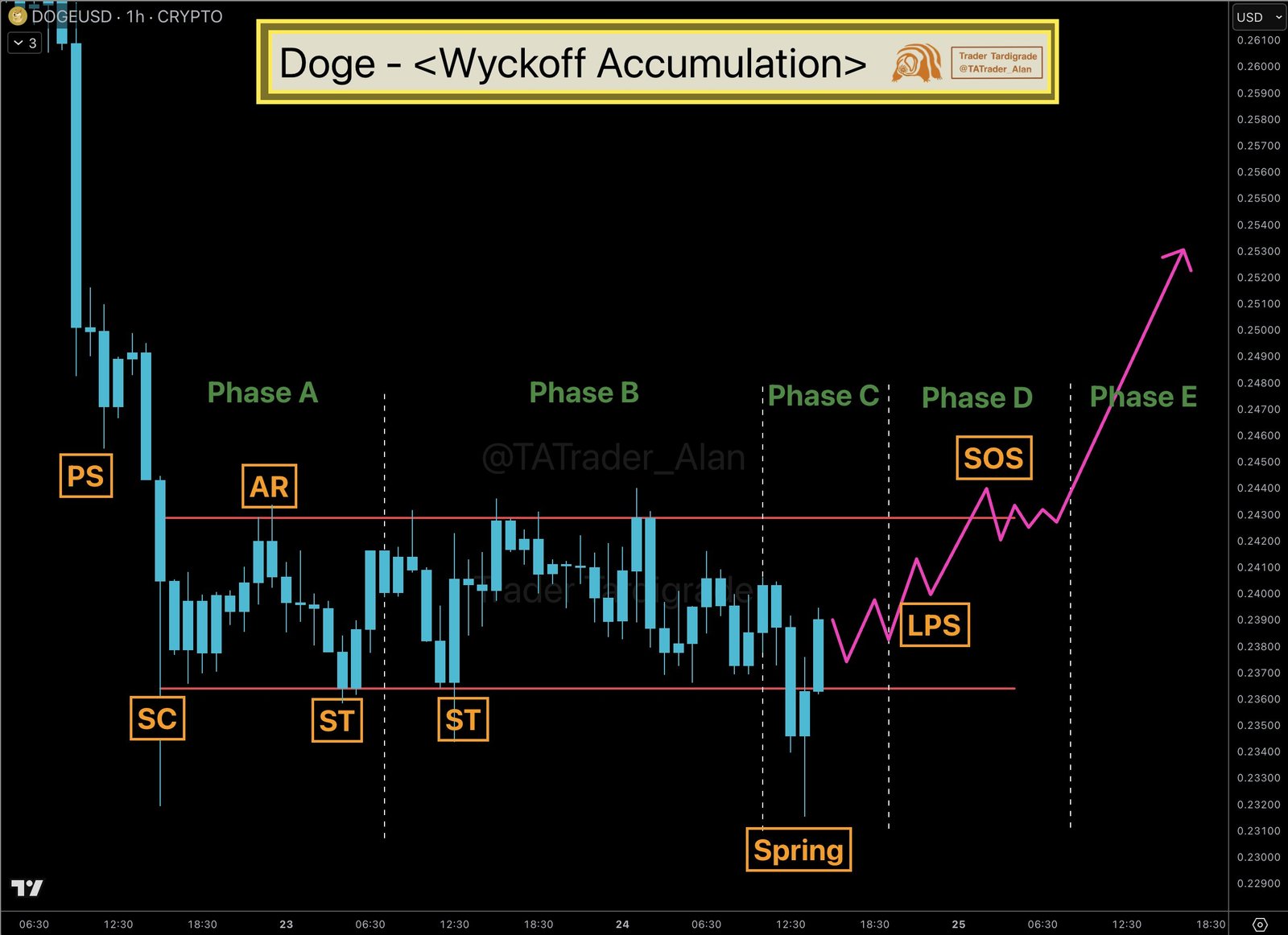
He says Dogecoin is bouncing from the spring in phase C, which in Wyckoff terms often signals a shakeout before demand returns. The path drawn then moves toward a last point of support and a sign of strength, indicating a possible shift from testing to trending. The view focuses on structure rather than price calls.
However, pattern confirmation typically requires follow through back inside the range and evidence of sustained demand. Until that step, the chart remains a scenario based on the Wyckoff framework. The emphasis stays on levels and behavior, not forecasts.
Dogecoin daily chart forms a rising wedge; 107% target needs a confirmed breakout
The chart dated September 24, 2025 shows Dogecoin against the United States dollar DOGE/USD on a daily timeframe from Coinbase. Price trades near 0.23896 while the exponential moving average 50-day reads 0.23874 and displayed volume is about 100.28 million. Two converging purple trendlines frame higher highs and higher lows since June, which creates a rising wedge. The upper boundary sits around the 0.29–0.31 area, and the lower boundary rises from mid-June toward the current session.
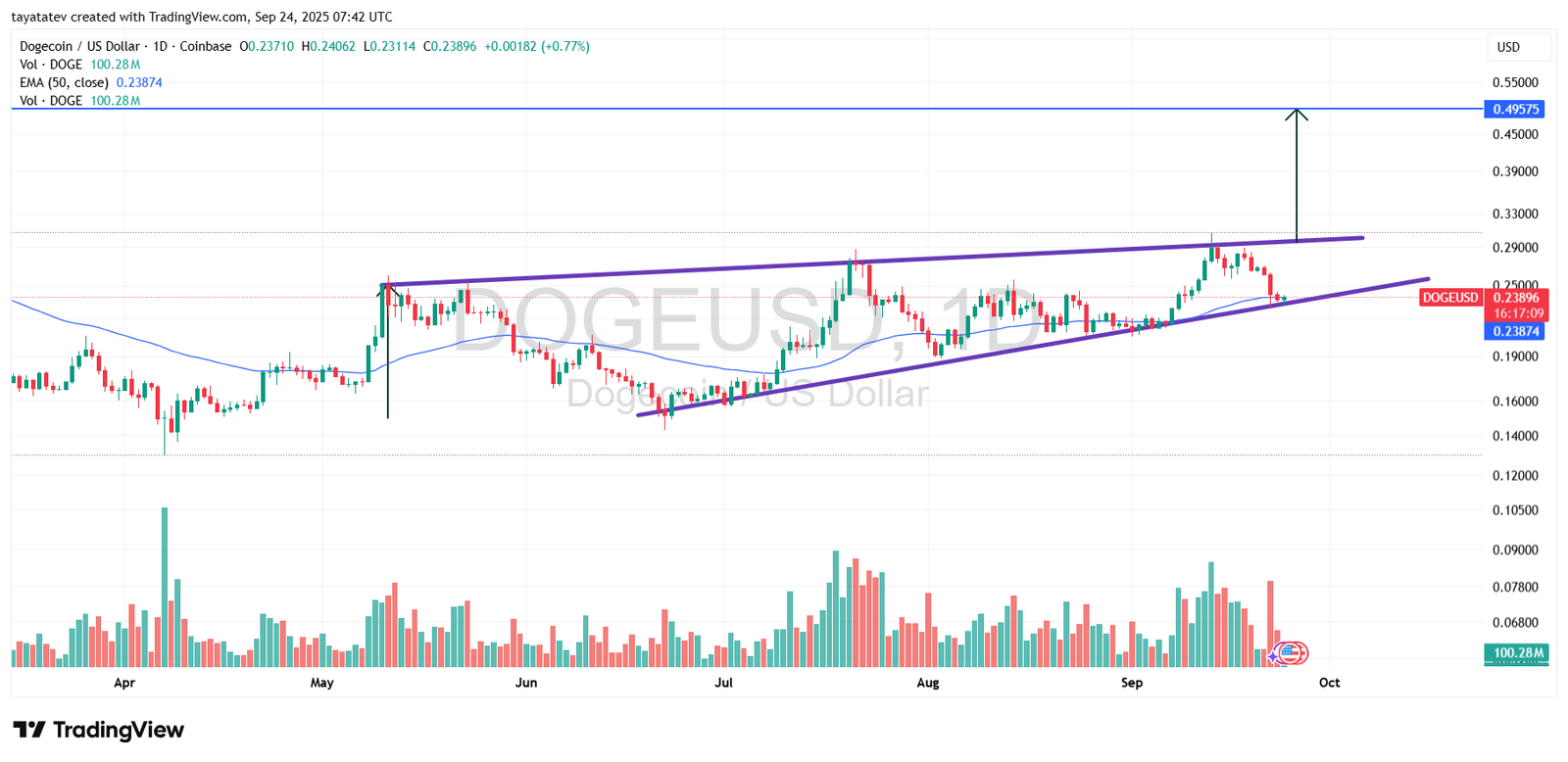
A rising wedge is a bearish pattern in classical technical analysis. It forms when price advances inside converging upward trendlines while momentum and volume often fade; statistically it more often resolves with a downside break below the lower boundary. However, traders also track invalidations. If price breaks and closes decisively above the wedge’s upper boundary on expanding volume, the bearish bias weakens and a topside measured move can follow.
Today’s chart sketches a blue horizontal objective near 0.49575, which is roughly a 107% gain from the current 0.23896 print. Mathematically, a 107% advance from 0.23896 implies about 0.49465, which aligns with the drawn level. Yet the pattern does not confirm that move on its own. Confirmation would require a daily close above the wedge’s upper boundary around 0.29–0.31, follow-through with rising volume, and sustained trading back above prior September highs. Until that sequence appears, the structure remains a rising wedge—historically a bearish setup—resting on the 50-day exponential moving average and the lower trendline.
Dogecoin daily RSI turns neutral-bearish after September fade
The chart is dated September 24 plots the 14-period Relative Strength Index with a moving average overlay. The Relative Strength Index reads 45.63, below the midline at 50, while the indicator’s moving average sits higher near 60.08. This placement shows momentum cooled from early September and now leans neutral-bearish on the daily timeframe.
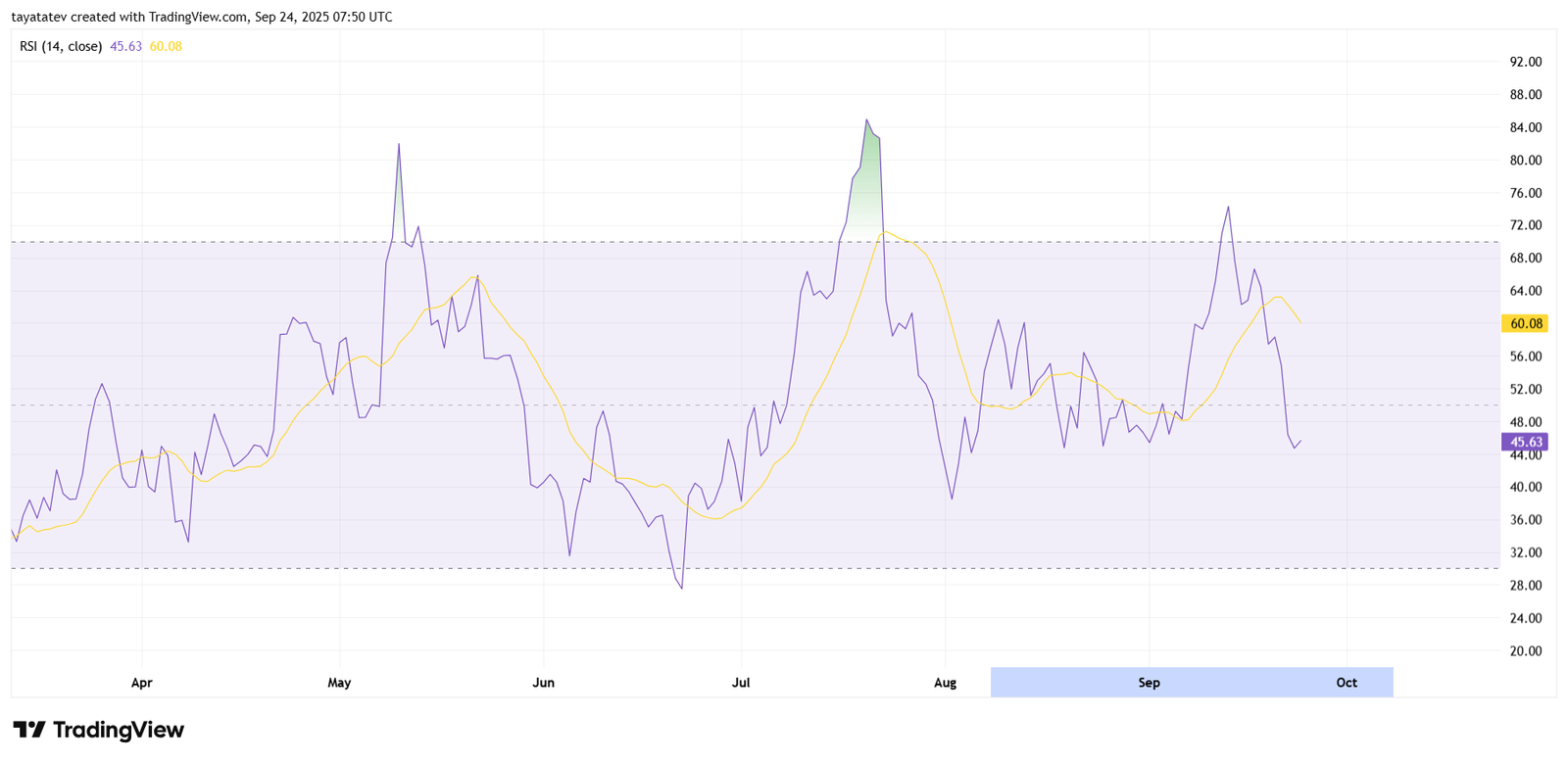
The plot highlights two momentum crests this cycle. A late July surge briefly pressed the Relative Strength Index into the overbought zone above 70, then early September printed another push toward the 70 area but with a lower peak. That lower high against price strength implies a bearish momentum divergence into mid-month. Afterward, the Relative Strength Index slipped through 50 and continued lower, confirming momentum loss rather than extension.
The current reading near 45 places Dogecoin in a range where sellers hold a modest edge, yet the market has not reached oversold conditions below 30. Momentum would improve if the Relative Strength Index reclaims the midline and then sustains above the moving average. Conversely, a continued drift toward the 40–35 band would signal persistent pressure. Until a clear cross back above 50 appears, the indicator frames trend energy as weakened compared with early September.


