



Charles Hoskinson, founder of Cardano and CEO of Input Output Global (IOG), called the recent ADA misappropriation claims “deeply personal and damaging.” On May 18, he posted a statement on X, denying accusations that over 318 million ADA—worth more than $600 million—were wrongly taken from unclaimed 2017 token sale wallets.
Hoskinson said the controversy affected his relationship with the Cardano community. He added,
“For a decade, I’ve been on the front lines. To not be given the benefit of the doubt here without strong evidence to the contrary means I don’t have the connection I thought with some people.”
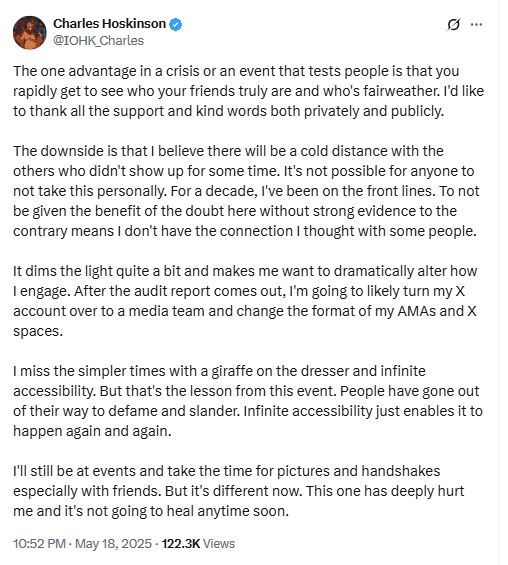
He plans to step back from direct interaction and hand his social media over to a media team once the audit is released.
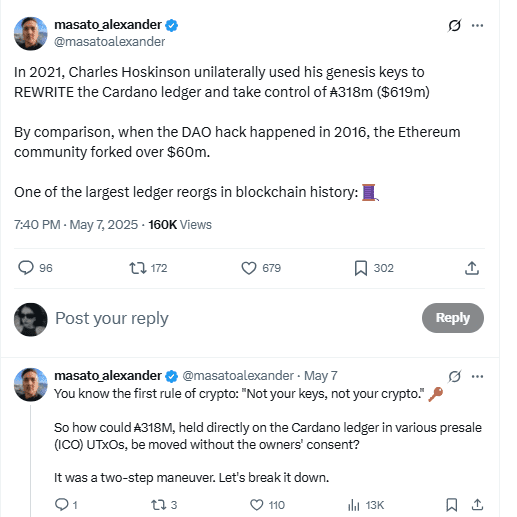
The claims allege that IOG used genesis keys to move unredeemed ADA from the Token Generation Event (TGE) without alerting the original holders. The allegations have sparked strong reactions online, especially after community member Masato Alexander published a detailed thread about protocol changes in 2020.
Protocol Changes and MIR Transactions Under Scrutiny
According to Alexander, a 2020 update to Cardano’s protocol enabled the reallocation of unredeemed UTxOs—unspent transaction outputs—to the network’s reserves. He further stated that a Move Instantaneous Rewards (MIR) transaction later moved the funds without informing the original ADA voucher holders.
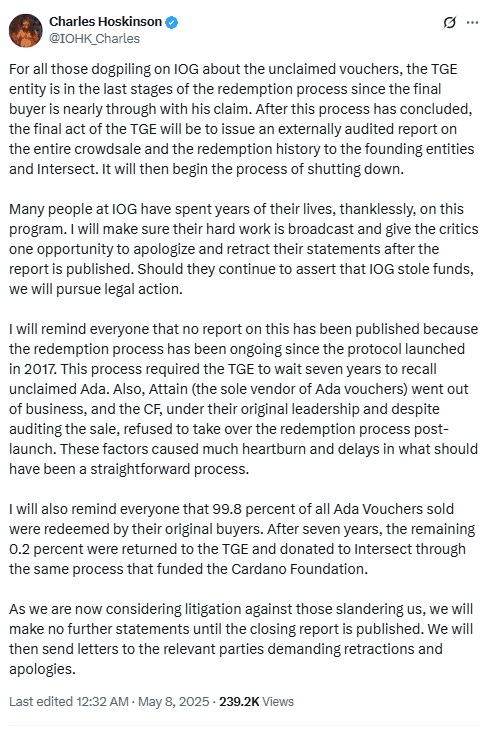
Hoskinson countered these claims, saying that 99.8% of all pre-sale ADA vouchers were redeemed. The remaining 0.2%, he said, was claimed under existing protocol rules after a seven-year window. Those funds, he noted, were transferred to Intersect, an industry body coordinating Cardano’s development.
Hoskinson stated that IOG would release an external audit to outline the full redemption history. He also said he would send legal letters demanding public retractions and apologies.
Alexander disputed the donation claim, citing Intersect’s interim executive director, who said in 2024 that the organization had received only $7 million—not $600 million worth of ADA. He also pointed out the lack of any detailed audit showing how the funds were moved.
Cardano Foundation and Emurgo Respond to Allegations
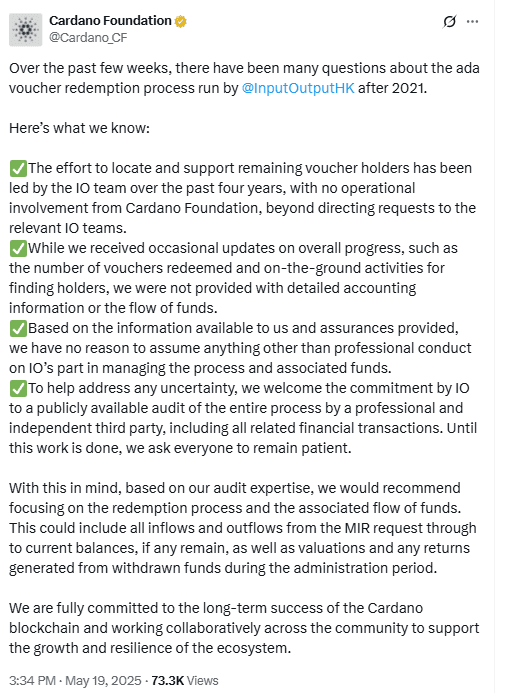
The Cardano Foundation addressed the issue on May 19. It confirmed that since 2021, it has not managed ADA voucher redemptions. It added that it had only received general updates and not detailed financial breakdowns.
The Foundation stated:
“The effort to locate and support remaining voucher holders has been led by the IO team over the past four years.”
It welcomed IOG’s commitment to publish an audit and recommended that it include all MIR transactions and fund movements.
Cardano’s commercial arm, Emurgo, also released a statement on May 19. It backed IOG, saying the seven-year redemption period involved several campaigns, KYC verification steps, and third-party investigations in Japan.
Emurgo said:
“While the vast majority of the pre-sale ADA vouchers have been successfully redeemed, there was a small percentage that had gone unredeemed.”
The firm explained that the Shelley upgrade had made unredeemed tokens unspendable, and moving them was necessary to allow redemptions. It called for patience and expressed concern over what it described as “excessive, unwarranted FUD,” which had caused damage to the project.
Both IOG and Emurgo have agreed on the importance of transparency. They said an external audit is the next step to confirm fund flows and ensure all technical steps align with Cardano’s protocol history.
ADAUSD Bearish Flag Signals 31% Downside Risk
Meanwhile, as of May 20, 2025, Cardano (ADA) has formed a bearish flag pattern on the daily chart from Coinbase.
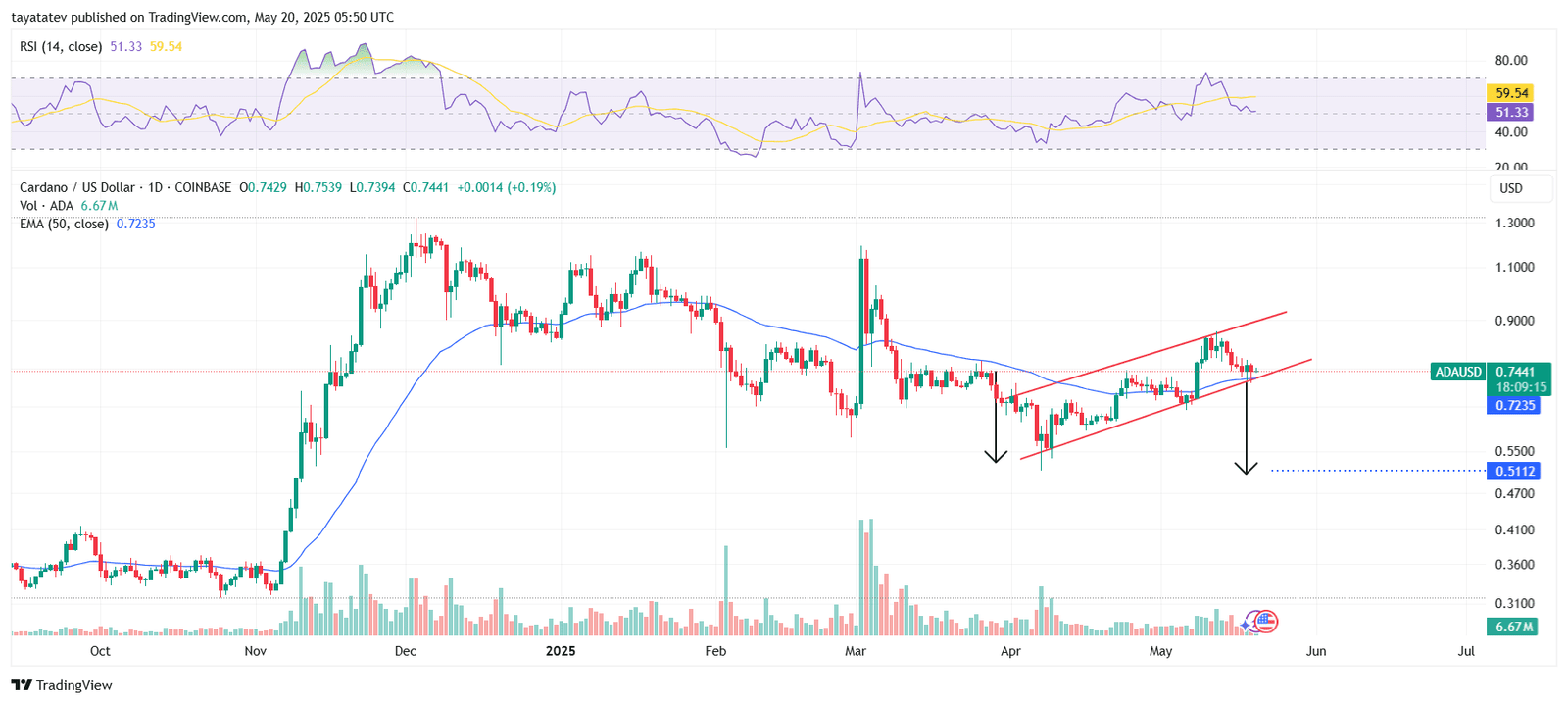
A bearish flag is a continuation pattern that appears after a sharp decline, followed by a short-term upward consolidation within parallel trendlines. It usually signals further downside once confirmed.
If confirmed, this pattern suggests that Cardano could drop 31% from the current price of $0.7441, targeting approximately $0.5112.
The Relative Strength Index (RSI), currently at 51.33, shows neutral momentum, just below the signal line at 59.54. This positioning reflects weak buying strength and could support further decline if bears gain control.
The 50-day Exponential Moving Average (EMA) sits at $0.7235, slightly below current trading levels. ADA has recently retested this EMA but failed to establish strong upward momentum, reinforcing the bearish setup.
The latest volume is 6.67 million, which remains subdued compared to previous surges. This low volume during the flag formation aligns with typical behavior before a breakout.
If selling volume increases and the price breaks below the flag’s lower trendline, Cardano could enter a strong downward phase. The measured move target points to $0.5112, in line with the height of the previous decline before the flag formed.


