


Ripple (XRP) price traded near $2.33 on May 27, following a modest 4% spike to a daily high near $2.354. The move followed a sharp rejection from the $2.65 zone earlier this month, triggered by the SEC’s failed motion to impose a higher penalty on Ripple.
XRP’s price has since consolidated between $2.29 and $2.47, with bulls struggling to reclaim upside momentum. In contrast, Bitcoin continued to dominate market sentiment, holding above $110,000 after setting a new all-time high earlier this week. Ethereum has lagged, barely clinging to the $2,600 level.
Broader crypto flows indicate a rotation toward large caps, but XRP has yet to break free of its legal overhang. Capital remains cautious ahead of critical legal developments that could tilt the balance.
Ripple’s ongoing battle with the U.S. Securities and Exchange Commission enters a pivotal phase this week. A closed-door SEC meeting on May 29 could influence the trajectory of the case. More importantly, the court-mandated deadline for a status update on settlement talks arrives on June 9. If no agreement materializes, the SEC may pursue its appeal by June 15. Each date holds the potential to spark volatility in XRP markets, depending on regulatory cues or a shift in Ripple’s legal footing.
Adding to the momentum, UFC icon Conor McGregor posted about XRP over the weekend, injecting a new dose of speculative interest into the asset.
McGregor’s XRP Post Reignites Debate as Institutional Flows Shift Away
Conor McGregor’s X post on May 26 rocked the crypto Twitter awake, triggering over one million views and reigniting debate over XRP’s decentralization just as capital flows began shifting sharply. McGregor was responding to Donald Trump’s earlier claim about a U.S. crypto reserve that may include XRP, Solana, and Cardano.
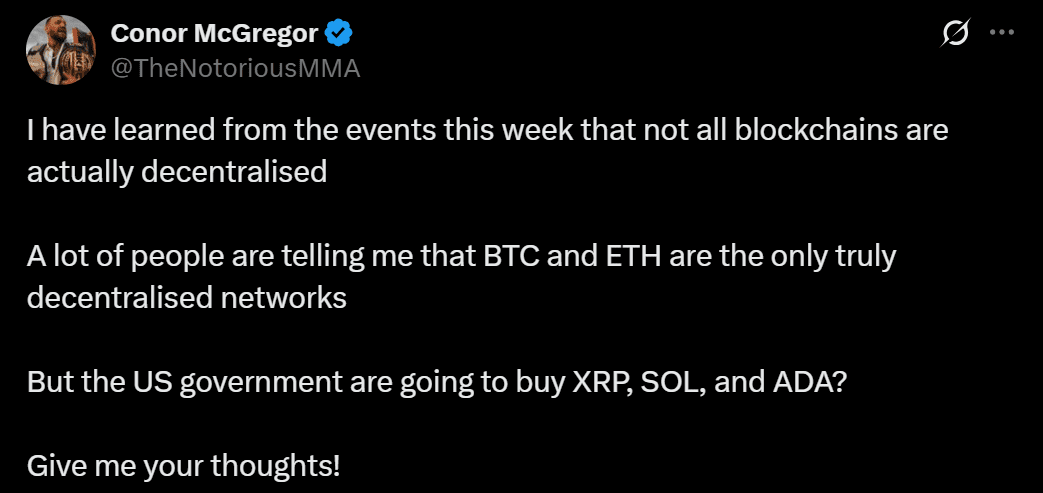
The martial artist questioned the inclusion of tokens “a lot of people are telling me aren’t truly decentralized.” His comment, skeptical yet open-ended, sparked a flood of community responses, with influencers, developers, and validators rushing to defend their ecosystems.
While XRP price showed no immediate spike, the attention renewed discourse around its suitability for sovereign or institutional holdings. Ripple lobbyist Brian Ballard’s influence over U.S. policymaking added weight to XRP’s inclusion, though the reserve’s holdings beyond Bitcoin remain unconfirmed.
Industry voices like Panos Mekras defended XRP’s decentralization by highlighting recent XRP Ledger upgrades and its Layer 1 functionality. Others argued that Bitcoin and Ethereum remain the only truly decentralized options. Meanwhile, Cardano supporters pointed to its on-chain governance model, and Ethereum advocates emphasized utility over strict decentralization.
However, for XRP, the timing couldn’t have been more critical. The asset recorded a record weekly outflow of $37.2 million from institutional products, according to CoinShares—the first net weekly outflow in 80 weeks.
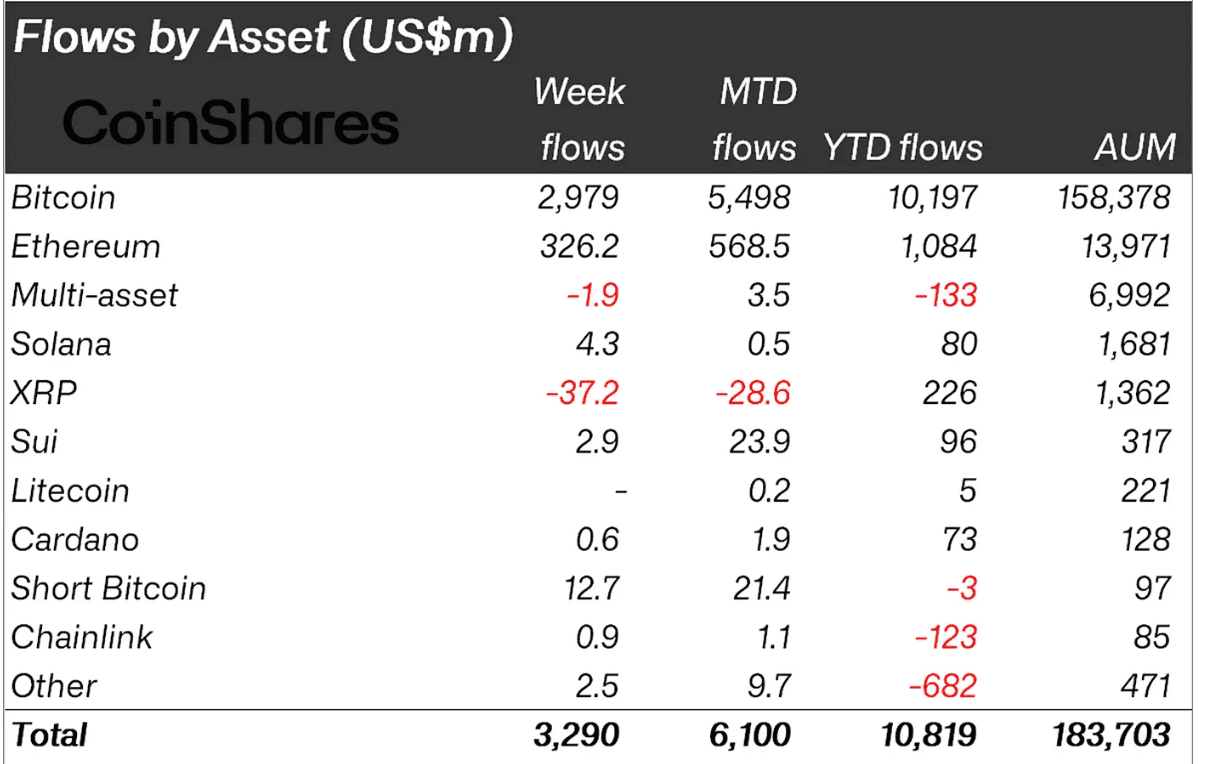
Month-to-date outflows now stand at $28.6 million, despite XRP holding a cumulative $226 million in inflows for the year. Conversely, Bitcoin recorded nearly $3 billion inflows, the token’s highest in nearly 4 weeks. Hence, XRP’s retreat signals a growing preference for agility and clarity in project direction.
Solana, Sui, and Cardano—also mentioned by McGregor—saw modest but positive inflows during the same period. Their perceived momentum and simpler regulatory narratives may be driving fresh capital rotation, especially as XRP’s legal risks and stagnant ecosystem weigh on investor sentiment.
Whether McGregor’s influence directly triggered the shift or simply mirrored underlying doubts, his post amplified a crucial inflection point: XRP is facing declining institutional trust and an increasingly vocal challenge to its public perception.
Technical Setup Fakeout Forces Crabbing Movement
XRP attempted a breakout from its falling wedge structure on May 12 but failed to sustain momentum above the pattern’s upper boundary. By May 15, the price had slipped back inside the wedge, confirming strong bearish pressure near the immediate resistance at $2.58. The rejection reinforced the validity of the pattern’s descending trendline, which continues to cap bullish attempts.
Two converging downward-sloping trendlines define the pattern. The falling wedge typically signals a potential bullish reversal. Traders calculate the pattern’s price target by measuring the pattern’s widest section and projecting that height from the breakout point. However, without a decisive breakout, this projection remains speculative.
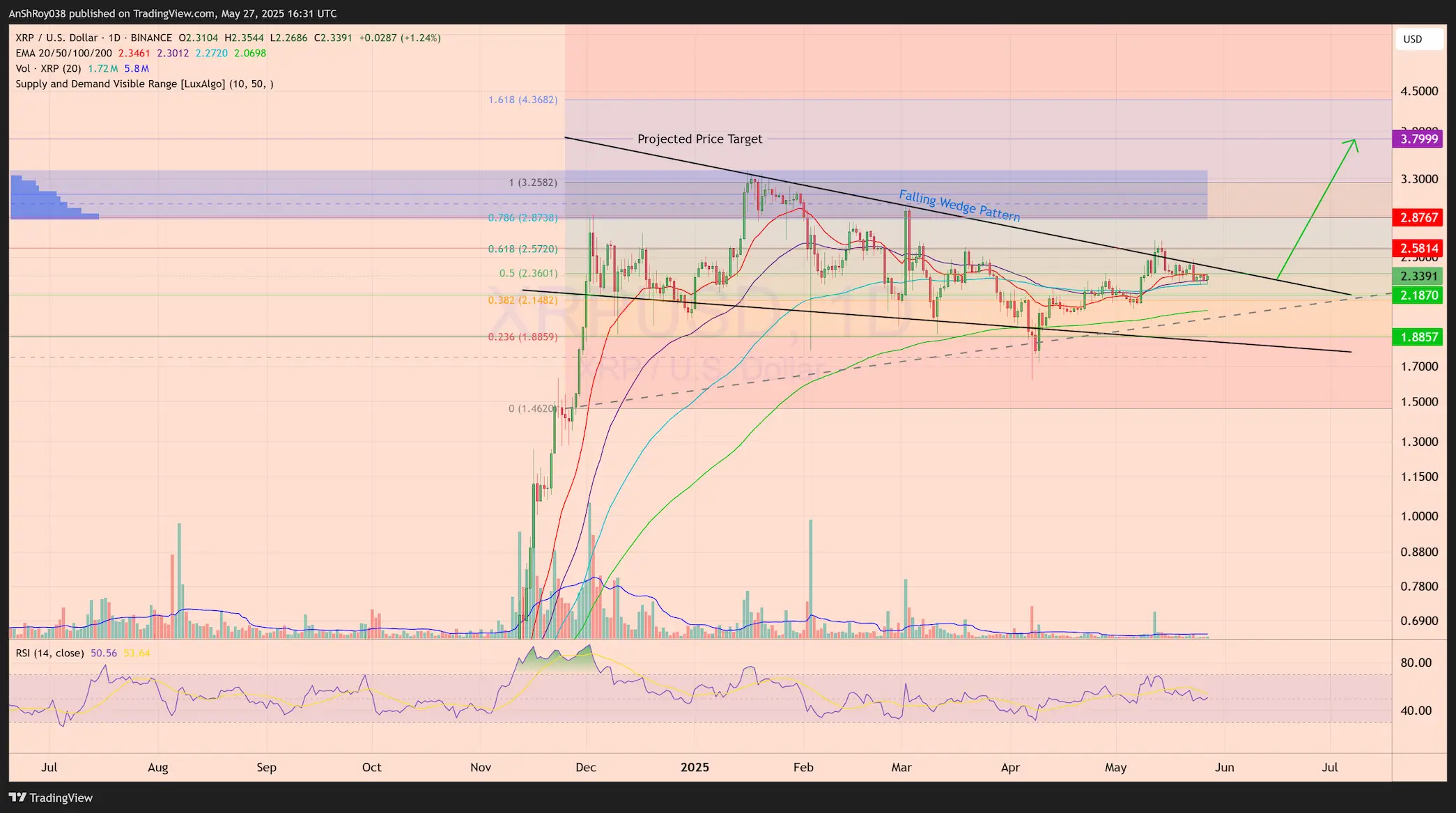
Currently, XRP trades just above the 100-day (blue) and 50-day (purple)EMAs, which form a support confluence. Bulls seem to be actively defending the dynamic support confluence of the EMAs. The 20-day (red) EMA, now acting as resistance, adds to the overhead pressure. The RSI hovers around the neutral 50 level, offering no clear directional bias but confirming the ongoing consolidation.
XRP’s failure to break above the wedge’s upper boundary and reclaim the $2.58 resistance reflects persistent uncertainty. The next downside test sits at $2.18. A breakdown below this level could invalidate the bullish wedge structure, and force XRP price to test the support near $1.89.
Meanwhile, a confirmed breakout could help the Ripple token price flip the immediate resistance and challenge $2.88. Until then, XRP remains trapped in a narrowing range, caught between structural resistance and critical short-term support.


