



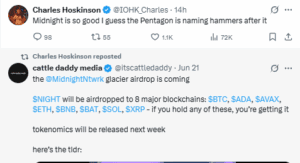
Charles Hoskinson, founder of Cardano and CEO of Input Output Global (IOG), has publicly promoted the upcoming “Glacier Airdrop” for Midnight Network. The airdrop, dubbed the “Glacier Drop,” will distribute Midnight’s native token $NIGHT to users of eight major blockchains, including ADA, BTC, ETH, and SOL. Hoskinson’s visible push, including public tweets, podcast appearances, and AMAs, appears unusually direct. But the rationale behind this campaign is strategic, not impulsive. His overt promotion ties directly to Midnight’s core architecture, regulatory relevance, and its foundational ties to Cardano.
Midnight is a Core IOG Project, Not an External Partnership
Midnight is not a third-party or ecosystem startup. It is built and funded directly by Input Output Global, the same firm that developed Cardano. Hoskinson himself initiated the research underpinning the project as far back as 2016. In his June 2024 Unshielded podcast appearance, he described Midnight as IOG’s “most sophisticated and advanced team” working on a blockchain protocol designed to integrate privacy, identity, and compliance into a single layer.

The protocol relies on three technical components:
- Decentralized identity systems (DIDs and AnonCreds),
- Private smart contracts using the Kachina protocol,
- Multi-resource consensus (Minotaur) that enables validators across chains to secure the network.
Given his direct involvement in the research, design, and deployment of these components, Hoskinson’s support is not an endorsement of an external product—it’s advocacy for his own firm’s infrastructure layer.
Midnight Solves a Regulatory Problem Cardano Alone Cannot Address
The blockchain industry is facing increasing pressure to integrate identity and compliance. Laws such as the EU’s MiCA framework and enforcement actions in the United States against DeFi protocols illustrate a regulatory shift toward transparency, especially in decentralized finance.
According to Hoskinson, blockchains like Cardano and Ethereum offer public transparency but lack native support for confidential data. Midnight introduces zero-knowledge cryptography that allows applications to prove compliance (e.g., KYC, post-tax funds) without revealing personally identifiable information. It supports selective disclosure, enabling regulated access to dApps without compromising user privacy.
Hoskinson calls this model “settlement as compliance.” His promotion of Midnight focuses on presenting it as a necessary tool for developers who want to remain decentralized while meeting legal obligations. By promoting the airdrop, he is introducing the infrastructure to those outside the Cardano ecosystem, especially developers on chains like Ethereum and Solana, who are more directly impacted by regulatory scrutiny.
The Glacier Airdrop Extends Midnight’s Reach Beyond Cardano
The Glacier Drop, set to distribute $NIGHT tokens to over 37 million users across eight chains, is not a marketing stunt—it’s part of the project’s design. Midnight’s Minotaur consensus supports validators from other chains, and the airdrop reflects that multi-chain architecture. By distributing tokens to users outside Cardano, the team avoids creating a siloed ecosystem.
Hoskinson’s promotion of the airdrop, including calling it “the biggest airdrop in the history of Cardano,” directly serves this purpose. Midnight will only succeed if it reaches developers and users across blockchains. For that to happen, awareness must be built. His visibility ensures that the project is introduced to a multi-chain audience, not just Cardano holders.
Unlike many airdrops that include insider or VC allocations, Midnight’s distribution explicitly excludes venture capital. Hoskinson has emphasized that this decision reflects the network’s commitment to decentralization and long-term utility. By backing an open, non-VC airdrop model, he reinforces the ethical principles he has promoted since founding Cardano.
Midnight is Not Competing with Cardano— it Complements It
A key reason behind Hoskinson’s open promotion is to clarify Midnight’s role. It is not meant to replace or compete with Cardano, but to add functionality that Cardano alone cannot provide—particularly around privacy, selective disclosure, and enterprise compliance.
During the Unshielded podcast, he explained that dApps from any chain could interact with Midnight using API calls. A decentralized exchange (DEX) on Ethereum could call into a Midnight smart contract to verify user eligibility without exposing personal data on-chain. This cross-chain functionality means Midnight must be promoted beyond Cardano’s ecosystem.
The design intention is to make Midnight a neutral privacy layer available to all—Bitcoin, Ethereum, Solana, and Cardano included. His promotion supports that neutrality by ensuring users and developers across ecosystems are aware of its utility.


