



Bitcoin’s BTC USD pair reclaimed the $108,000 level on June 26, sparking renewed optimism across the crypto market. The rally followed cooling geopolitical tensions and growing institutional interest in BTC. Traders were quick to frame the move as the start of a larger breakout.
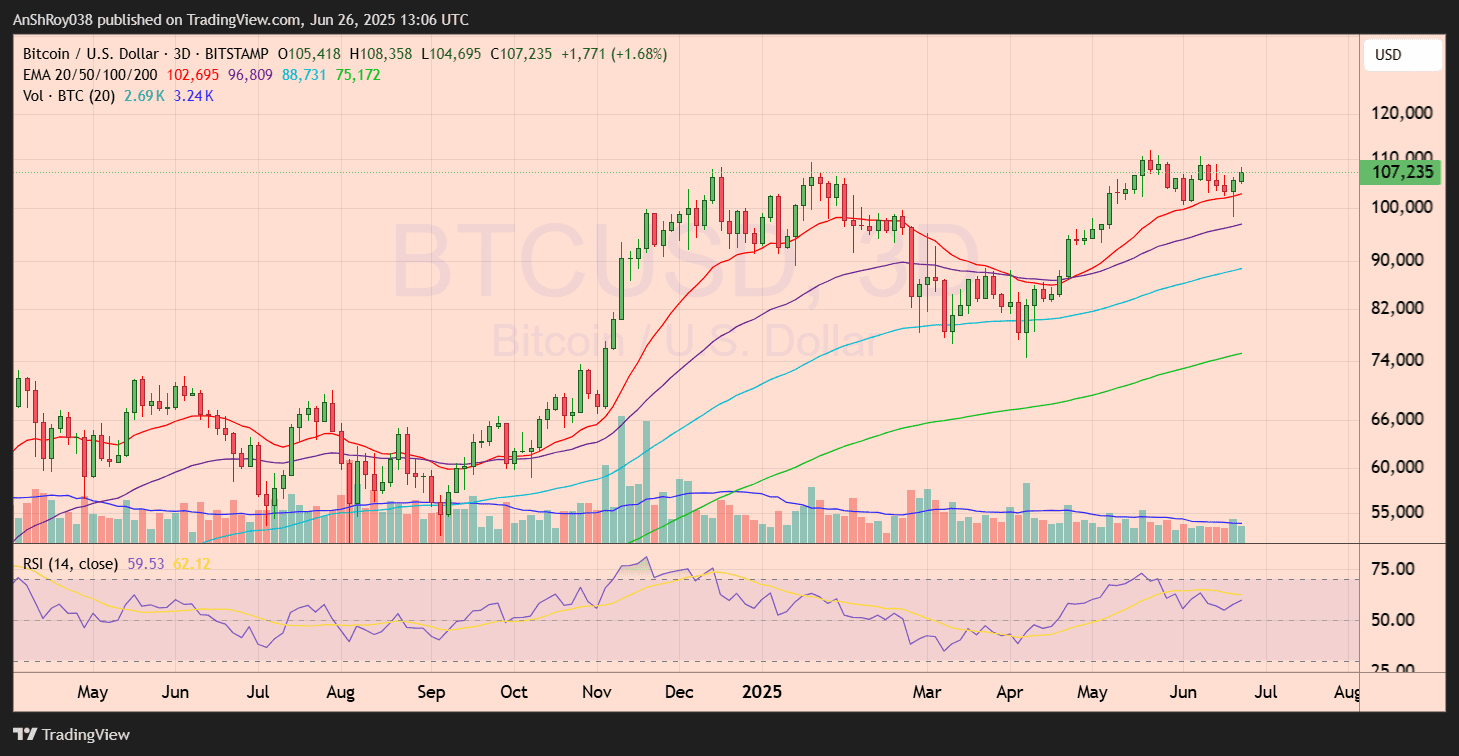
However, despite the apparent shift in sentiment, Bitcoin’s price faced bearish pressure above the $108,000 mark. Since May 2025, the price level has repeatedly rebuffed BTC’s upside attempt. This raises doubts about the rally’s sustainability. The token’s RSI remains neutral.
Analysts warned of a reversal in the token’s near future, even as market participants continue to celebrate the token’s short-term strength.
Analysts See Chances of a Sub-$100K BTC Price Tag
Although bullish narratives have gained momentum following BTC’s recovery above $107,000, quite a few analysts remained cautious, with some highlighting downside targets near $90,000.
In an X post, crypto analyst Henry told his 68,000 followers that the geopolitical risk from renewed Middle East tensions could lead to a drop toward that level. Henry warned that macro volatility could quickly erase recent gains.
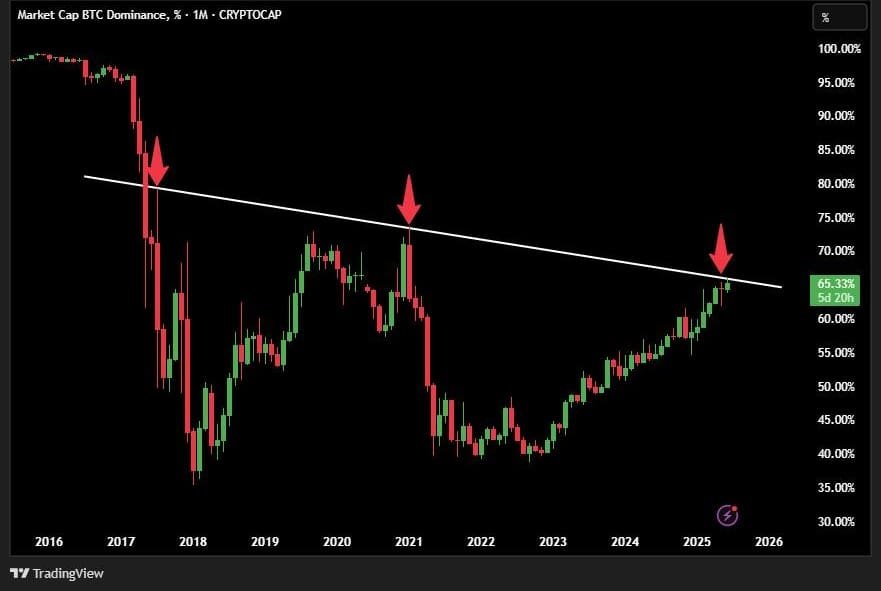
The analyst also shared a Bitcoin dominance chart, noting that the metric has approached a multi-year descending trendline, which marked peaks in 2017 and 2021. Henry highlighted this level again as a potential rejection point. Bitcoin dominance is currently attempting to flip over the trendline, rising nearly 2.2% in June 2025.
However, declining BTC dominance does not necessarily mean BTC weakness. It could also mean that altcoins are racking up gains. Yet, the historical repetition could be a bearish cue for BTC price action.
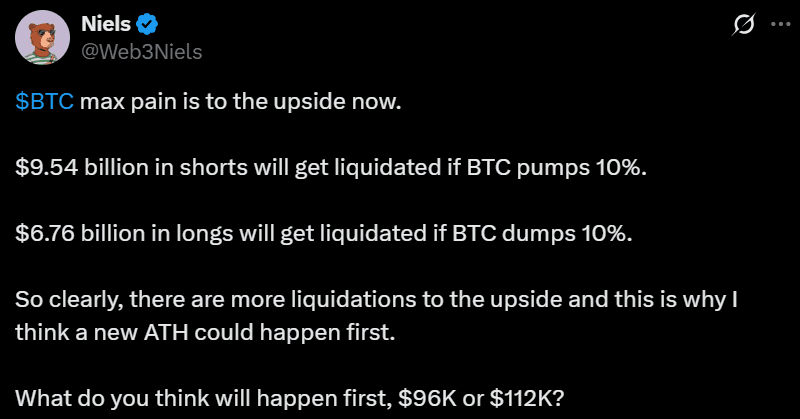
Niels Klaver, co-founder of Tedlabs, shared an X post highlighting that over $6.7 billion in long positions would be liquidated if Bitcoin drops by 10%. This is compared to $9.54 billion in short liquidations in the event of a 10% upside. A 10% upside from BTC’s current price levels would help the token reach $117,000, a new ATH.
However, even a rise to $110,000 (a 2.5% rise) could initiate short liquidations to the tune of $2.23 billion, forcing a short squeeze. On the other hand, a drop to $102,000 (a 5% drop) would liquidate $2.67 billion in long positions. Failing to move above $108,000 price mark could hurt market sentiment, which could help the bears.
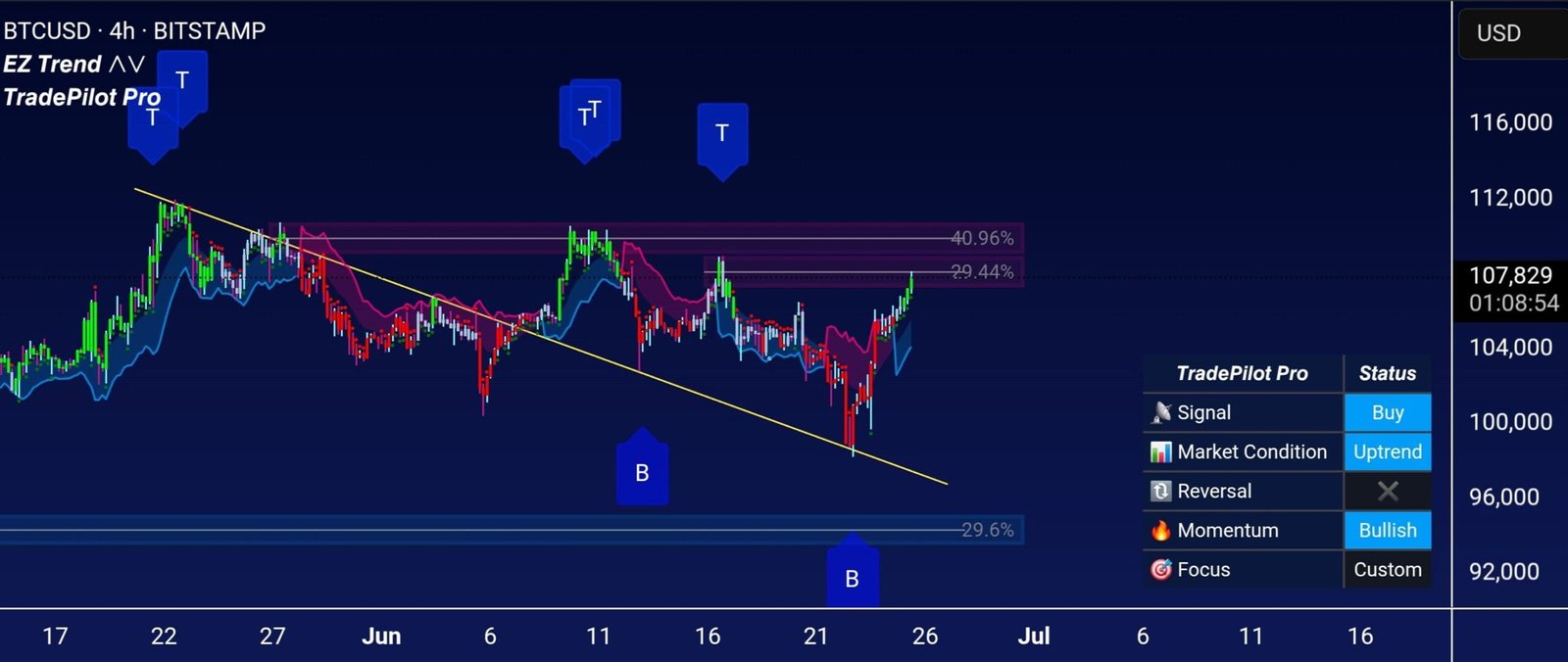
Another trader, with the X username Nite, offered a more technical perspective. He pointed out that Bitcoin had entered a bearish order block—a known zone of sell-side resistance. Nite shared a chart that showed the BTC USD pair stalling at this region, with prior instances of rejection from the same level. He added that altcoins may continue to gain traction while Bitcoin consolidates or chops around resistance.
Independent crypto analyst Dom emphasized that Bitcoin’s latest move lacked strong spot market support. The analyst argued that BTC must decisively reclaim $108,500 to regain its bullish structure; otherwise, further sideways movement or a pullback would likely occur.
Institutional Inflows Continue
Bitcoin has seen a wave of institutional inflows this week, with large ETF issuers including Fidelity, BlackRock, Invesco, and ARK Invest recording significant BTC purchases. Christiaan, a crypto analyst, highlighted that institutions have not stopped buying Bitcoin, likely treating the recent downtrend as a buy opportunity.

Institutional interest in Bitcoin is increasing, with a fresh wave of corporate buyers entering the market. BlackRock extended its buying streak to 12 consecutive days, purchasing $340 million worth of BTC without selling a single coin since June 6. Meanwhile, Japanese firm Metaplanet added 1,234 BTC to its balance sheet, bringing its total holdings to 12,345 BTC—one of the largest among public companies.

Other new entrants also emerged. Streaming company Mega Matrix disclosed its first-ever Bitcoin purchase, acquiring 12 BTC for $1.27 million. Following a recent stock offering, B Treasury Capital bought 66 BTC as part of its treasury allocation strategy.
These purchases signal renewed institutional confidence despite Bitcoin’s choppy price action. While heavyweight firms are scaling positions, smaller corporations are also jumping on the bandwagon, suggesting a broader shift in corporate treasury management toward Bitcoin exposure as a hedge and long-term store of value.


