



Hashflow (HFT) jumped nearly 90% in the past 24 hours, trading around $0.1343 as of July 1. The surge pushed its market capitalization above $130 million, with daily trading volume above $130 million. This is HFT’s largest single-day move since December 2023, when it last tested the $0.15 range.
Binance Solana Integration Expands Liquidity
One main driver of the HFT price spike is Binance’s integration of Hashflow on the Solana network. Binance Global Inc enabled deposits and withdrawals for HFT on Solana on June 5. The move added lower-cost routing for traders and DeFi users.

Hashflow confirmed on June 30 that its Solana rollout now connects with Jupiter, Kamino, and Titan — three major Solana DeFi protocols. Solana’s decentralized exchanges handled about $362 million in trades over the past 24 hours, with about 316,000 active daily addresses, DefiLlama data shows. Solana’s total value locked (TVL) stands at $8.58 billion, up from about $3 billion in early 2025.
Some traders initially worried that sudden unlock batches would flood supply. Hashflow addressed this by publishing its full unlock plan, which releases tokens daily in a linear flow. Around 1 million HFT unlock daily, equal to about 0.1% of the max supply. At current prices, this means about $134,000 worth of new tokens enter circulation each day.
The circulating supply sits at 581.88 million HFT out of a total supply of about 998 million. The steady daily schedule means no large cliffs are ahead.
Funding Rates and Trading Pairs Confirm Speculative Demand
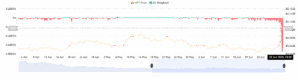
Alongside steady supply releases, speculative interest rose in derivatives markets Perpetual futures data shows that HFT funding rates turned positive on June 30, reaching about +0.10%. Positive funding means traders paid to keep long positions open, signaling bullish positioning.
Most HFT spot trading still runs through Binance’s USDT pair, which handles over 70% of daily liquidity. Other exchanges like KuCoin and Gate.io hold smaller shares.
HFT Clears EMAs But Faces Overheated RSI
Additionally, technical patterns show how this speculative push played out on the chart. HFT’s daily chart shows it has broken above its 20, 50, 100, and 200 EMAs for the first time since January. The Relative Strength Index (RSI) stands near 85, well above the typical overbought line of 70. Historically, RSI levels this high often see short-term corrections or sideways trading.
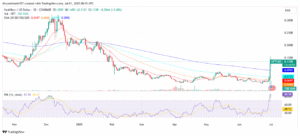
The next visible resistance is near $0.15, which capped the price during its last big rally in January 2025. Closest support sits around $0.10, the breakout zone from June.
Notably, Hashflow’s seven-day gain of about 164% outpaces other Solana ecosystem tokens. Over the same period, Solana (SOL) rose about 3.6%, Uniswap (UNI) gained 3.5%, and Chainlink (LINK) added 1.1%. This shows the HFT spike is more tied to its specific liquidity boost and unlock clarity than to a broader Solana rally.


