



On June 30, 2025, BitMine Immersion Technologies announced a $250 million private placement to fund a new Ethereum treasury strategy. The company priced 55,555,556 common shares at $4.50 each. The deal was signed and is expected to close around July 3, subject to NYSE American’s Supplemental Listing Application approval.
The company stated it will use the net proceeds to buy Ethereum (ETH) and hold it as the firm’s main treasury asset. The transaction was funded through a mix of cash and crypto. It marks a shift in BitMine’s financial strategy, focusing more on protocol-level exposure and ETH-native financial tools.
The deal was led by MOZAYYX and included major names from traditional finance and crypto, including Founders Fund, Pantera, FalconX, Republic Digital, Kraken, Galaxy Digital, DCG, Diametric Capital, Occam Crest Management, and Thomas Lee.
Thomas Lee Named Chairman as Ethereum Treasury Focus Intensifies
BitMine appointed Thomas Lee as Chairman of the Board of Directors on the same day the funding round was announced. Lee is the Founder of Fundstrat and Chief Investment Officer at Fundstrat Capital. His appointment came alongside his direct participation in the raise.
In a statement, Lee said:
“This transaction includes the highest quality investors across trad-fi and crypto venture capital, properly reflecting the rapid and continued convergence of traditional financial services and crypto.”
Lee also added that BitMine will use ETH to access staking and decentralized finance (DeFi) activities within the Ethereum protocol. He mentioned a key focus for BitMine would be tracking ETH held per share as a metric of value for shareholders.
Ethereum to Serve as Primary Reserve Asset for BitMine
BitMine will allocate the full amount from the private placement to acquire ETH for treasury use. The firm’s treasury position in ETH will rise over 16 times following the new acquisition.
The firm had already begun building its Ethereum reserves, making its first ETH purchase on June 9, 2025. The company’s CEO, Jonathan Bates, said the new raise would accelerate that process:
“The private placement will accelerate BitMine’s treasury holdings shortly after its first treasury purchase.”
Bates added that FalconX, Kraken, and Galaxy Digital would collaborate with BitMine to scale the Ethereum treasury strategy. The firm will continue working with BitGo and Fidelity Digital as its existing custody partners.
According to Lee, the company’s ETH strategy connects to broader adoption of stablecoins and smart contracts. Citing recent comments by U.S. Treasury Secretary Scott Bessent, he said the stablecoin market could grow from $250 billion to $2 trillion.
Lee stated:
“Stablecoins have proven to be the ‘ChatGPT’ of crypto, leading to rapid adoption by consumers, merchants and financial services providers.”
He added that Ethereum handles the majority of stablecoin transactions, which gives ETH protocol-level utility. BitMine plans to gain direct access to this functionality through its growing ETH reserves.
Legal, Advisory, and Listing Details Behind the Ethereum Move
BitMine’s offering relied on a private placement exemption under Section 4(a)(2) of the Securities Act and Regulation D. The company and investors signed a registration rights agreement requiring a future SEC registration for resale of the issued stock.
ThinkEquity, LLC acted as the placement agent. Cantor Fitzgerald & Co. advised MOZAYYX. MOZAYYX was represented by Winston & Strawn LLP. BitMine was represented by FitzGerald Kreditor Bolduc Risbrough LLP. Greenberg Traurig, LLP served as counsel to the placement agent.
BitMine trades on the NYSE American under the ticker BMNR. The company’s operations span Bitcoin mining and advisory services, with locations in Trinidad, Pecos, and Silverton, Texas. It now identifies as a Bitcoin and Ethereum network company.
Ethereum Forms Ascending Channel Pattern, Eyes Potential 17% Breakout
On July 1, 2025, Ethereum (ETH/USDT) formed an ascending channel pattern on the 4-hour chart. An ascending channel is a bullish continuation pattern where prices trend higher between two upward-sloping parallel lines.
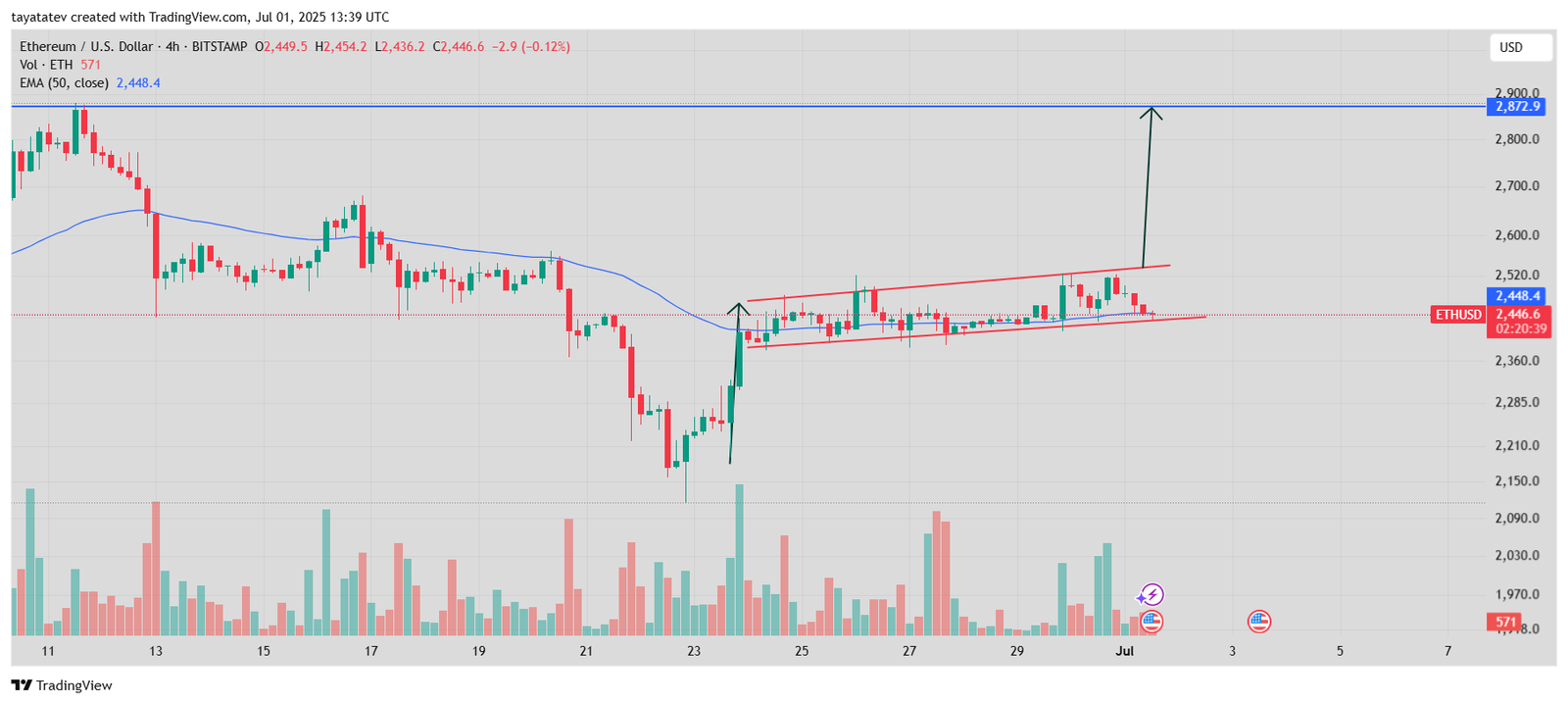
Currently, Ethereum trades at $2,446. If the pattern confirms a breakout above the upper trendline, the price may climb 17% from the current level, reaching approximately $2,872.
The pattern began forming after a strong bullish impulse on June 23, marked by a sharp green candle and increased volume. Since then, ETH has traded within a parallel channel, making higher highs and higher lows. The lower trendline has held support multiple times, showing consistent buying interest.
The 50-period Exponential Moving Average (EMA) stands at $2,448 and aligns closely with the current price, indicating a pivotal zone. Ethereum has hovered near this EMA, suggesting the asset is consolidating before a decisive move.
Volume levels have remained relatively stable during the consolidation phase. However, a breakout above the upper trendline of the channel could trigger higher buying activity, especially if volume spikes.
The key resistance to watch is near $2,520. A clear move above this level with volume could validate the ascending channel breakout. In that case, the next target lies around $2,872, which matches the measured move from the flagpole height of the prior surge.
Meanwhile, support remains near $2,435, the lower boundary of the channel. If Ethereum breaks below this level with volume, it may invalidate the bullish structure and trigger a pullback.
Ethereum RSI Drops Below Signal Line, Indicates Weakening Momentum
Meanwhile, Ethereum’s 14-period Relative Strength Index (RSI) dropped to 44.30, moving below its signal line, which sits at 55.72. The RSI, a momentum indicator that measures the speed and change of price movements, ranges from 0 to 100. Values below 50 generally reflect weakening buying strength.
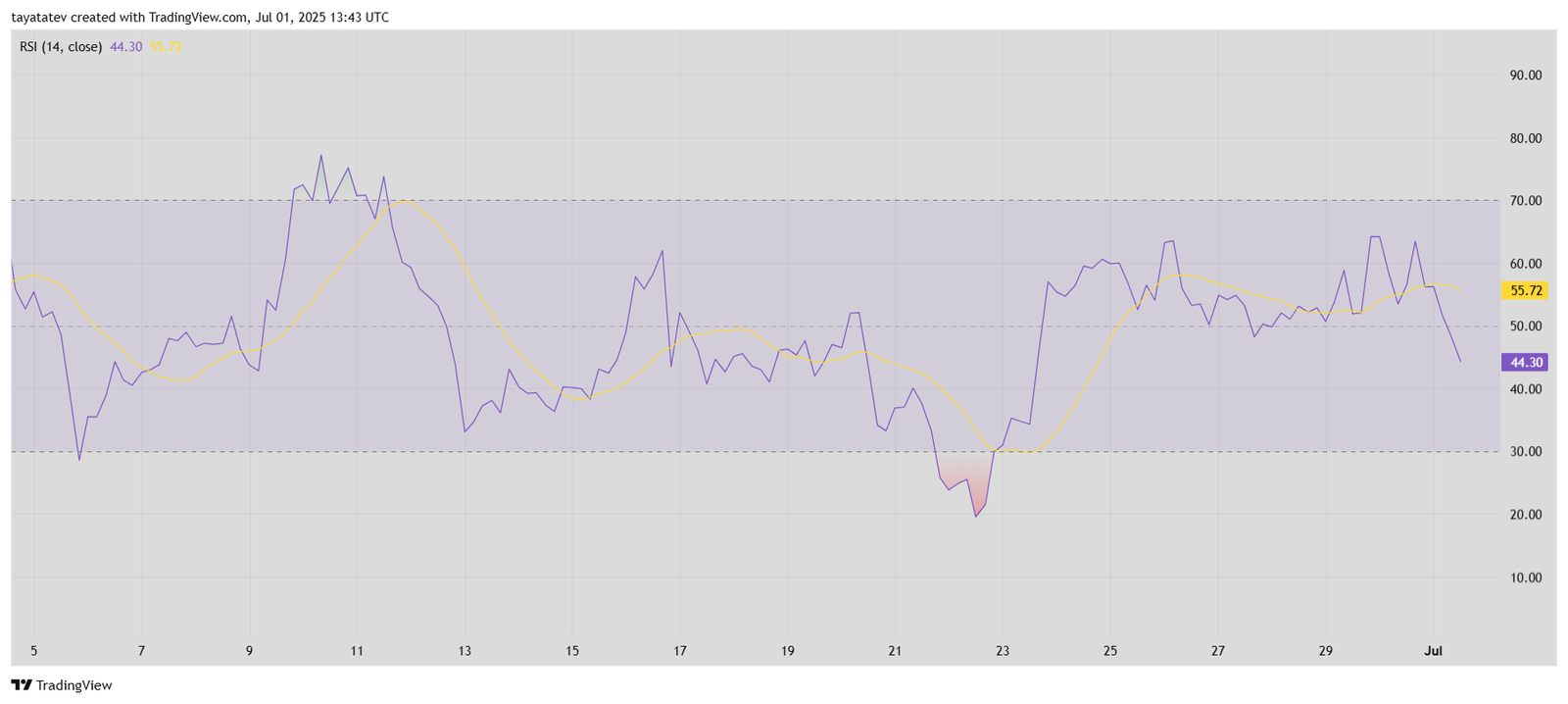
In this case, the RSI broke beneath its 14-day moving average after hovering above it since June 23. That shift suggests sellers may be gaining short-term control. The RSI last touched oversold territory (below 30) on June 23 before bouncing back, which coincided with a strong upward move in Ethereum’s price.
Now, with the RSI slipping again, the indicator signals reduced bullish momentum. The crossover below the signal line often serves as an early warning of a possible price slowdown or pullback.
However, the RSI remains above 40, meaning Ethereum still has room to fall before becoming oversold. If the RSI continues to trend lower while price stays inside the ascending channel, traders will likely watch for divergence or support confirmation on the price chart.


