


DeFi Development plans to raise $100 million through a private convertible note sale to buy Solana (SOL). The company, formerly Janover, rebranded in April to focus entirely on Solana and is now following a strategy similar to MicroStrategy’s Bitcoin accumulation. The notes are due in 2030, and the offering could expand to $125 million if demand allows. Some funds will also support stock buybacks through a prepaid forward structure to manage risk.
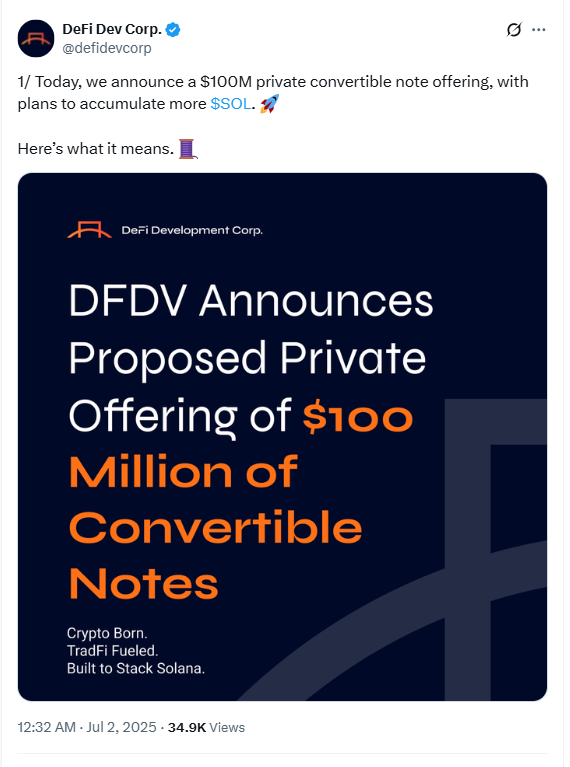
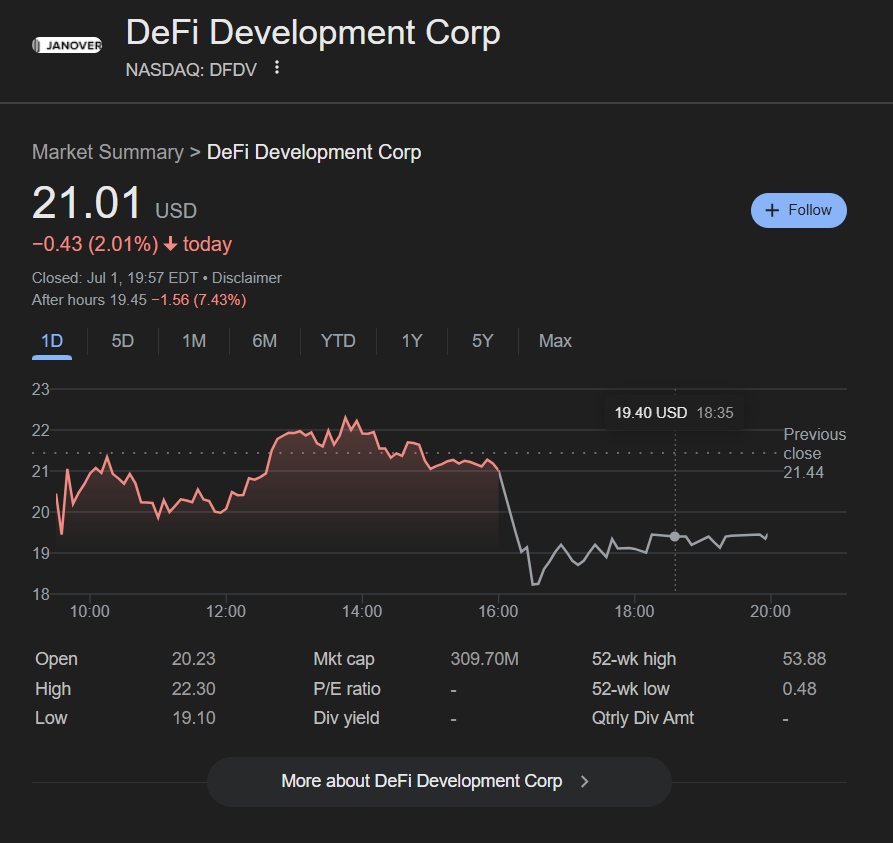
Investor response turned negative shortly after the announcement. DeFi Development’s stock fell over 7% in after-hours trading, dropping from $21.01 to $19.45. The decline began less than 30 minutes after the company posted the $100 million note offering on X. Earlier this year, the SEC blocked the firm’s plan to raise $1 billion for Solana purchases. However, DeFi Development later secured alternative funding and began acquiring the token.
Solana’s market performance adds pressure. After a brief rally in May, SOL saw declines throughout June and has fallen another 6% today. These price drops could impact demand for the company’s stock sale, which is key to funding the crypto buy.
While MicroStrategy’s regular Bitcoin purchases have supported BTC prices, it’s uncertain whether DeFi Development can have the same effect on Solana. The market’s early reaction suggests institutional investors remain cautious, especially as Solana faces bearish trends. Whether the offering succeeds or not, it will show how far corporate crypto strategies can stretch beyond Bitcoin.
Anchorage Digital Backs JitoSOL Mint and Redemption as First Federally Chartered Partner for Solana Staking
Meanwhile, the Jito Foundation has partnered with Anchorage Digital to offer full support for minting and redeeming JitoSOL, the leading liquid staking token on Solana. This integration makes JitoSOL the first Solana-based liquid staking token supported by a U.S. federally chartered crypto bank.

Anchorage Digital Bank N.A.—the only crypto bank to hold a national trust charter from the Office of the Comptroller of the Currency—now allows institutions to custody, mint, and redeem JitoSOL. These services are also available through Anchorage Digital Singapore, which holds a payment license from the Monetary Authority of Singapore.
The foundation stated that this move enables institutions and SOL holders to maintain liquidity while earning staking rewards and protocol revenue. Anchorage Digital said the platform’s mint-and-redeem support comes with institutional-grade security features, including HSMs, biometric authentication, and behavioral analytics.
Self-Custody Coming Through Anchorage’s Porto Wallet
Beyond custody services, JitoSOL mint and redemption functions will soon become available through Porto, Anchorage Digital’s self-custody wallet. This option targets institutional users seeking direct control over their Solana assets while engaging in liquid staking.
Nathan McCauley, CEO of Anchorage Digital, called the integration “a seamless, custom-built mint and redeem experience.” He said the partnership reflects Anchorage’s expanding support for Solana and DeFi infrastructure.
The Jito Foundation released a Securities Classification Report arguing that JitoSOL does not qualify as a security under U.S. law. It also published a memorandum to guide the tax treatment of liquid staking, aiming to align JitoSOL with regulatory standards.
According to Thomas Uhm, Chief Commercial Officer at Jito Foundation, the product meets key operational needs for ETF issuers. He pointed to in-kind creation and redemption, strong market liquidity, and Anchorage’s infrastructure as critical for regulatory compliance.
With support from a federally regulated bank, JitoSOL is now positioned for broader integration into financial products like staking-enabled ETFs. The Jito Foundation said liquid staking tokens are increasingly viewed as a compliant alternative to traditional staking and could see growing institutional demand.
Solana (SOL/USDT) Forms Bullish Flag, Eyes Breakout Toward $231
On July 2, 2025, Solana(SOL/USDT) formed a bullish flag pattern on the daily chart, suggesting a potential upward continuation. The pattern started in early May with a sharp rally from around $115 to $170, followed by a downward-sloping consolidation throughout June. This structure created a classic bullish flag—a chart pattern that signals a pause before a possible breakout. If confirmed, it often leads to a strong price increase.
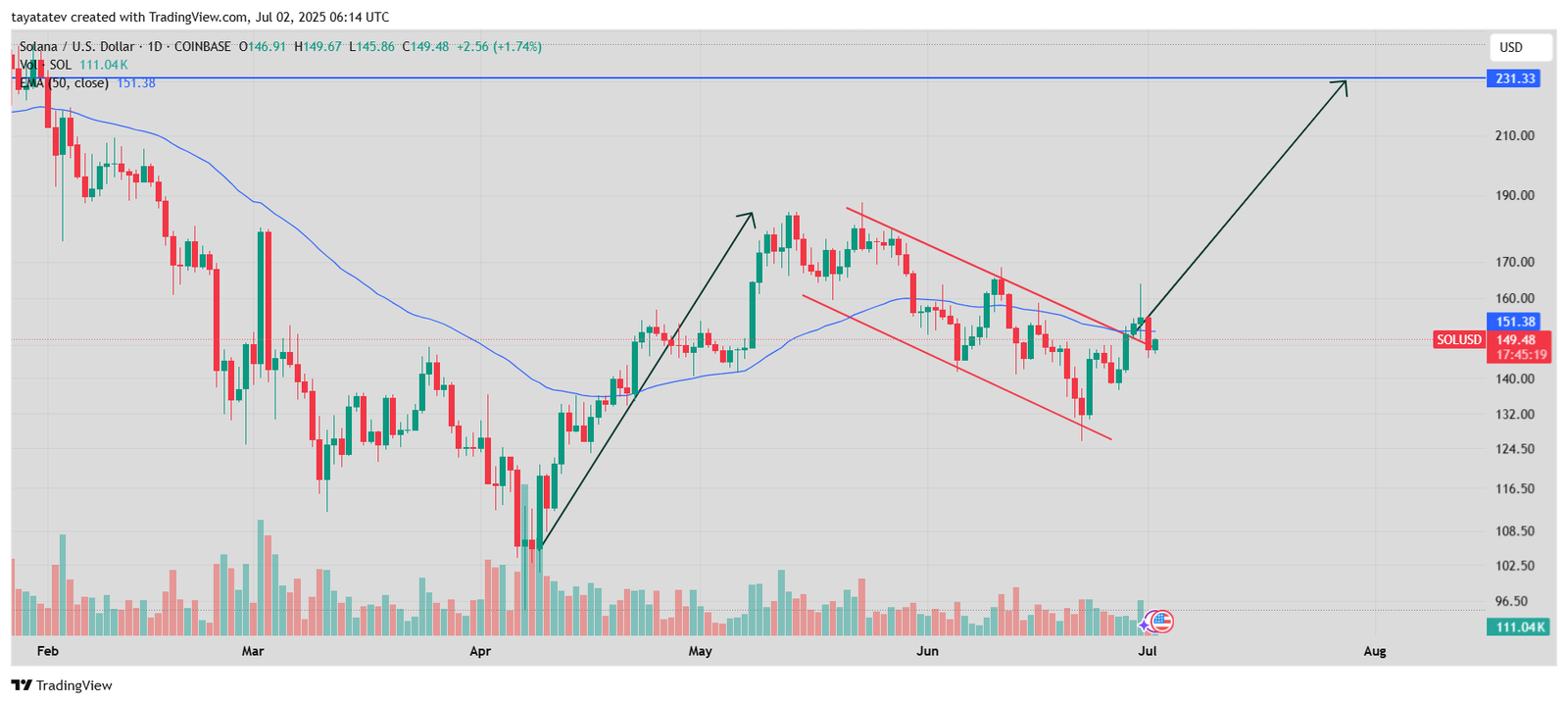
Solana broke above the flag’s upper trendline around July 1 and moved up 6%, briefly reaching $149.48. However, the rally faced resistance at the 50-day exponential moving average (EMA) of $151.38. After hitting that level, the price pulled back and is now hovering just below the EMA. A successful second test and rebound from the breakout zone, near $145–$148, could confirm the flag’s validity.
If Solana holds that zone and breaks above the EMA with volume support, the bullish flag projection indicates a 54% move from the current price. This would place the next target near $231.33. For now, traders are watching to see whether Solana confirms the pattern with a second breakout push.
Solana RSI Moves Toward Neutral Zone, Signals Caution Ahead
On July 2, 2025, Solana’s Relative Strength Index (RSI) stood at 49.85 on the daily chart. The RSI is a momentum indicator that measures the speed and change of price movements. A reading above 70 typically signals overbought conditions, while a reading below 30 suggests oversold conditions.
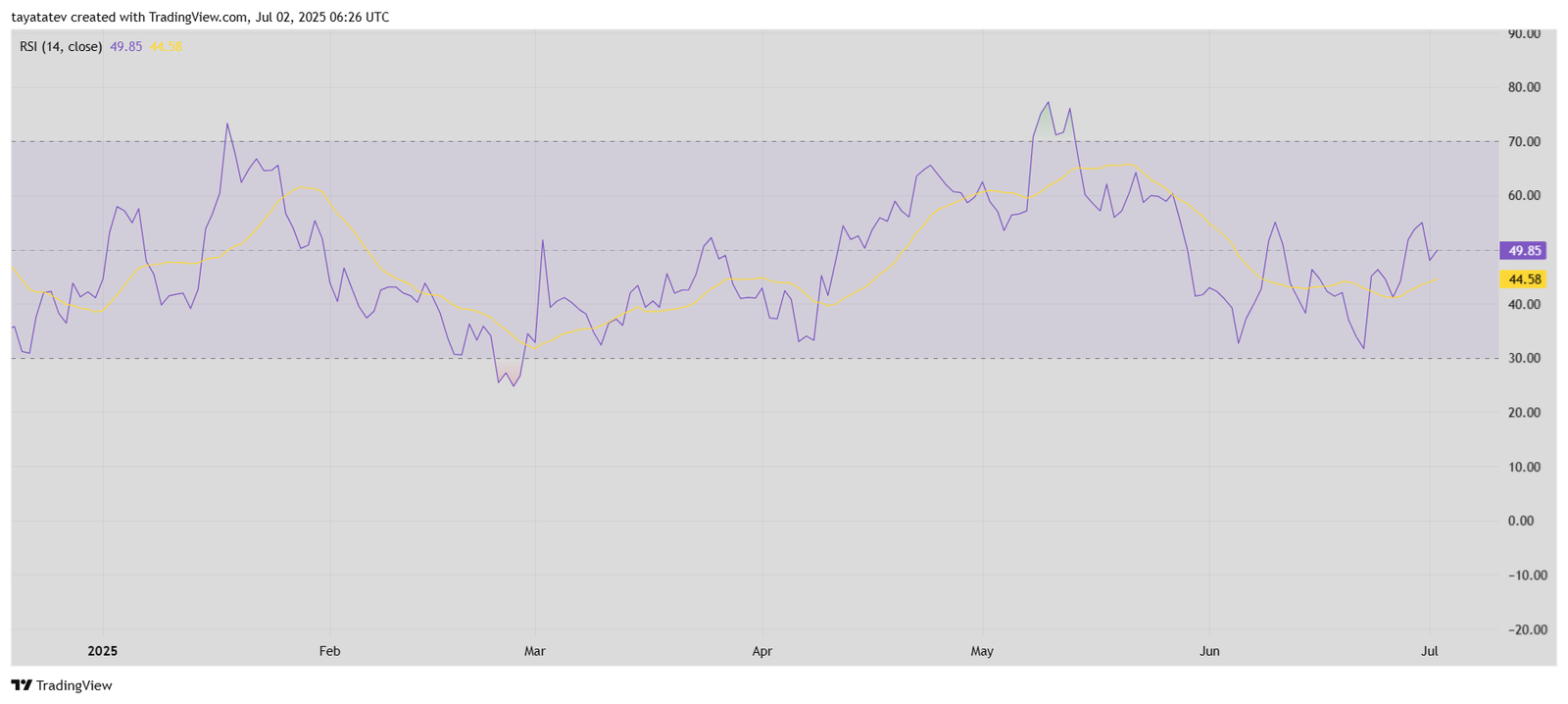
At the moment, Solana’s RSI is rising but remains just under the midpoint of 50, while the 14-day RSI moving average is still lower at 44.58. This setup suggests that buying pressure is building, but the trend has not yet fully turned bullish.
The RSI line recently crossed above its moving average, which could be an early sign of a trend reversal. However, for confirmation, the RSI needs to break decisively above 50. Until then, momentum remains neutral, and the price could continue moving sideways or face resistance.
If Solana holds its current support level and RSI continues climbing, the indicator may support the bullish flag breakout discussed earlier. But if the RSI turns down again, it could signal weak momentum and a failed breakout attempt.


