



The Pi Network (PI) team, usually known for its long silences, jolted its community awake with a cryptic yet urgent announcement recently. The team called on users to finalize their KYC and activate two-factor authentication.
The alert, issued from the project’s official X account, stood out as one of the few direct messages from the core team this year, instantly sparking rumors of a significant internal shift or long-awaited upgrade. But, for all the noise, PI coin price barely flinched. The token continued to drift sideways, stuck in a lifeless range that no amount of hype seems able to revive.
Core Team’s Rare Reminder Sparks Hype—and Frustration
Pi Network’s official X account broke its silence with a direct call to action.

The post urged users who had yet to migrate to the main net to review Step 3 of the migration checklist and enable two-factor authentication (2FA). The update stressed that 2FA is mandatory for wallet activation and main net eligibility, catching attention not because of what it said but because it came at all.
Pi Network’s Core Team has maintained a pattern of silence that borders on calculated ambiguity. So when they speak—even to reiterate checklist items—the community reads between the lines.
This time was no different. Influencers began speculating that the announcement was a coded heads-up for a long-awaited development. “Something is coming?” posted one user, while others circled back to earlier rumors of a Binance listing or second migration window expansion.

But below the surface of renewed excitement, dissent lingered. Users responded with mounting frustration, pointing out unresolved technical issues and broken migration flows. One user accused the team of “shirking responsibility,” demanding action instead of repeated reminders. Another shared a wallet activation screen that remained locked for months despite completing KYC, asking for a solution to remaining stuck at the same step for months.
These replies undercut the narrative of seamless progress. The migration campaign has been marketed as a success story, but persistent reports of stalled approvals, broken wallet links, and mapping errors suggest otherwise. The Core Team may be attempting to reignite interest, but their foundation remains shaky, and users are starting to push back.
PI Coin Price Has No Reaction… to Anything
The Pi Network coin, the fruit of countless hours of mobile-based mining, remains stuck in the mud. Not a very useful attribute in an asset class that belongs to a category that is supposed to be alive and volatile. The token has steadily remained in a downtrend since reaching its ATH earlier this year.

The token has tried to jump upwards multiple times. This has been evident from the long upper wicks in its daily candles. But, the sellers have nearly always won. However, the hopium remains strong. This is the case because, despite such sad price performance, social media is flooded with posts claiming the PI USD pair would soon reach $5, $10, $100. Not to mention the general consensus value of $314,159.
Speculation around Pi Network’s hint of a “major update” did little to shake PI coin out of its inertia.
This hasn’t stopped Pi loyalists from doubling down on optimism. Some accounts have pointed to the token’s repeated short-term upticks as proof of underlying strength, suggesting a breakout is just around the corner. Hashtags linking Pi to prominent names like Binance, Ethereum, and Solana have reappeared in full force, as if name-dropping could will a rally into existence.
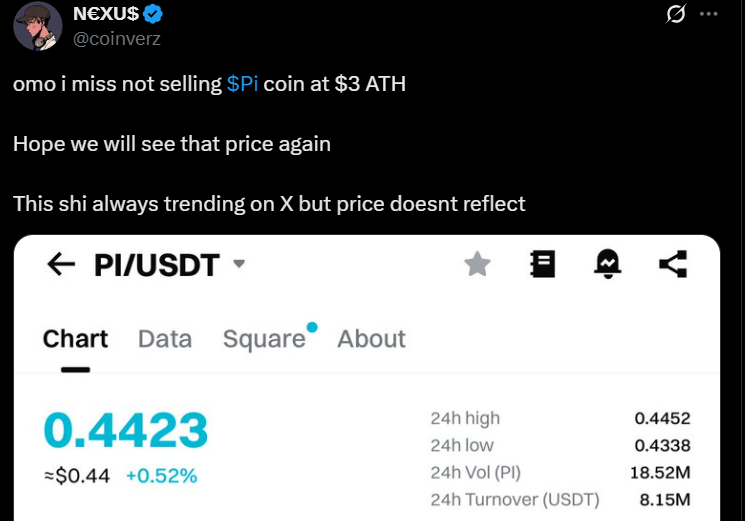
However, alongside the hype, frustration continues to simmer. Other users, still holding from PI coin’s inflated early listings, voiced regret over missed exits. They have questioned why constant online chatter has failed to translate into upward movement. Despite trending frequently on X, PI’s price has refused to show any real strength.
The PI token remains unmoved by all the talk of momentum and bullish structure. It continues to brush off speculation, announcements, and even broader altcoin rallies. It sits in the same listless range that has come to define its post-launch trajectory.


