


Wealthy Asian investors are raising their exposure to cryptocurrencies, targeting around 5% of their portfolios. Reuters reported that family offices in Singapore, Hong Kong, and mainland China are part of this trend.
Wealth managers said they are receiving more client inquiries about digital assets. Cryptocurrency exchanges confirmed that trading volumes have risen, and new crypto investment funds are attracting strong participation.
Jason Huang, founder of NextGen Digital Venture, said his company raised over $100 million in a few months for a long-short crypto equity fund launched in Singapore in May 2025. He added that his previous fund, closed in 2024, returned 375% in less than two years.
UBS reported that Chinese family offices abroad are leading some of these allocations. The bank said second- and third-generation members are increasingly involved in crypto, with allocations reaching about 5%.
Wealthy Asian Investors Drive Exchange Growth
Crypto exchanges across Asia reported higher activity in 2025. Hong Kong’s HashKey Exchange said its registered users grew 85% year-on-year by August. CryptoQuant data showed trading volumes at South Korea’s three largest exchanges rose 17% this year, while average daily volumes climbed more than 20%.
Wealthy Asian investors expanded their activity beyond Bitcoin. Flows included stablecoins, altcoins, and direct holdings of Ether. The launch of spot Bitcoin and Ether exchange-traded funds (ETFs) in Hong Kong in April 2024 also supported institutional flows.
More than 40% of Hong Kong’s inflows came from stablecoins during this period. HashKey Exchange noted that investor participation continued to grow as approval of Bitcoin and Ether ETFs shifted market focus to direct holdings.
Retail Adoption Remains Strong in Asia
Retail adoption remains at the center of Asia’s crypto growth. Chainalysis reported that the Central and Southern Asia and Oceania (CSAO) region recorded more than $750 billion in inflows between mid-2023 and mid-2024, accounting for 16.6% of global volume. Most inflows came from transactions under $10,000 used for trading, remittances, and decentralized finance (DeFi).
India ranked first in the 2024 Global Crypto Adoption Index by Chainalysis, led by retail investors on centralized exchanges. Indonesia ranked third, with activity boosted by decentralized finance and a fast-growing Web3 sector. Vietnam ranked fifth, with adoption split between centralized exchanges and DeFi. The Philippines placed eighth, supported by remittance payments and play-to-earn gaming activity.
Singapore processed nearly $1 billion worth of cryptocurrency through merchant services in the second quarter of 2024. Stablecoin transfers dominated these retail-level transactions.
East Asia Shifts Toward Institutional Crypto Adoption
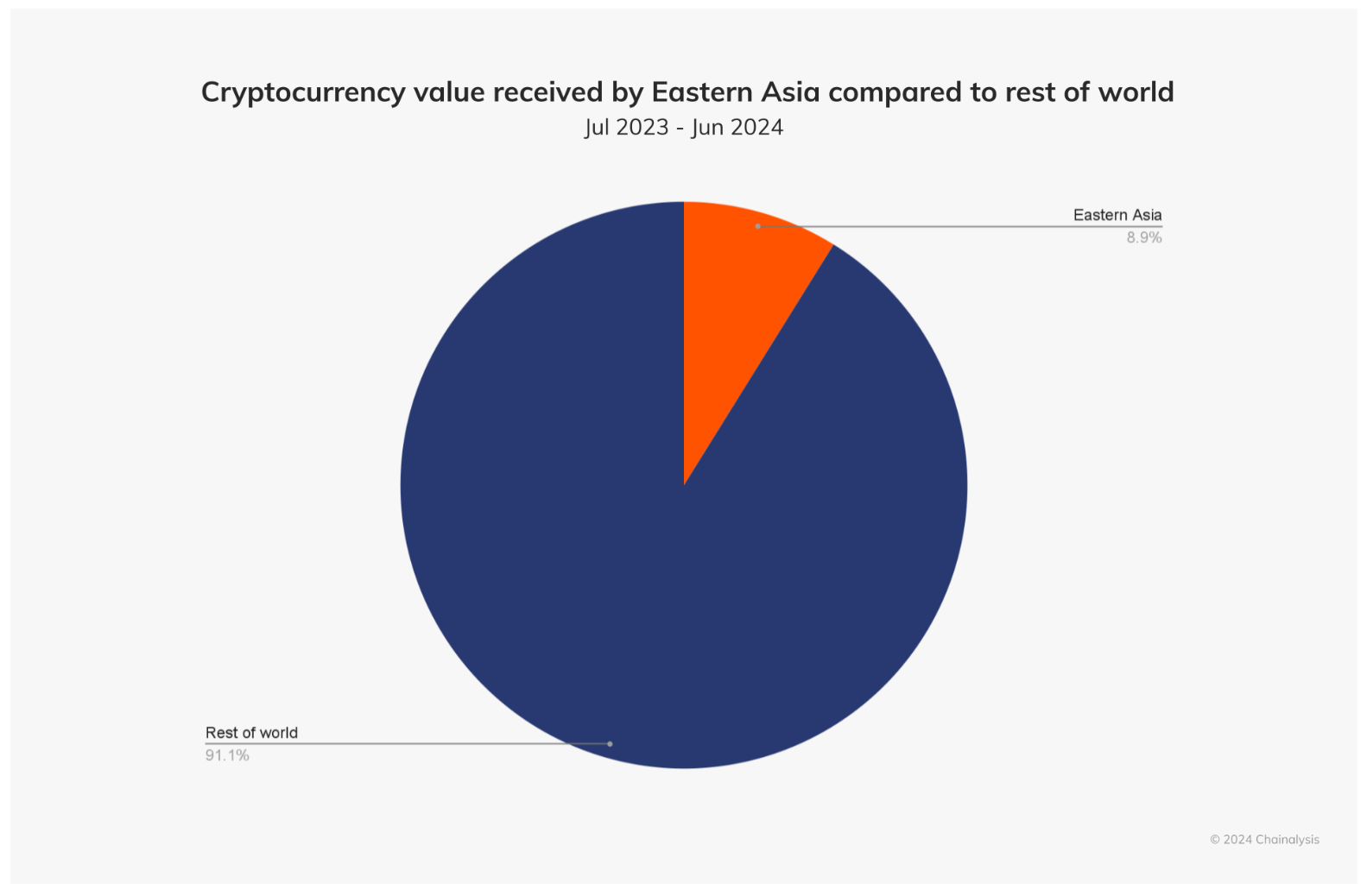
East Asia displayed a stronger institutional focus. Chainalysis reported nearly $400 billion in inflows from mid-2023 to mid-2024, led by professional investors and wealthy citizens using crypto as a store of value.
South Korea received around $130 billion in inflows, making it the largest market in the region. Professional traders drove activity using altcoins, stablecoins, and arbitrage strategies tied to the “kimchi premium.”
Hong Kong recorded the fastest growth in East Asia, with crypto activity up 85.6% year-on-year. Bitcoin and Ether ETFs approved in April 2024 supported direct holdings and institutional adoption.
In China, after the 2021 ban on exchanges, activity shifted to over-the-counter (OTC) and peer-to-peer platforms. Wealthy Chinese investors increasingly used crypto for wealth preservation and overseas transfers. The trend grew in late 2023 as property markets weakened and stock indexes declined.
Wealthy Asian Investors Support Developer Growth
Wealthy Asian investors are not only allocating to digital assets but also indirectly supporting development. The 2024 Electric Capital Developer Report said Asia accounts for 32% of active crypto developers, compared to just 12% in 2015.
The report added that 41% of new crypto developers now come from Asia. This shift shows how the region is shaping blockchain projects and decentralized applications, aligning with rising allocations from wealthy Asian investors.


