



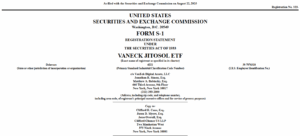
Global asset manager VanEck has filed an S-1 registration with the U.S. Securities and Exchange Commission (SEC) to launch the first American exchange-traded fund (ETF) backed by a liquid staking token. The product, called the VanEck JitoSOL ETF, would hold only JitoSOL, a staking token issued by Jito Network on the Solana blockchain.
ETF Would Expose Investors to Solana Rewards
JitoSOL represents staked Solana (SOL) locked with validators. Unlike simply holding SOL, the token accrues staking rewards while remaining transferable. This process, known as liquid staking, enables holders to access yield without sacrificing liquidity.
If approved, the fund would not only track Solana’s price (SOL to INR) but also provide investors access to staking income through a regulated investment vehicle.
This filing is the first attempt to register a U.S. ETF tied to a liquid staking token. Unlike VanEck’s spot Bitcoin ETF and Ether ETF launched in 2024, this product directly integrates blockchain-native yield into a publicly traded security.
In traditional ETFs, assets generate no additional income beyond price appreciation. By contrast, JitoSOL accrues Solana’s staking yield. The structure could open a new pathway for institutional investors to gain exposure to staking rewards without navigating blockchain infrastructure directly.
SEC Has Blocked Staking in ETFs Before
The SEC’s position on staking has been uncertain. In February 2023, the regulator charged crypto exchange Kraken with offering an unregistered staking program, resulting in a $30 million settlement and the closure of its U.S. staking service. The SEC also sued Coinbase that year over similar claims, though the regulator dismissed the case in February 2025.
At the same time, SEC staff guidance has softened. In May 2024, the agency stated that solo and delegated staking generally fall outside securities law because protocol rules, not third parties, determine rewards. In August 2024, staff extended that view to liquid staking. They noted that tokens like JitoSOL could be treated as ownership receipts rather than investment contracts—provided providers do not exercise discretionary control.
However, these statements are non-binding and may be reinterpreted by the Commission or courts.
VanEck’s filing follows a July 31 letter to the SEC co-authored by Jito Labs and the Jito Foundation, with backing from VanEck, Bitwise, Multicoin Capital, and the Solana Policy Institute. The groups argued that liquid staking tokens like JitoSOL improve security and efficiency by spreading stake across validators and reducing operational complexity.
They also pointed to existing SEC guidance as evidence that liquid staking tokens align with current rules.
SEC Chair Signals Openness to Crypto Products
When the SEC approved spot Ether ETFs in May 2024, issuers initially proposed to stake ETH held in funds. The Commission rejected those features, requiring all references to staking to be removed before approval. As a result, Ether ETFs from BlackRock, Fidelity, Grayscale, and VanEck launched without staking.
The JitoSOL ETF would test whether the SEC is ready to allow staking exposure in ETFs directly. This would be a step beyond its prior approvals.
Speaking at an industry panel in Jackson Hole last week, SEC Chair Paul Atkins hinted at regulatory changes. He said the Commission is working to clear “bottlenecks” that slow innovation and emphasized that future rules should adapt to new technologies.
VanEck is not alone in pursuing Solana staking products. Fidelity, Grayscale, and Franklin Templeton are also preparing staked Solana fund proposals. These demonstrate broad institutional interest in bringing blockchain yields into regulated markets.


