



Pi Network’s Hackathon 2025 officially began on August 21 and is set to run until October 15. The event has already attracted more than 2,100 developers from over 100 countries. According to organizers, around 900 participants are still seeking teammates, highlighting growing interest in building on the platform.

The hackathon carries a prize pool of 160,000 PI tokens, with 75,000 PI allocated to the top team. Developers are encouraged to design decentralized applications (dApps) that expand real-world use cases for the network. Tools such as Pi App Studio and the Brainstorm app are central to the competition.
Midpoint Evaluation Set for September
The Pi Foundation has scheduled a midpoint evaluation session for September 19. This checkpoint will allow judges and mentors to provide structured feedback to teams before the final submission deadline. Organizers said the review is designed to ensure projects remain aligned with Pi Network’s utility goals as the ecosystem expands.
The structure reflects a growing emphasis on quality and usability. By incorporating early reviews, Pi Network aims to promote more mature dApp concepts by the time winners are announced in mid-October.
Domain Auction Deadline Extended
Alongside the hackathon, the Pi Foundation confirmed an extension of the “.pi domain” auction deadline to September 30, 2025. The domains act as Web3 identifiers, enabling developers to establish distinct digital brands within the Pi ecosystem.
Organizers explained that the extension would give users more time to secure unique names for upcoming applications. The move also reflects increasing demand from developers and businesses seeking to integrate Pi’s blockchain into consumer-facing services.
Ecosystem Expansion Beyond Tokens
The hackathon and domain initiative mark a shift in focus from token trading to practical adoption of Pi Network technology. Institutional partnerships and technical integrations, including improved KYC processes and interoperability with exchanges, are also shaping the project’s evolution.
With thousands of developers now engaged and new infrastructure tools being rolled out, Pi Network is positioning itself as an ecosystem built on real-world functionality rather than speculation.
Pi Network Price Struggles Under Downtrend Pressure
The Pi Network token has remained in a steady downtrend, as shown on the PI/USDT four-hour chart. Since late June, the price has been making lower highs along a descending trendline, with every attempt at recovery meeting resistance. On August 25, the token traded near $0.34, slipping below the 50-period EMA at $0.3599, which further highlights bearish control. Trading volume stood at around 5.25 million PI, confirming steady selling activity.
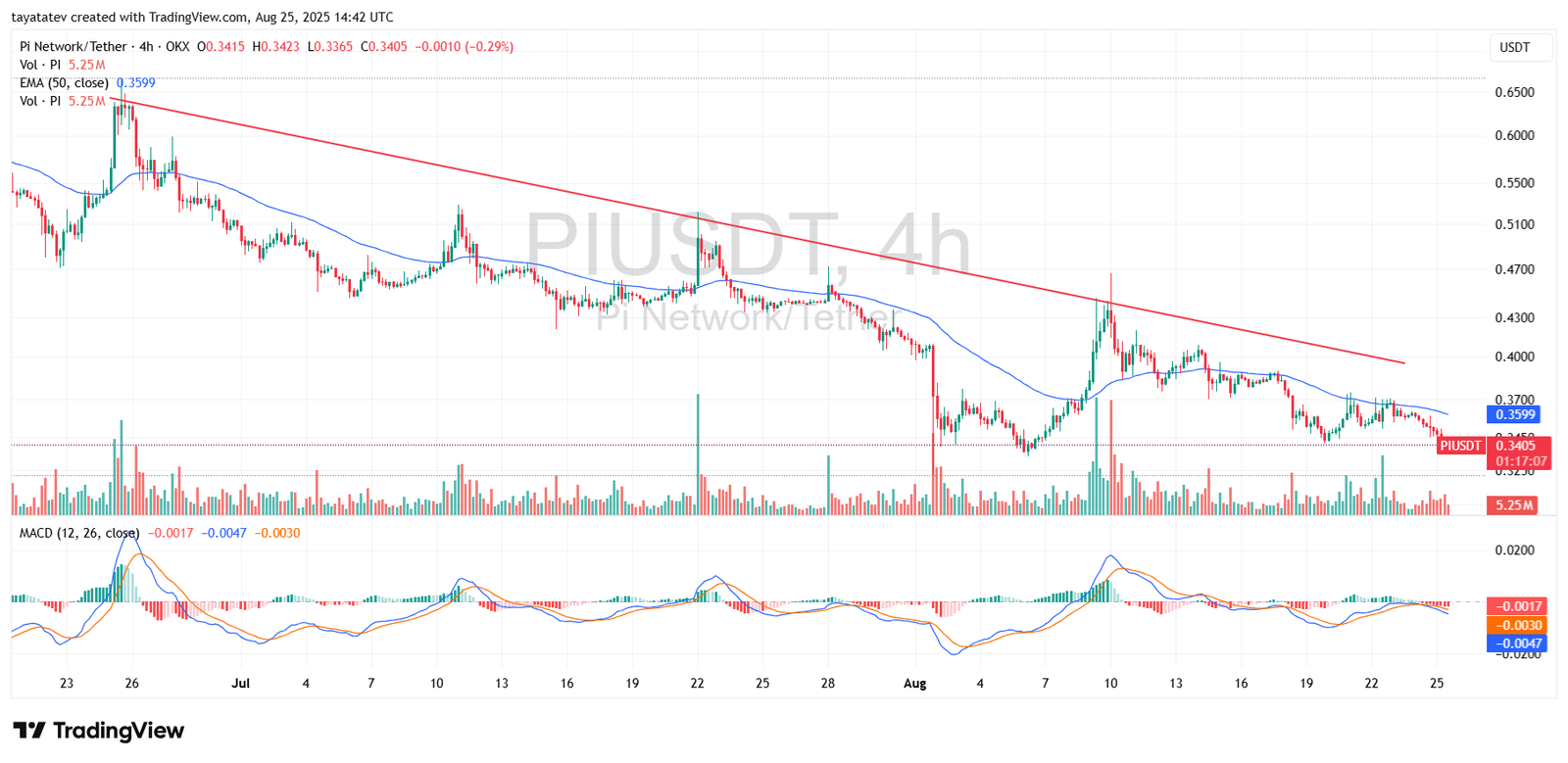
Momentum indicators show weakness as well. The MACD line has crossed below the signal line, with both positioned under the zero axis, signaling negative momentum. The RSI, not visible in this chart, would likely reflect oversold conditions given the recent decline. Despite brief rallies in early August, the token has failed to sustain moves above $0.40, instead returning to test support levels near $0.33. The consistent rejection at the descending resistance suggests that Pi Network remains locked in a bearish structure unless it can break decisively above the trendline and reclaim the EMA.
Pi Network Price Analysis with Bollinger Bands
The Pi Network token continues to trade under pressure, with its four-hour chart showing a persistent downtrend. The red descending trendline marks the series of lower highs since late June, confirming sustained selling momentum. On August 25, the token was priced around $0.3410, slipping below the 50-period EMA at $0.3599, a sign that bearish sentiment remains dominant.
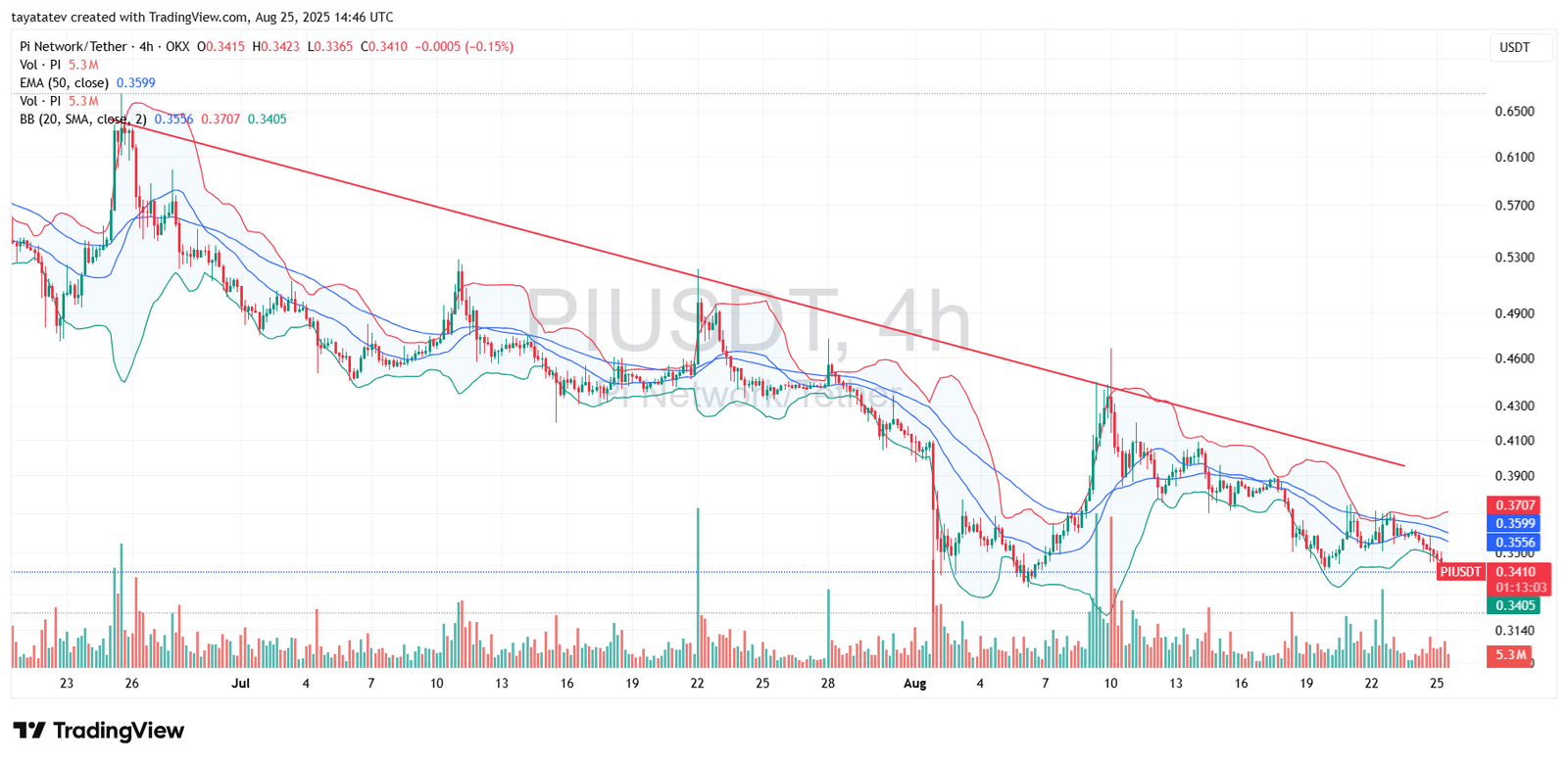
Bollinger Bands show the price moving near the lower band, which typically signals oversold conditions and weaker demand. When candles consistently test the lower band without strong rebounds, it suggests that sellers are firmly in control, and any bounce attempts lack strength. At the same time, the middle band, which aligns closely with the 20-period moving average around $0.3556, has acted as short-term resistance, rejecting recovery efforts.
Trading volume, recorded at 5.3 million PI, reflects moderate participation but not enough buying pressure to reverse the trend. Each attempt to push above $0.37 has failed, reinforcing the descending structure. Unless Pi breaks above the upper Bollinger Band near $0.3707 and sustains that level, the token is likely to remain within the bearish channel. The overall setup illustrates tightening volatility within a declining trend, leaving Pi vulnerable to further downside unless momentum shifts.
Pi Network Balance of Power Shows Weak Buyer Control
The Balance of Power (BoP) indicator for Pi Network currently sits at –0.09, reflecting a tilt toward sellers. Over the past weeks, the BoP has moved erratically between sharp positive and negative swings, but the overall trend has leaned below zero. This shows that although buyers occasionally attempt short-lived rallies, sellers consistently regain control.
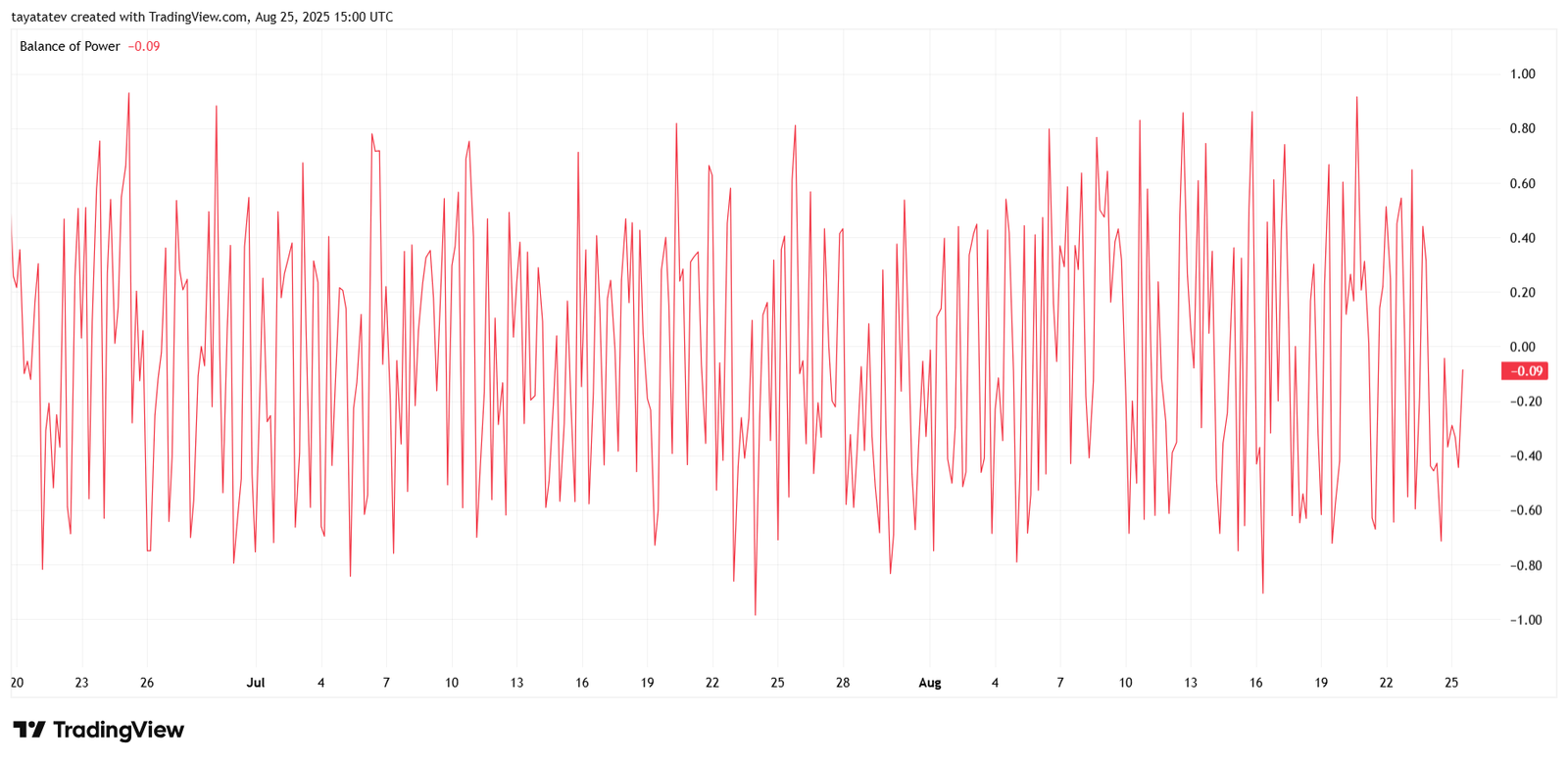
In technical terms, a BoP reading below zero indicates that distribution outweighs accumulation. The persistent dips into negative territory since July suggest that bullish efforts have been unable to establish dominance. Each bounce has quickly faded, feeding into the broader downtrend visible on Pi’s price chart.
With BoP hovering in negative territory, the market dynamic signals sustained selling pressure. Unless the indicator can establish sustained movement above the neutral line, Pi Network will likely continue to face difficulty reversing its bearish structure.


