



Ripple has secured a stronger regulatory position after the conclusion of its high-profile battle with the U.S. Securities and Exchange Commission (SEC). The case, which started in 2020, reached a key turning point in 2023 when Judge Analisa Torres ruled that XRP sold on exchanges was not a security.
In August 2025, both Ripple and the SEC dropped their appeals, leaving that ruling in place and providing long-awaited clarity. The XRP community, often referred to as the “XRP Army,” played a central role in pushing the narrative that secondary market sales should not be treated as securities transactions. Their advocacy, amplified across social platforms and in legal commentary, added weight to Ripple’s defense and shifted the case’s trajectory. With this outcome, Ripple now faces a clearer regulatory environment that allows it to expand institutional partnerships without the overhang of litigation.
Rising Odds for an XRP ETF
Institutional interest in XRP is gaining momentum as traders focus on the possibility of a spot exchange-traded fund (ETF). Data from prediction platform Polymarket shows a 91 percent chance that the SEC will approve an XRP ETF by the end of 2025. The probability jumped 20 percent in recent weeks, marking the highest level recorded this year.

The steady rise in expectations reflects growing confidence after recent regulatory signals. In early September, the SEC and the Commodity Futures Trading Commission (CFTC) issued a joint statement clarifying that certain spot crypto asset products could be traded on designated exchanges. This announcement reduced uncertainty and boosted investor sentiment toward pending ETF applications.
If approved, a spot XRP ETF could channel billions in institutional inflows, similar to trends observed with Bitcoin and Ethereum ETFs earlier in the year. Asset managers and trading platforms are already positioning for potential listings, which would deepen XRP’s integration into traditional financial markets.
Legislative Momentum with the Clarity Act
Beyond the courtroom, Ripple’s path is tied to upcoming legislation. Senator Cynthia Lummis has emphasized that the Clarity Act, which could pass as early as October, will establish a more concrete framework for digital assets. The proposed law seeks to define which tokens qualify as securities and which fall under commodity rules.
If enacted, the legislation may accelerate institutional adoption of XRP by permitting ETFs, enabling companies to hold digital assets on balance sheets, and supporting permissioned decentralized exchanges that align with banking standards. Ripple’s escrow structure, which releases XRP in measured amounts, may also become more relevant in this context as institutions look for assets with predictable supply. Together, regulatory clarity and new legislation could shift XRP from a contested asset into a recognized component of financial infrastructure.
SWIFT Questions XRP’s Readiness
Despite legal victories and rising optimism, Ripple still faces skepticism from traditional financial institutions. Tom Zschach, Chief Innovation Officer at SWIFT, recently questioned whether XRP technology meets the standards required for global banking integration.

SWIFT’s concerns revolve around settlement reliability, compliance with cross-border regulations, and alignment with existing banking infrastructure. While Ripple has promoted its technology as faster and cheaper than traditional systems, established financial networks demand a proven track record at scale.
The skepticism highlights the challenges Ripple must overcome to position XRP as a cornerstone of international payments. At the same time, SWIFT’s cautious stance shows that institutional adoption will depend on technical validation as much as regulatory clarity.
Emerging Competition in the Payments Space
As Ripple strengthens its regulatory footing, new challengers are entering the payments market. Projects such as Remittix, described by some as “XRP 2.0,” are drawing investor interest. These smaller projects promote themselves as more agile, promising faster innovation cycles and niche use cases.
Recent reports suggest that Remittix has attracted capital from whale investors, positioning itself as a competitor in cross-border remittances. The rise of such projects underlines the competitive environment Ripple faces. Even with legal clarity and potential ETF approval, XRP must navigate a field where newer tokens aim to capture both retail and institutional attention. The shifting dynamics show that while Ripple has removed significant obstacles, the broader landscape continues to evolve rapidly.
XRP Chart Forms Bullish Flag With 80% Upside Potential
On September 5, 2025, theXRP/USD 4-hour chart showed the token trading at $2.82 while hovering just under its 50-period EMA at $2.85. The price action has carved out a bullish flag pattern, a technical formation where an initial sharp rally creates a “flagpole” and is followed by a controlled, downward-sloping consolidation channel. This structure often signals a pause before the broader uptrend resumes.
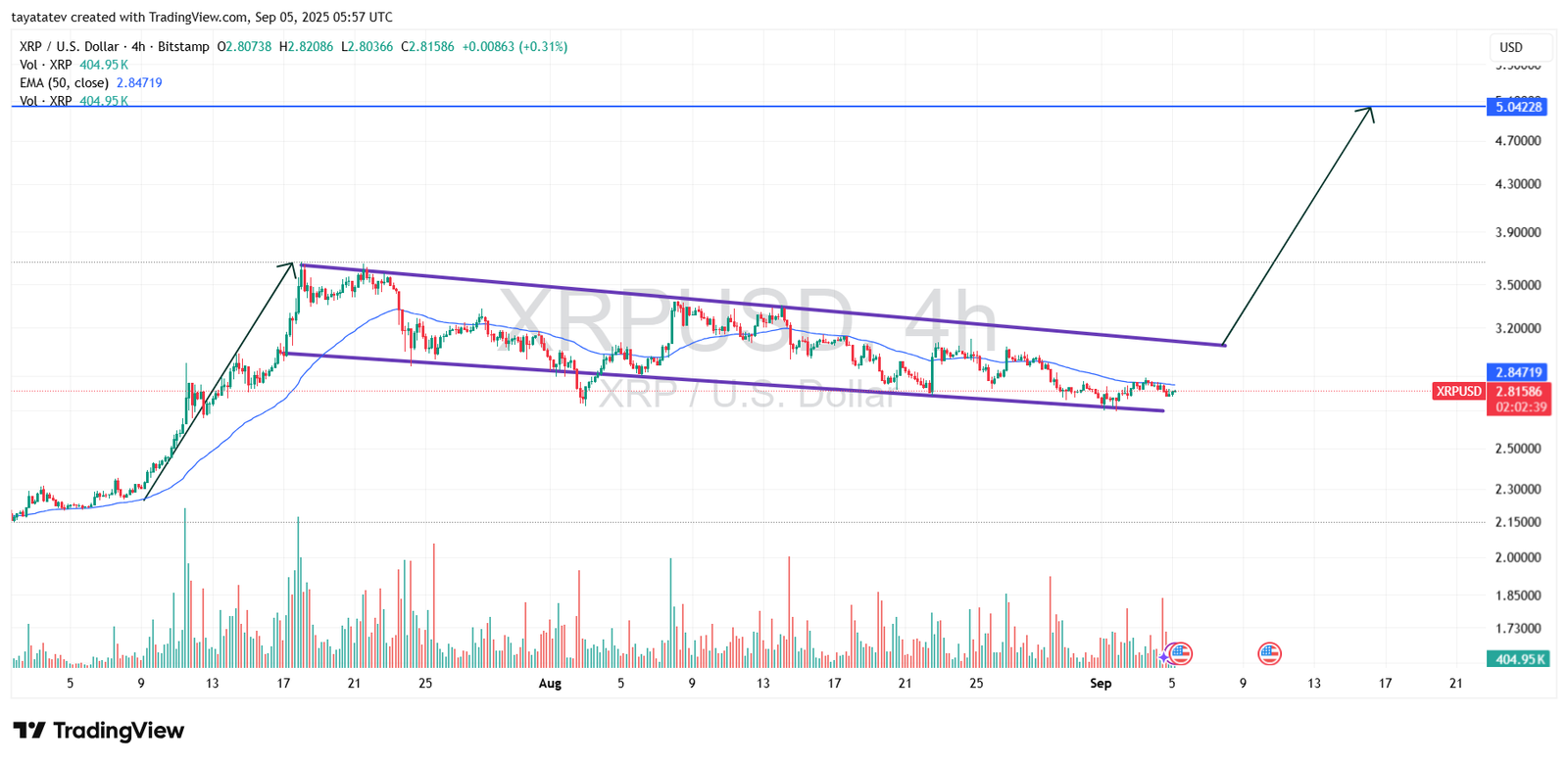
The chart indicates that XRP has been moving within parallel resistance and support lines since mid-August. Volume has eased during this phase, matching the typical behavior of flag consolidations. Traders now focus on the upper boundary of the channel, positioned near $3.15 to $3.20, as the level that must be cleared for confirmation. A breakout with strong volume would validate the bullish flag and set up a measured move.
That measured move projects an advance of roughly 80 percent from current levels, placing the potential target near $5.04. The alignment between the calculated objective and the charted resistance at $5.04 reinforces the significance of this level. Until price decisively breaks the flag’s upper trendline, however, the setup remains unconfirmed. A failure to reclaim the top boundary could extend the consolidation or expose XRP to further tests of support around $2.70.
This chart now highlights a pivotal moment: a confirmed breakout above the flag could accelerate XRP toward the $5 mark, while rejection would postpone the move.
XRP RSI Analysis – Neutral Momentum Signals (Sep 5, 2025, 06:15 UTC)
On September 5, 2025, the Relative Strength Index (RSI) for XRP on the 14-period setting printed 46.36, while its signal line stood at 49.92. This placement leaves XRP in the neutral zone, well between the overbought threshold at 70 and the oversold floor at 30.
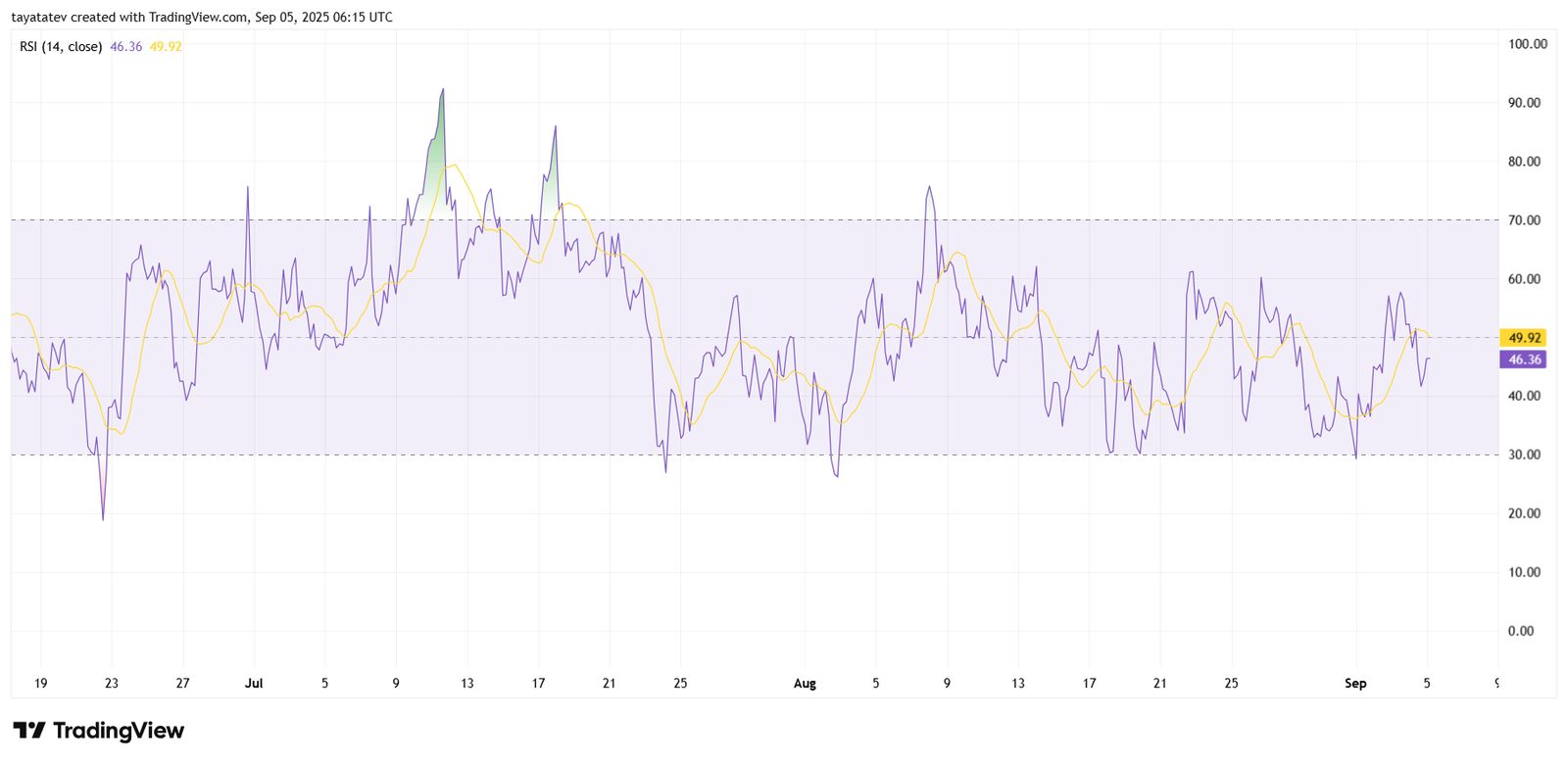
The chart shows that XRP has oscillated within this broad mid-range band since late July, reflecting a market lacking strong directional conviction. Spikes above 70 earlier in the summer quickly reversed, and dips below 30 were short-lived, reinforcing the sideways character of momentum. The RSI’s recent recovery from sub-40 readings in late August highlights attempts by buyers to stabilize price action, yet the failure to reclaim the 50 level decisively indicates that momentum remains capped.
For now, RSI trends parallel the ongoing consolidation seen in XRP’s price chart. Until the RSI can break sustainably above 55, the market remains balanced, with neither bulls nor bears holding decisive control. A push higher would confirm the buildup of momentum behind a potential breakout, while repeated failures near mid-range risk extending the consolidation phase. The indicator underscores that XRP’s momentum is neutral but poised for direction once external catalysts drive volume and conviction.
XRP MACD Analysis – Momentum at Crossroads (Sep 5, 2025)
On September 5, 2025, the Moving Average Convergence Divergence (MACD) indicator for XRP showed the MACD line at -0.00679, the signal line at -0.00453, and the histogram at -0.00225. These values place XRP in a delicate balance, with momentum leaning slightly negative but not strongly directional.
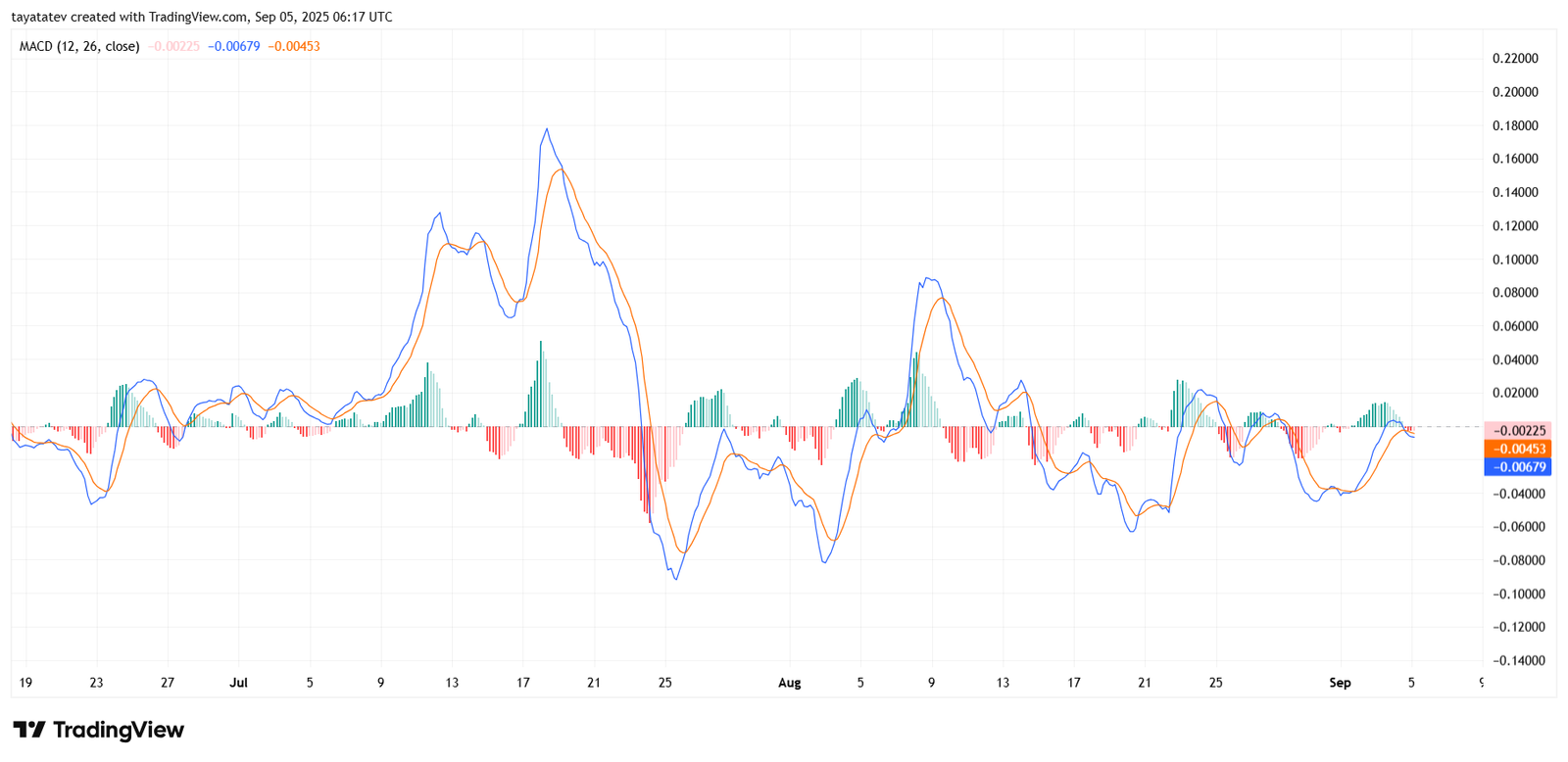
The chart displays frequent crossovers since July, reflecting indecision and consolidation phases in price. Notably, the July surge produced a strong positive MACD reading above 0.20, but that momentum quickly faded by late July and turned deeply negative into August. Since then, both MACD and signal lines have oscillated tightly around the zero line, indicating a lack of trend strength. The histogram bars mirror this, shrinking in recent days and underscoring muted conviction among traders.
Currently, the MACD line sits just below the signal line, signaling mild bearish momentum. However, the close spacing between both lines suggests that a small push in price could trigger a new bullish crossover. If XRP price confirms the breakout from its broader chart patterns, the MACD would likely flip into positive territory, strengthening the case for renewed upward momentum. Until then, the indicator confirms that XRP’s momentum remains fragile, with the market waiting for a decisive trigger.


