



Kaito AI is expanding beyond social “Yapper” rankings into fundraising and identity. Since late July, the company opened Capital Launchpad, tightened anti-spam rules on leaderboards, and lined up new, funded ecosystem campaigns with major networks.
Earlier in the year, Binance listed KAITO and distributed tokens through its HODLer Airdrops program.
Capital Launchpad opens; early campaigns follow
Kaito’s Capital Launchpad went live in late July with a reputation-driven allocation model and a staged process from pledge to FCFS. Company posts and industry coverage say the platform will redistribute project-token fees to the community via a forthcoming gKAITO framework. The rollout began with onboarding and KYC on July 22.
Projects began using the venue soon after. Theoriq announced a pre-TGE community sale on Kaito’s Launchpad in late July; third-party reports detailed timelines and participation steps. Theoriq later highlighted strong pledge interest after the window closed.
Networks scale Yapper programs
Major ecosystems extended official leaderboards tied to Kaito’s “Yaps” attention signals. Arbitrum launched a 400,000-ARB “Yap to Earn” campaign that ran May through August; Injective rolled out a program distributing 6,000 INJ to the top 100 participants over three months; Aptos introduced a Kaito leaderboard and set rewards for the top 100 eligible yappers.
Elsewhere, MANTRA committed monthly OM rewards through October, while Quai Network allocated 6 million QUAI split between general and project-specific boards. More recently, GOAT Network launched its own Kaito-powered leaderboard as the model spread to newer communities.
Rewards Station centralizes payouts; API opens data
Kaito introduced the Rewards Station as a single page to discover, track, and claim campaign rewards, describing it as the first step toward “Kaito Earn.” Guides and the company’s posts position it as a hub across project leaderboards and future task verification.

In parallel, Kaito exposed its attention dataset via a public Yaps API. Documentation describes Yaps as an open protocol for tokenized attention, accessible programmatically for teams that want to build dashboards, scoring, or attribution around social signals.
Identity effort targets verification; anti-spam rules tighten
Kaito partnered with Humanity Protocol to issue privacy-preserving Yapper Credentials, with Kaito serving as an identity validator and classifying contributors into tiers (Inner CT, Emerging CT, Yapper). Humanity later earmarked 0.2% of its $H supply to reward verified yappers and Kaito stakers.
At the same time, Kaito raised reputation thresholds and deployed additional anti-farming filters on August 8 to suppress low-quality content and botting, according to company posts and industry coverage. Project FAQs now underscore alignment and sentiment checks on project-specific boards.

KAITOUSDT 4-hour breakout: what happened and what’s next
KAITO/USDT broke a multi-week downtrend with a vertical 4-hour surge to roughly $1.55, then pulled back to about $1.38. Volume spiked to the session’s highest on the chart, while price reclaimed the 50-EMA at $1.06 in a single move. The candle shows momentum acceleration and likely short covering after weeks of compression near $0.95–$1.10.
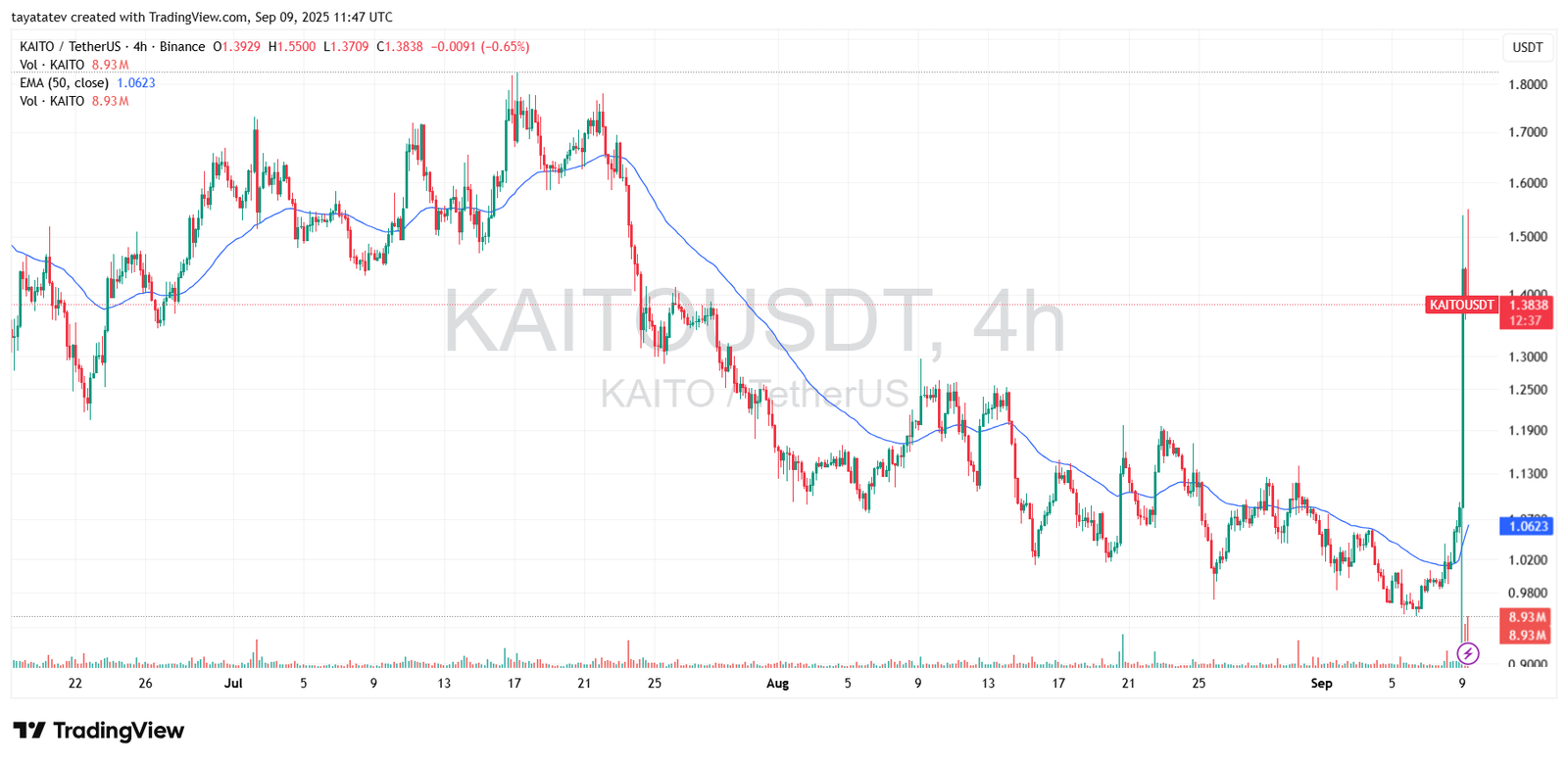
The structure now shifts from distribution to potential trend change. Price sits well above the 50-EMA, so the tape often cools before choosing direction. Therefore, expect volatility and a battle to define a higher low. If buyers hold the breakout area between $1.20 and $1.30, the market can base and later probe the $1.55 wick high. However, if momentum fades, mean reversion toward $1.06–$1.10 becomes probable as price retests the reclaimed average and the top of the prior range.
Momentum signals favor patience. The distance from spot to the 50-EMA is stretched, which increases pullback risk even in a new up-leg. A constructive path would feature sideways digestion above $1.20, shrinking ranges, and rising 50-EMA slope, followed by attempts to clear $1.55 and then the late-July supply near $1.70–$1.80. Conversely, a decisive break back below $1.06 would weaken the reversal case and return price to the old range.
Bottom line: the breakout is real and volume-backed, but the next confirmation is a higher low above the 50-EMA. Watch the $1.20–$1.30 shelf for support and $1.55 for continuation, with $1.06 as the key pivot that defines whether the trend change holds.
KAITOUSDT 4h MACD: momentum flips positive
The MACD line has exploded above the signal line and above the zero axis. The reading near 0.081 marks the strongest positive print on this chart since early July, while the histogram has turned sharply green around 0.048. This confirms a momentum regime shift to the upside on the 4-hour timeframe.
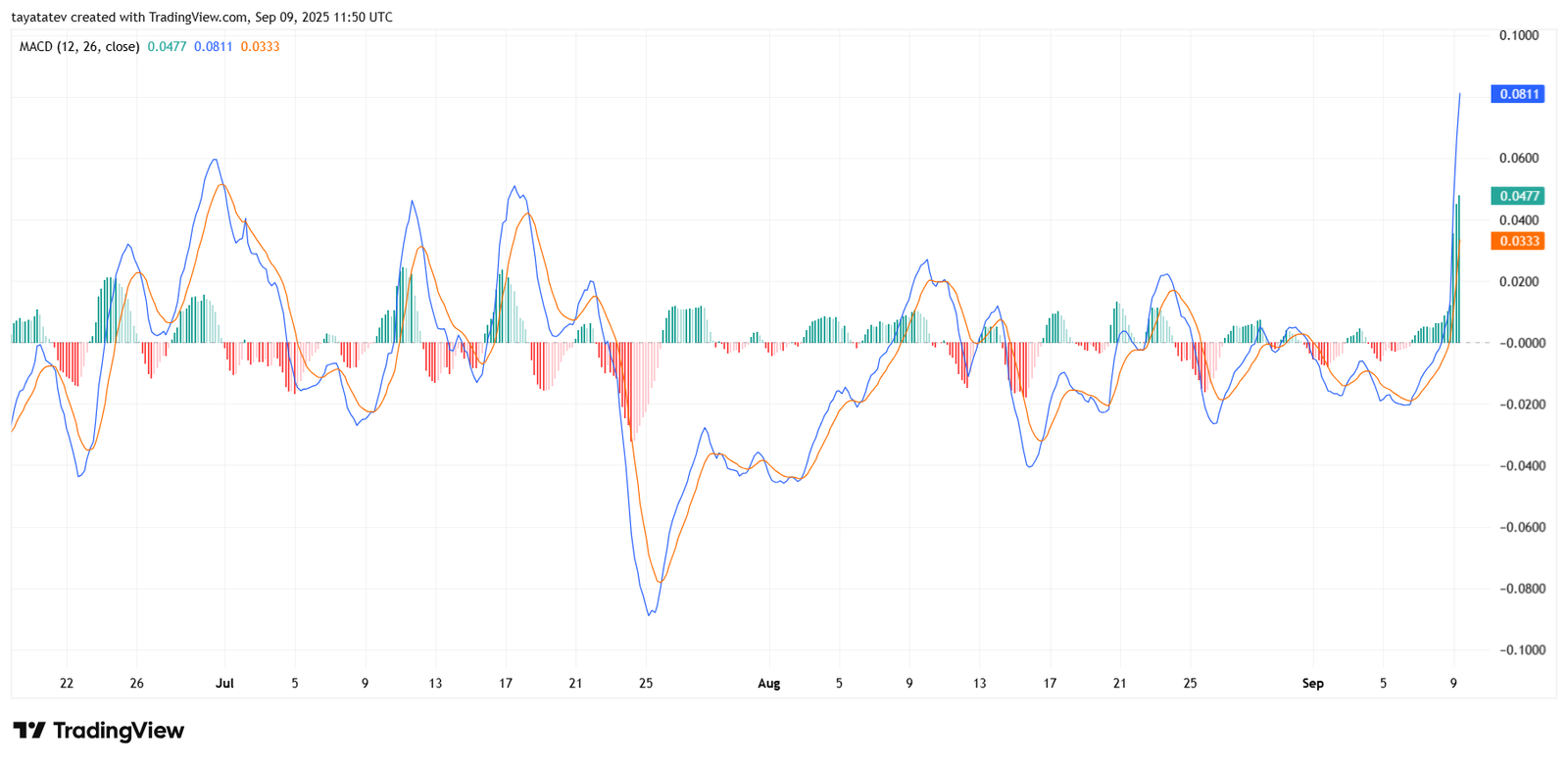
Previously, MACD oscillated tightly around zero with frequent whipsaws. Now the lines have separated with a steep positive slope, showing impulse rather than noise. As long as MACD stays above zero and the signal line continues to rise, upside momentum remains in control on this timeframe.
However, such vertical spikes usually cool. Expect the histogram to contract first; shrinking green bars would signal the start of digestion even without an immediate bearish cross. A healthy reset would see MACD drift toward the signal line and then turn back up while holding above zero. A full loss of the zero line would warn that the breakout was a short-lived squeeze.
KAITOUSDT 4h RSI: momentum regime shifts, risk of near-term cool-off
RSI (14) spiked to the high 80s and now prints around 79, its strongest 4-hour reading on this chart since early summer. The oscillator cleared 70 decisively and separated from its signal average near 63, which confirms impulsive upside momentum rather than a routine bounce. In bull regimes, such overbought prints often mark power, not immediate tops, especially if RSI holds above 50 on subsequent dips.
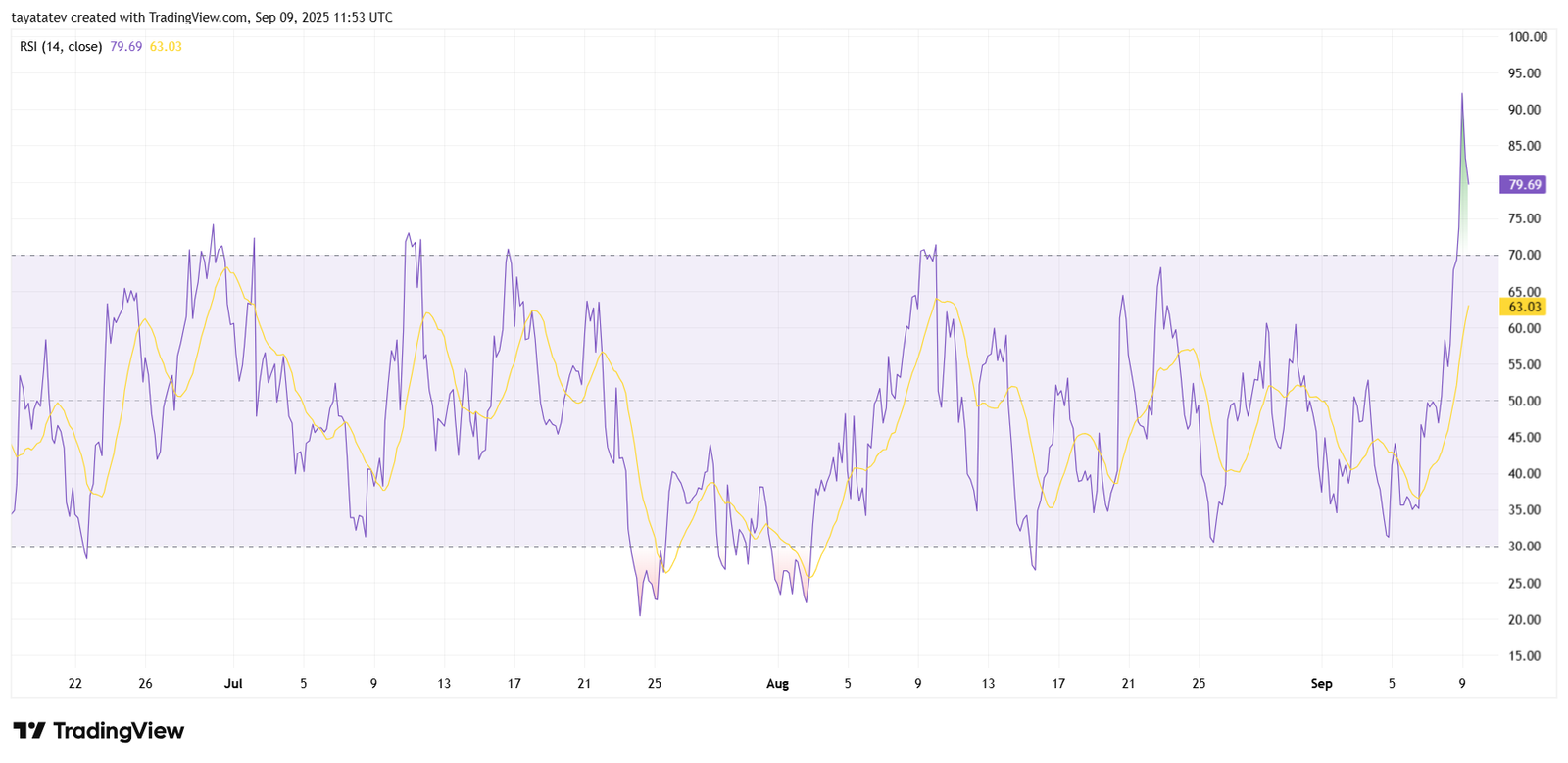
However, the vertical rise raises pullback risk. After similar surges earlier in the period, RSI tended to compress and revisit the 50–60 band before the trend made its next leg. Therefore, a constructive consolidation would show RSI cooling toward 60–65 while staying above 50; that behavior would keep the bull range intact and support a higher-low setup on price. Conversely, a quick drop back under 50 would warn that the breakout failed and momentum has reverted to neutral.
In short, the RSI signals a regime change to positive momentum on the 4-hour timeframe. Now watch whether it can maintain a bullish range—lows above 50 and recurrent pushes above 70—during the next digestion phase. That behavior would align with the earlier price breakout and favor continuation attempts after volatility settles.


