


Anchor Protocol was launched in March 2021 by Terraform Labs on the Terra blockchain. Its idea was simple but powerful: let users deposit TerraUSD (UST), an algorithmic stablecoin, and earn a fixed yield of nearly 20%. Borrowers could use LUNA and other crypto assets as collateral to access loans, while depositors enjoyed steady returns.
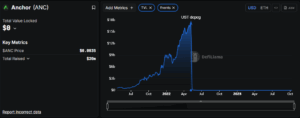
This promise of stability made Anchor the centerpiece of the Terra ecosystem. By early 2022, the protocol had become one of the largest lending platforms in crypto. According to DeFiLlama data, its total value locked (TVL) reached nearly $17 billion in May 2022, accounting for more than 70% of all circulating UST. Anchor was hailed as a model for predictable returns in decentralized finance, and its governance token, ANC, traded above $6.
UST Depeg Triggered $17 Billion Exit and Anchor’s Rapid Collapse
Anchor’s success depended entirely on UST’s ability to maintain its one-dollar peg. In May 2022, that peg broke. As UST depegged, investors rushed to withdraw funds from Anchor, draining billions from the protocol in just days. By the end of May, its TVL had crashed below $30 million.
Anchor’s reserves, which had already been under pressure due to declining borrowing demand, quickly evaporated. Even after proposals to inject $450 million into the yield reserve and reduce interest rates, the exodus could not be stopped. Borrowers faced more than $1 billion in liquidations, and platforms like Celsius and StableGains, which had customer funds in Anchor, suffered losses of hundreds of millions.
The collapse of UST and LUNA erased the foundations of Anchor’s business model. The “risk-free” 20% yield was revealed as unsustainable, and with no stable collateral to support it, the protocol’s purpose vanished almost overnight.
ANC Token Now Trades at Fractions of a Cent With No Liquidity
Anchor Protocol still exists in name, but not in function. The ANC token trades at about $0.0029, giving it a market capitalization of roughly $1 million. At its height, the token had reached $6.17, meaning it has lost more than 99.9% of its value.

Liquidity has all but disappeared. The 24-hour trading volume is effectively zero, showing that almost no investors are buying or selling the token. This makes ANC extremely volatile, as even minor trades can cause large price swings. The token now ranks around 2,585th among all cryptocurrencies, far from its days as a leading DeFi asset.
On technical charts, ANC continues to trend downward. Exponential moving averages remain stacked against the price, and the Relative Strength Index hovers near oversold conditions. However, these signals carry little weight in a market where volume is almost nonexistent.
DeFiLlama data shows Anchor’s TVL is now $0. For a protocol that once held nearly $17 billion, the complete wipeout shows its fall from dominance.
Failed Governance Fixes Could Not Save Anchor Protocol’s Business Model
Before the collapse, there were attempts to adjust Anchor’s model. Governance proposals suggested lowering yields from 20% to a variable range closer to 4–5%. Another proposal, called “veANC,” aimed to redesign tokenomics by rewarding long-term ANC holders. These measures, however, came too late. By the time they were introduced, trust in UST and Terra had already collapsed.
Since 2023, there have been no credible signs of new development or community revival. Unlike other failed projects that later rebranded or pivoted, Anchor has seen no migration to Terra 2.0 or integration with new stablecoin systems.
In practical terms, Anchor Protocol is dead. Its primary use case—paying depositors high yields on UST—ended with the collapse of Terra. Without UST or an alternative stablecoin, the platform has no functioning product.
The ANC token lingers on exchanges, but a token without an active protocol has limited meaning. In recent years there have been no major development updates, governance decisions, or community revival plans. Anchor functions more like a ghost of the Terra ecosystem than a live project.
Revival Requires Stablecoin Backing, But No Plans Exist Today
The chances of Anchor Protocol returning to its former scale are minimal. Its original model depended on UST, which no longer exists in its stable form. Without a stablecoin to support fixed yields, Anchor has no functional base to rebuild on.
There have been no major development updates, governance proposals, or signs of a new team taking control since 2023. Unlike other failed projects that rebranded or pivoted, Anchor has not launched on Terra 2.0 or migrated to another chain. Its TVL remains at zero, and liquidity in ANC trading is nearly nonexistent.
For ANC to rise again, it would require more than speculative trading. It would need a complete redesign of the protocol’s tokenomics, integration with a stable and widely used asset, and renewed trust from the crypto community. As of now, none of these conditions are visible.
In short, while tokens can sometimes experience short bursts of speculative activity, the fundamentals behind Anchor Protocol suggest that a sustained future rise is highly unlikely.


