



Can Dogecoin add native zero-knowledge proof checks and unlock Layer-2 apps? That question led today’s coverage. Several outlets resurfaced the DogeOS proposal to add an opcode so Dogecoin nodes can verify succinct ZK proofs. They explained it as a way to anchor off-chain execution while keeping the base chain simple.
The pitch is straightforward: verify proofs on-chain, let rollups post results, and settle activity to Dogecoin. As a result, developers could build EVM-style experiences off-chain and finalize to DOGE without custom bridges. The idea emphasizes constraints on proof size and cost to avoid slowing block validation.
Importantly, nothing shipped today. Reports describe the ZK plan as under discussion with no activation path, vote, or merge target. The renewed attention lands months after the initial July briefings from DogeOS and follow-on explainers across crypto media.
What changes if the proposal advances
First, Dogecoin would gain a native hook for proofs rather than relying on external bridges. That matters because bridges introduce operational and security risk; proof verification on-chain can reduce custom glue code. Therefore, the protocol change is framed as a minimal base-layer tweak that enables more complex logic elsewhere.
Second, the path could support rollups that use Ethereum tooling but settle to Dogecoin. Media today highlighted that developers could reuse existing stacks and standard audit patterns while tapping DOGE’s brand and miner base. The focus remains on practicality, not hype.
Third, any new “proof-posting” transaction type could alter fee composition over time. Analysts note that Dogecoin’s fee base is modest; added proof traffic might lift miner incentives if adoption arrives. However, that outcome depends on governance, engineering, and real usage—not headlines.
No new releases or foundation posts today
There is no Dogecoin Core release dated Sept. 27, 2025. The project’s public releases page still shows v1.14.8 as the latest tagged build, published in December 2024. Consequently, there were no code changes shipped today that affect node operators or users.
Official community channels also stayed quiet. The Dogecoin Foundation’s blog lists its most recent 2025 entry as April 10, 2025, with no Sept. 27 update. As a result, there are no new foundation directives, network settings, or governance notices today.
Finally, developer forum threads continue to reference 1.14.8 guidance for operators, but they do not announce new binaries today. That aligns with the releases page and reinforces the absence of a fresh cutover.
Dogecoin’s non-price story is a renewed spotlight on a ZK-proof opcode that could enable L2 settlement anchored to DOGE. The idea remains a proposal with no activation schedule. Meanwhile, official channels and the Core repo show no new releases or announcements dated Sept. 27.
Whales trim holdings as 1–10M DOGE cohort offloads 40 million
Forty million DOGE moved out of whale wallets in the past 24 hours, according to Ali (@ali_charts) citing Santiment’s cohort data for addresses holding 1 to 10 million coins. The chart shows a clear drop in that band while price action chopped, signaling distribution from larger holders rather than quiet accumulation. Source: Ali on X, Santiment.
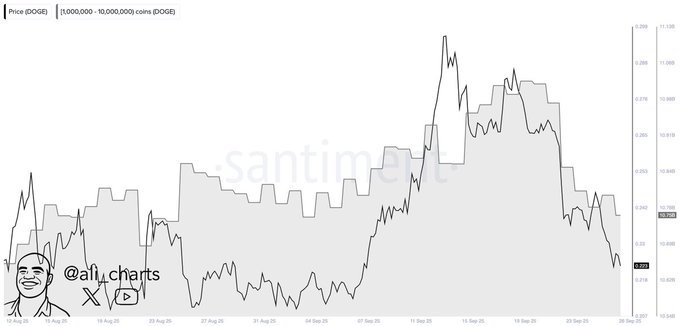
This shift tightens resting liquidity and, in turn, can amplify intraday swings as market makers adjust inventories. Moreover, when the 1–10M DOGE cohort reduces exposure, exchange order books typically feel the change first because these wallets control meaningful flow relative to retail. The move therefore points to a short-term supply overhang until the market absorbs it.
However, the impact depends on where the coins went. If transfers landed on exchanges, immediate sell-side pressure rises; if they moved OTC or to smaller cohorts, supply disperses and the effect softens. Consequently, follow-through hinges on subsequent on-chain prints—exchange inflows, cohort rotation, and whether large wallets resume net additions.
DOGE wave count flags a $0.20 pivot as diagonal unfolds
An Elliott Wave read from Man of Bitcoin shows Wave 3 likely forming as a diagonal on the four hour DOGEUSD chart. The schematic places a descending trendline overhead and marks $0.20 as the first decision point. A firm break and hold below that level would argue that the larger Wave b remains incomplete to the downside.
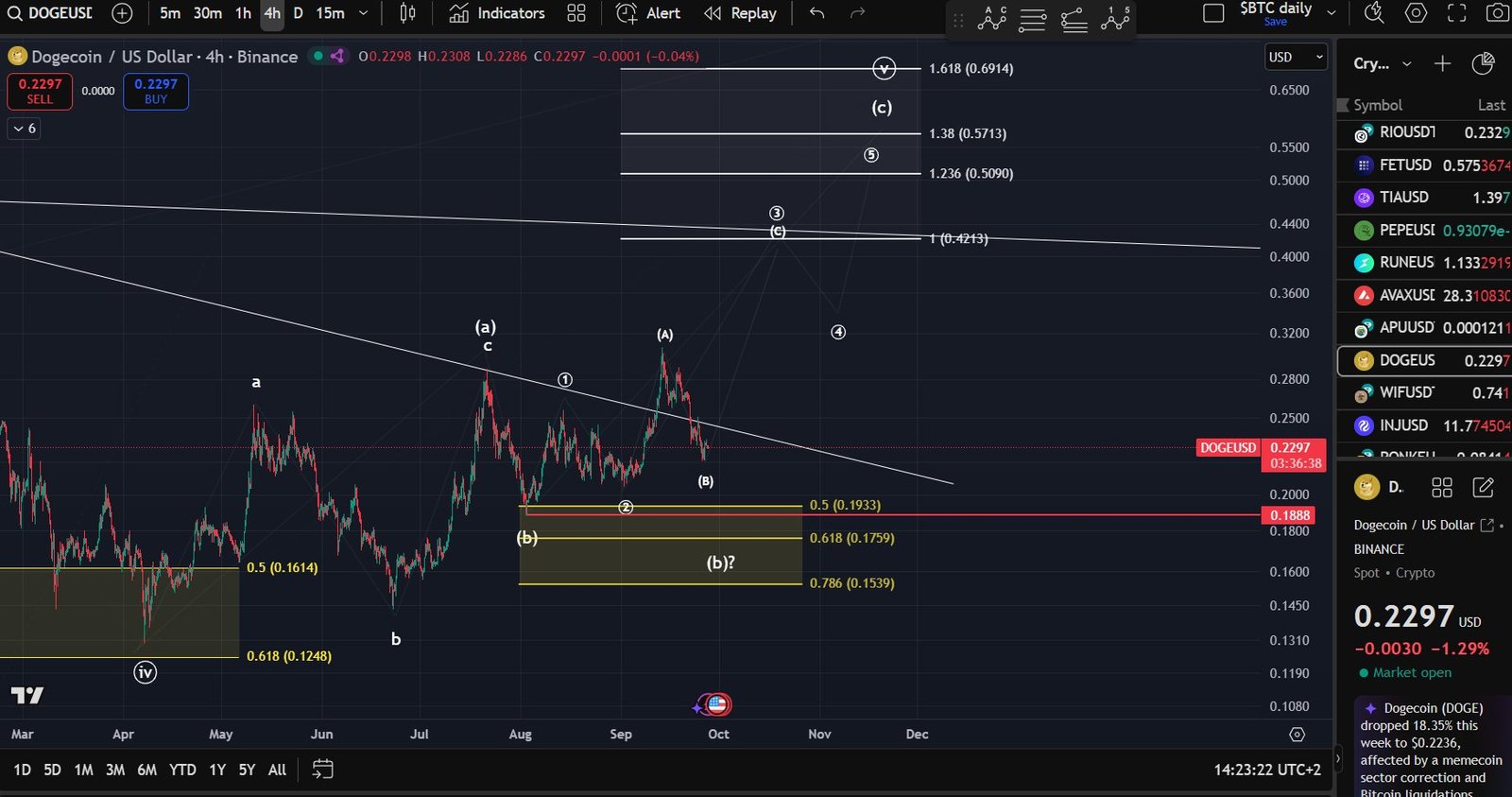
The chart outlines a retracement box beneath spot that clusters three Fibonacci levels around $0.1933, $0.1759, and $0.1539. As price approaches this zone, traders typically reassess whether momentum is carrying a corrective leg or setting a base for the next impulsive push. Therefore, reactions inside this band will help confirm or reject the active diagonal.
Upside reference levels appear as Fibonacci extensions at $0.5090, $0.5713, and $0.6914, aligned with a scenario where the diagonal resolves higher after validation. However, the trendline capping prior rallies remains the near term constraint. Until candles reclaim and hold above that line, the $0.20 pivot and the retracement box guide the risk map.
DOGE tests weekly channel resistance; watch follow-through above the trendline
Emilio Crypto Bojan’s weekly chart shows Dogecoin pressing the upper boundary of a rising channel that has capped advances since spring. Price pulled back to the mid-channel area and now approaches the same diagonal that rejected prior attempts. Therefore, the next weekly closes matter more than intraday spikes.
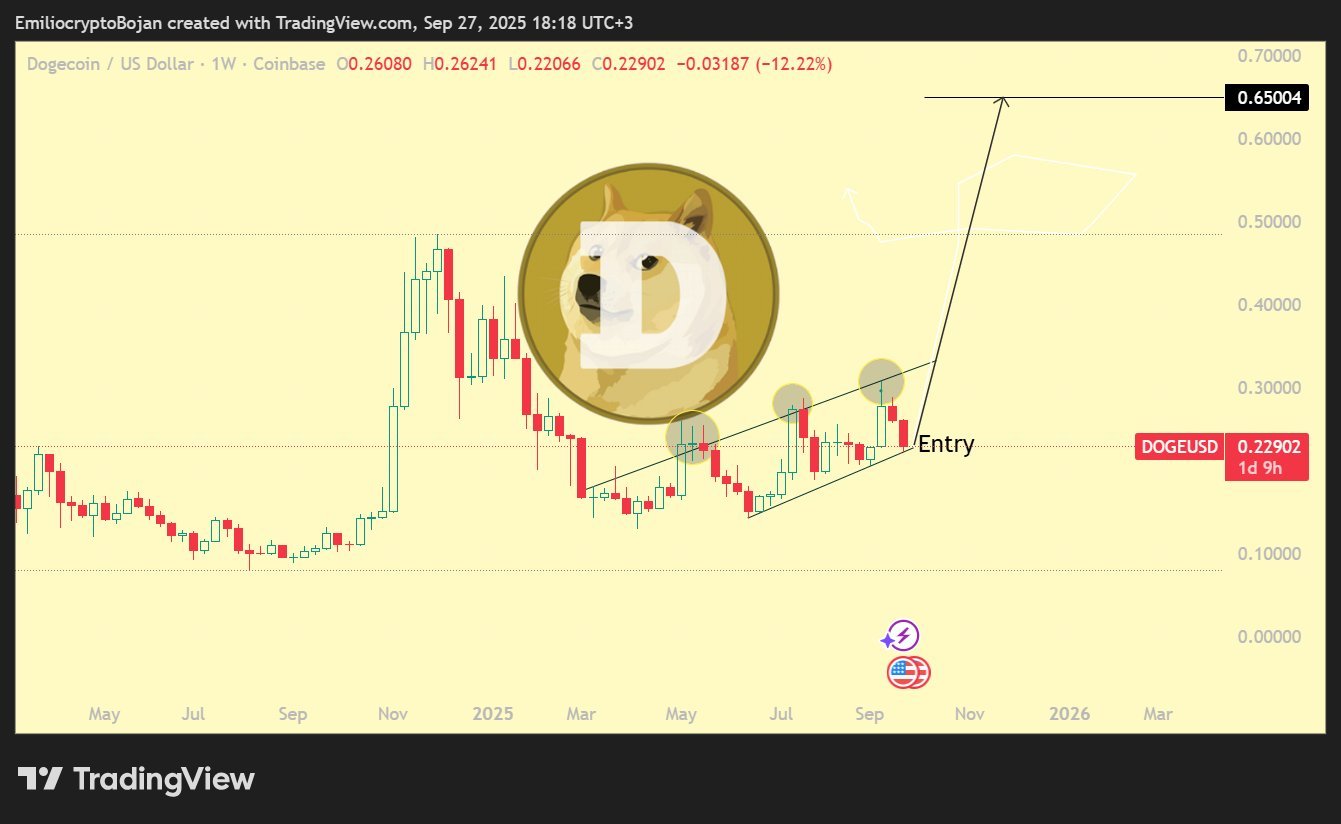
The chart maps a bullish path that requires a decisive breakout and weekly hold above the channel top. If candles close above that line with expanding volume, the move would confirm strength rather than another tap-and-fade. Until then, the structure remains a range within an orderly channel, and the “entry” tag on the graphic sits near the current mid-zone.
Targets on the graphic extend toward the 0.50–0.65 area, but those projections depend on validation after the break. Conversely, failure at the boundary would keep the pattern intact and return price toward the channel median. As a result, confirmation—via closes and participation—sets the tone for the next leg rather than single-day moves.


