



Pavel Durov says French intelligence asked Telegram to censor Moldova election content in 2024. He says the request came with an offer to “say good things” to the judge in his French case. Durov says he refused.
He wrote that Telegram first removed posts that “clearly” broke its rules. Those removals, he says, followed the platform’s terms of service. They were unrelated to politics.
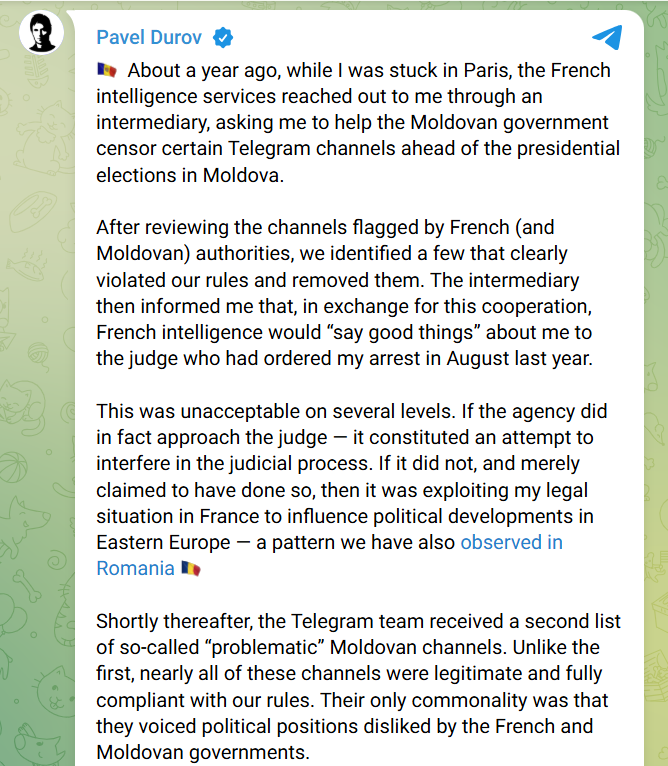
Then the pressure escalated, according to Durov. He says officials sent a second list focused on Moldova election channels. He says those channels complied with Telegram rules and voiced political views that authorities disliked.
Pavel Durov, Telegram, Censorship: What He Says Happened
Durov described two separate lists from authorities. The first targeted clear rule violations on Telegram. He says the team acted on that list under normal policy.
The second list, he says, was different. It named Moldova election channels that, in his view, followed Telegram rules. He says the common theme was political speech, not policy violations.
“Shortly thereafter, the Telegram team received a second list of so-called ‘problematic’ Moldovan channels. Unlike the first, nearly all of these channels were legitimate and fully compliant with our rules. Their only commonality was that they voiced political positions disliked by the French and Moldovan governments. We refused to act on this request,”
wrote Durov.
Moldova Election, Privacy, Free Speech: The Second List
Durov says the second list tested the line between policy enforcement and politics. He says Telegram treats political speech as protected unless it breaks rules. Durov maintains that the listed channels did not.
He also shared a broader statement on elections and speech. He argued that censoring political content during a vote undermines the vote itself. Durov framed the issue as a simple choice.
“You can’t ‘defend democracy’ by destroying democracy. You can’t ‘fight election interference’ by interfering with elections. You either have freedom of speech and fair elections — or you don’t.”
The Moldova election episode, he says, mirrors other pressure points. He ties it to past requests from European authorities. He highlights attempts to shape online debate during election periods.
France, EU Proposal, Encryption: Wider Context
The claims arrive amid Durov’s legal fight in France. He was arrested in August 2024, drawing a strong response from the crypto community and civil-liberties groups. Coverage linked the case to platform liability and privacy rules.
In May 2025, Durov cited a similar push involving Romanian election content. He says French intelligence also pressed for removals there. He says Telegram declined again.
The backdrop includes an EU proposal to monitor all messages, including encrypted chats. By 2025, 19 member states backed that approach. Privacy advocates warned it would weaken encryption and expand state access to user data.
Telegram, Encryption, Privacy: No Backdoors, Says Durov
After the 2024 arrest, Durov sharpened Telegram’s stance on privacy. He said the platform will not hand over encryption keys. Durov also said it will not build a backdoor for state access.
He added that Telegram would exit jurisdictions rather than compromise encryption. Durov named France among places it would leave if forced. He positioned this as a policy line, not a negotiation.
In June, Durov issued a warning about France and censorship. He linked ongoing pressure to broader social risks. Supporters in the crypto sector amplified his statements and tied them to free-speech debates.
France, Privacy, Telegram: Source And Reaction
The source for these claims is Pavel Durov’s own Telegram post. It names French intelligence as the requester and references Moldovan interests. It centers on Moldova election channels in 2024.
Industry reaction followed earlier developments in 2024 and 2025. The crypto community highlighted privacy, encryption, and speech issues on Telegram. Civil-liberties groups focused on state requests during elections.
Related commentary pointed to the EU scanning proposal and its impact on encryption. The discussion remains active as member states debate privacy and platform rules. The dispute continues across courts, parliaments, and policy forums


