



Aster made headlines after its ASTER token jumped more than 2,000% in its first week, lifting its market cap above $3 billion. The decentralized exchange also surpassed its rival Hyperliquid in daily fees and volume. But what is Aster, and why are traders rushing in?
What is Aster?
Aster launched in September 2025 as a decentralized exchange (DEX). It supports spot trading but focuses on perpetual futures — contracts that let traders speculate on prices without expiry dates. Positions stay open as long as collateral is maintained, allowing traders to go long or short depending on market expectations.
Aster launched across BNB Chain, Ethereum, Solana, and Arbitrum, giving users from multiple ecosystems access to the same platform.
The platform allows up to 1,001x leverage, compared with Binance’s 20x and Hyperliquid’s 40x. Such leverage enables large positions with little collateral but exposes traders to instant liquidation from small price swings.
Aster also introduced hidden orders, which conceal size and direction until execution. This reduces front-running but limits transparency for other traders. The platform further accepts yield-bearing collateral, allowing assets posted as margin to continue earning staking or lending income.
Recently, the exchange faced technical issues. A glitch in its XPL perpetual contract market caused abnormal price spikes and forced liquidations.
Token Surges 2,000%, Market Cap Tops $3 Billion
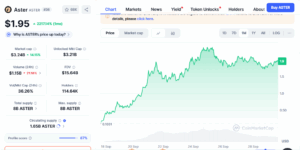
The ASTER token debuted at about $0.08 and quickly reached an all-time high of $2.42 before settling near $1.95. That rally pushed its market capitalization above $3 billion, ranking it 36 on CoinMarketCap.
Speculation that Aster was backed by Binance fueled its early rise. On September 27, Binance co-founder Changpeng “CZ” Zhao clarified that Binance has no official role in Aster. His link is limited to YZi Labs, an investment firm with a minority stake, and his personal advisory role.
Despite its rapid rise, the token has already shown volatility. Aster price has dropped more than 20% from its all time high, including a 4% dip after CZ’s clarification.
ASTER has a maximum supply of 8 billion tokens, with 53.5% allocated to community rewards and airdrops. Stage 2 of its airdrop program — 320 million tokens, or 4% of supply — ends in October 2025. Unclaimed tokens will return to the rewards pool.
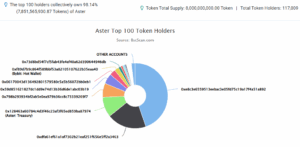
Ownership is highly concentrated. On-chain data shows six wallets control about 96% of supply, with one wallet holding nearly 45%. This raises concerns about governance and potential market instability.
Aster Boosted BNB Chain Fees Above Solana
In late September, the protocol generated more than $25 million in daily fees and over $46 billion in 24-hour trading volume, making it the second-highest fee-earning protocol across all blockchains, behind only Tether.
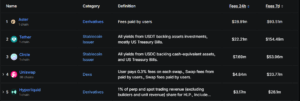
The activity pushed BNB Chain ahead of Solana in daily fee revenue, with BNB Chain collecting more than $1.4 million in a single day.
Aster trading also overtook Hyperliquid in both daily revenue and 24-hour trading volume during its first week. On some days, Aster logged $24.7 billion in trading versus Hyperliquid’s $10 billion, while collecting 10 times more in fees ($14.3 million vs. $1.1 million).
Hyperliquid, however, continues to lead in overall volume and long-term adoption. Structurally, Hyperliquid operates on its own blockchain with full transparency, while Aster relies on existing networks, favors hidden orders, and plans to launch its own Aster Chain.


