


The SEC is exploring a path to let blockchain-based equities trade on approved crypto exchanges. The plan would allow trading in tokenized stocks that mirror publicly listed shares. Sources describe the work as early stage but active.
The exploration centers on how these tokenized stocks would meet investor-protection, disclosure, and surveillance standards. Staff are weighing how existing equity rules could apply to tokens that represent the same underlying shares. They are also assessing custody, transfer, and record-keeping on blockchains.
This SEC review sits alongside broader interest in tokenization across markets. Policymakers continue to examine how on-chain records can coexist with national market system requirements. As a result, the agency is comparing traditional post-trade plumbing with distributed ledgers for accuracy and auditability.
Tokenized stocks on crypto exchanges: where trading is starting
Several venues have begun offering tokenized stocks outside the US. Robinhood introduced tokens referencing hundreds of US shares for eligible European users. The products track listed equities while settling on crypto rails. Trading windows extend beyond standard market hours.
Kraken rolled out its own tokenized stocks lineup for select clients. The exchange lists large-cap names with weekday availability. These pilots give early data on liquidity, spreads, and settlement finality for blockchain-based equities.
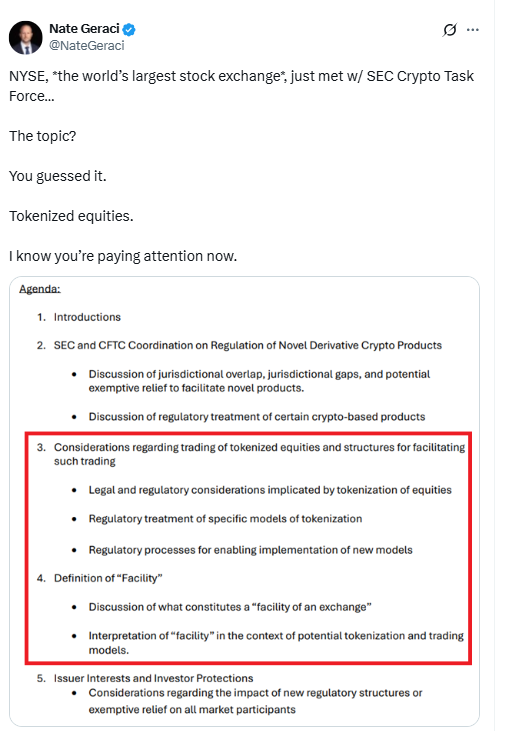
These crypto exchanges place emphasis on compliance checks, asset backing, and redemption logic. They publish documentation on how token supply maps to underlying shares. They also outline corporate-action handling for splits, dividends, and voting.
Citadel Securities’ warning on tokenized securities
Traditional market makers have voiced concerns. Citadel Securities urged regulators to ensure tokenized securities compete by delivering real efficiency, not regulatory gaps. The firm wrote that “tokenized securities must achieve success by delivering real innovation and efficiency to market participants, rather than through self-serving regulatory arbitrage.”
The letter pressed for parity with core equity rules, including best execution, market-data obligations, and fee transparency. It also flagged risks of liquidity fragmentation if tokenized stocks trade on separate books. Therefore, alignment with surveillance and reporting standards remains central.
Industry coverage the same week amplified these themes. Commentators highlighted the need for consistent clearing, settlement, and proxy flows. They also pointed to cybersecurity and reconciliation controls for blockchain-based equities.
Nasdaq rule filing and market structure for tokenized stocks
Nasdaq has pursued a rule filing process to list tokenized securities under familiar exchange standards. The approach aims to embed on-chain settlement into existing surveillance and corporate-action frameworks. It also anticipates coordination with central securities depositories for record integrity.
The Nasdaq rule filing focuses on keeping price discovery within the national market system. It stresses that tokenized stocks should not create parallel markets with opaque pricing. Instead, they should operate under the same quoting, routing, and trade-through logic as traditional shares.
This plan would also define issuer disclosures for on-chain settlement mechanics. It would require clear documentation for minting, burning, and redemption of tokens that track listed equity. That way, investors can understand how blockchain-based equities connect to the underlying securities.
Tokenization market size: $31 billion RWA, small but rising equity slice
The broader tokenization market of real-world assets (RWA) has surpassed $31 billion in value. Most of that sits in tokenized US Treasuries and private credit. However, tokenized stocks remain a small but growing segment.
Over recent months, on-chain equity value nearly doubled from a low base. Transfer counts and active addresses increased as more venues listed equity tokens. These trends suggest more experiments in blockchain-based equities and clearer reporting on flows.
Analyst notes compare this rise to early DeFi phases, yet they stress rulebook alignment. Growth now concentrates where disclosures, custody, and redemption terms are explicit. As pilots mature, data on spreads, depth, and volatility for tokenized stocks is expanding.
Policy signals, names, and numbers to watch
Regulatory voices continue to shape the timeline. Public remarks from commissioners invited dialogue on tokenization and market safeguards. Staff consultations with venues and issuers remain ongoing.
Market participants are watching the SEC, Nasdaq, Citadel Securities, Robinhood, and Kraken. They track filings, comment letters, and product notices tied to tokenized stocks. They also monitor operational metrics like settlement times and reconciliation accuracy.
Finally, researchers cite the $31 billion headline for RWA with equities still near 2% of that total. They point to a rapid month-over-month climb from a smaller base. These figures frame the current scale of blockchain-based equities against the larger tokenization market.


