



Hedera ended its Sibos 2025 run on October 2 in Frankfurt, marking the fourth and final day of its booth operations. The team positioned itself at stand DISM67, where it presented live demonstrations. Focus areas included tokenization, cross-border payments, 24/7 treasury functions, digital identity, and AI-driven solutions. The Sibos event program listed Hedera in the Discover Zone from September 29 to October 2, giving the network a high-visibility presence among enterprise audiences.
The official Sibos organizers noted over 12,000 finance professionals attended this year’s conference. Hedera used this setting to emphasize its push into regulated use cases and institutional-grade applications. The format allowed Hedera to meet directly with banks and service providers seeking settlement and credentialing solutions.
Developer Update: Dynamic Address Book Rollout
Hedera issued a developer update tied to the upcoming Dynamic Address Book. The network announced that node account IDs will undergo structural changes when the consensus node software v0.68 launches in December 2025. Governance milestone HIP-1299 supports the shift, setting the framework for technical updates across the ecosystem.
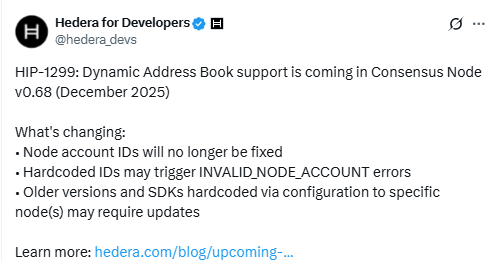
The announcement urged developers to review dependencies where static node identifiers may be embedded in their applications. Adjustments will be needed to maintain performance once the new software is released. Hedera pointed out that this is part of its broader effort to improve flexibility and resilience in network operations.
Teams working with Solidity contracts or Hedera Token Service should begin validating their applications against the revised address book behavior. Hedera cautioned that HTS token transfers and other contract interactions could be affected without early testing, making preparation essential for smooth integration.
Context: Hedera’s Enterprise Push
Hedera’s Sibos campaign reflected its larger strategy to target enterprise adoption. The booth featured demonstrations on tokenization, payments, micropayments, identity verification, and AI-driven services. These align with Hedera’s positioning as a platform for regulated environments and large-scale institutional use cases.
The Sibos theme for 2025 centered on “the next frontiers of global finance.” Hedera’s showcase fitted this narrative, giving banks and custodians a direct look at settlement systems, real-time treasury, and asset issuance pilots running on its network.
Community and partner posts during the event confirmed Hedera’s participation in panel discussions and booth sessions. These cross-references added further context to the stand’s activities, highlighting Hedera’s effort to project reliability and regulatory alignment in front of financial institutions.
Crypto.news flags HBAR “breakout” setup amid ETF chatter
Crypto.news reported that Hedera’s HBAR “bounced from September lows,” and, moreover, chart watchers now point to a falling-wedge pattern with a double bottom near $0.2050. The outlet added that traders “eye a push toward $0.30+,” framing the move as momentum building into an “ETF season.”
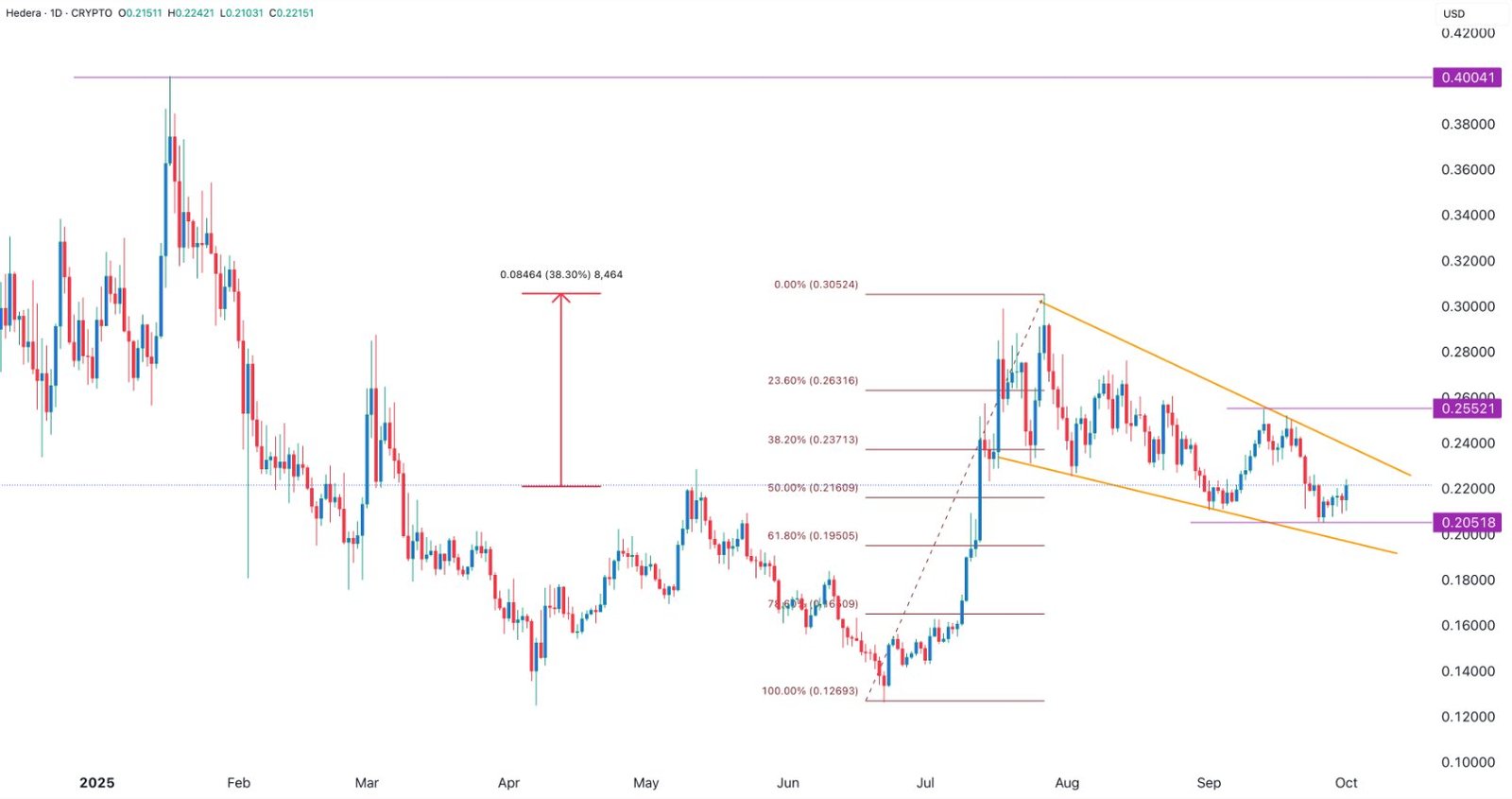
Furthermore, the post highlights a claim that the SEC is “pending review of a Grayscale Hedera ETF,” which, in turn, the report says could add fuel to sentiment. However, the note presents this as context for trader discussion rather than an approved product. It attributes the near-term setup to pattern recognition on daily candles and a sequence of higher lows off September levels.
In addition, the shared chart illustrates Fibonacci retracement bands and a wedge converging into October. As a result, the narrative centers on whether HBAR can break the wedge’s upper trendline on expanding volume. Finally, the post frames the pattern as the technical driver, while ETF headlines function as a secondary catalyst discussed by market participants.
Analyst maps HBAR “mini re-accumulation” with RSI squeeze on weekly chart
Crypto trader Maelius shared a weekly HBAR/USDT chart that frames price inside a “mini re-accumulation zone” after a sharp rally and cooldown. The view places higher-timeframe support in a broad green band beneath current levels and shows price consolidating just above it. The structure follows a prior downtrend break and a series of range tests, implying supply absorption rather than trend continuation.
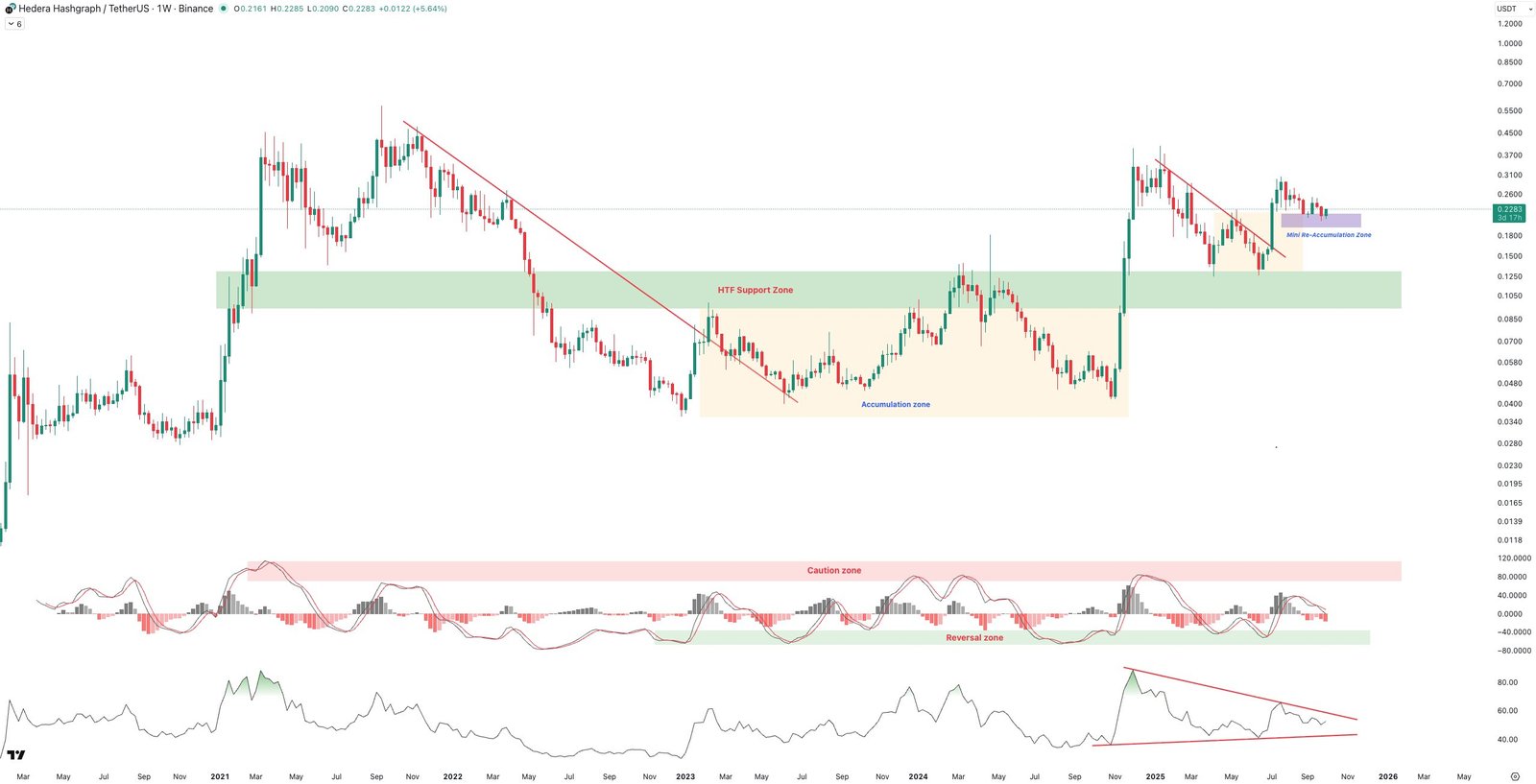
The chart overlays MACD cycles with labeled “reversal” and “caution” regions. Recent weekly bars sit near the midline as histogram momentum fades, which matches a pause after the summer advance. Because MACD hasn’t reclaimed the upper band, the setup still requires confirmation from trend and momentum before a directional move.
At the bottom, the weekly RSI forms a contracting triangle with lower highs and higher lows, signaling a volatility squeeze. Maelius says a breakout in RSI would validate the next push higher; however, the signal has not triggered yet. Therefore, the immediate focus is whether RSI can break its downtrend line while price holds the re-accumulation band, turning consolidation into continuation.
HBAR daily RSI points to improving momentum
The 14-day RSI just reclaimed the neutral 50 line (≈50.2) while its moving average trails near 44. This crossover signals momentum improvement after September weakness. Moreover, the slope of the RSI has turned up for the first time since late August, indicating buyers are regaining control of near-term swings.
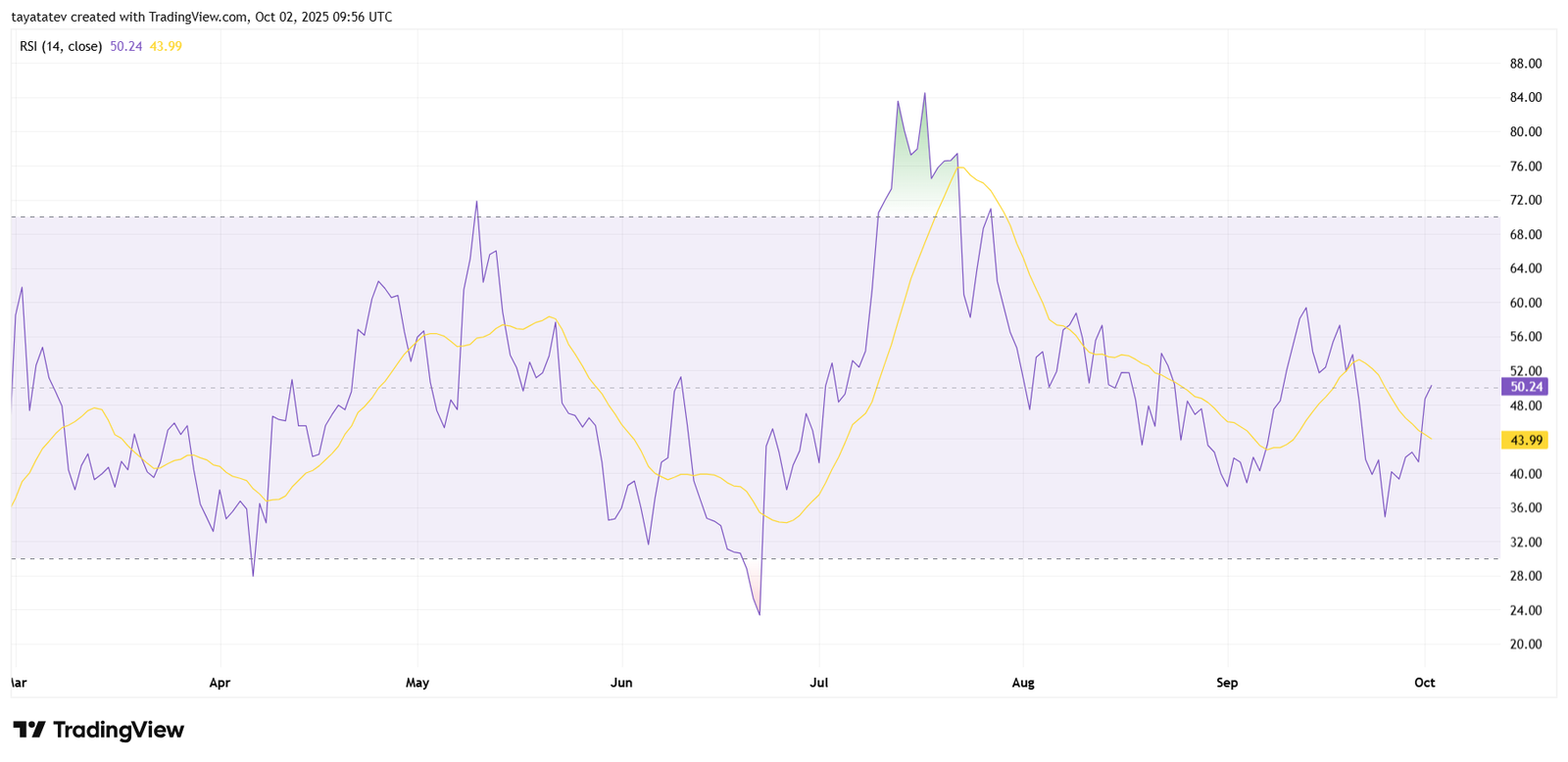
Previously, in July the RSI spiked well above 70 and then rolled over into August, creating a visible momentum peak. Subsequently, RSI made lower highs through September while staying mostly below 50, which confirmed a cooling phase. Now, with RSI back above both 50 and its average, the gauge exits that corrective regime and returns to a neutral-to-constructive posture.
From here, watch the 55–60 band as the next momentum hurdle; daily rallies often stall there during early recoveries. Conversely, a drop back under 45–46 would show fading impulse and revive rangebound behavior. In short, the indicator currently favors stabilization with early upside momentum, yet it still needs follow-through above 55 to establish a stronger trend.


