


Charles Hoskinson, founder of Cardano (ADA), acknowledged that the blockchain has lagged behind other networks in decentralized finance (DeFi). Speaking in an interview at the Token 2049 event, Hoskinson said Cardano “misstepped on the DeFi side” but outlined a plan centered on its Midnight protocol and Bitcoin-linked DeFi initiatives.
Cardano Holds Less Than 0.4% of DeFi Liquidity
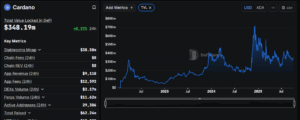
According to DeFiLlama, Cardano holds around $346 million in total value locked (TVL) — placing it outside the top 10 DeFi blockchains.
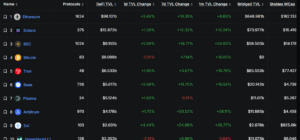
By comparison, Ethereum leads the market with $98.1 billion, followed by Solana ($12.8 billion) and BNB Chain ($9.1 billion). This means Cardano controls less than 0.4% of total DeFi liquidity, underscoring Hoskinson’s acknowledgment that the network trails its Layer-1 competitors.
Hoskinson addressed the shortfall directly:
“We did a great job building a decentralized ecosystem with on-chain governance. But we misstepped on DeFi, and everyone said the numbers don’t look good.”
He added that network valuation depends on more than liquidity metrics, citing Cardano’s governance framework and its community of 1.3 million staked wallets, according to Input Output Global (IOG).
Cardano Turns to Midnight to Regain DeFi Ground
Hoskinson said the Midnight network aims to address Cardano’s infrastructure and adoption challenges. The project’s whitepaper describes it as a sidechain emphasizing privacy and interoperability with a dual-token system:
NIGHT, a fixed-supply utility and governance token representing 24 billion units.
DUST, a shielded resource generated by holding NIGHT and used to pay transaction fees.
Midnight is currently in testnet. Its Glacier Drop airdrop distributes tokens to holders across Bitcoin, Ethereum, Solana, Avalanche, XRP, and Cardano. According to Midnight’s official blog, about 8% of NIGHT’s total supply has been claimed.
Further Reading: Charles Hoskinson is Blatantly Promoting Midnight Airdrop — Why?
Hoskinson said integrations with Brave, Blockchain.com, and Bitcoin.com have expanded the network’s potential reach, though those partnerships have not yet shown measurable on-chain activity.
Hoskinson described Bitcoin DeFi as a significant development area for Cardano, citing compatibility between both blockchains’ UTXO models.
“We’re UTXO, Bitcoin’s UTXO. You can write Cardano smart contracts that compile and run on Bitcoin. The model allows both networks to verify ownership through hash-locked transactions, enabling cross-chain operations without wrapped tokens or centralized bridges.”
He said.
The statement aligns with Cardano’s interoperability focus, though no live cross-chain execution environment has yet been deployed.
Treasury and Governance Funding Underway
Hoskinson said Cardano’s on-chain treasury, opened through recent governance upgrades, now holds roughly 1.5% of ADA’s total market capitalization. This gives the community significant funding authority through on-chain votes. Under the Voltaire framework, any holder can propose and vote on initiatives, provided they lock a 100,000 ADA deposit per submission.
He added that over 200 engineers continue to work across Cardano’s Layer-1 and Layer-2 ecosystems. The Hydra scaling solution has achieved throughput tests equivalent to more than 1,000× current mainnet capacity, though deployment timelines remain unspecified.


