



Cardano pushed core development forward today. Teams shipped a fresh Mithril update, progressed Plutus improvements, and confirmed the Hydra v1.0.0 tag for mainnet experiments. Meanwhile, Intersect highlighted SRE readiness work and live governance activity across committees and tooling.
Mithril update: decentralization and reliability
First, the Mithril team integrated the Haskell DMQ node in end-to-end tests. This step helps validate message queuing across components and reduces integration risk during rollouts. As a result, test coverage now reflects production paths more closely.
Next, engineers advanced Phase 1 of decentralizing configuration parameters. They exposed incremental database snapshots by epoch in the client and CLI. In practice, this lets operators fetch smaller, time-scoped artifacts and speeds recovery and sync.
Finally, the team ensured the signer initializes uniquely per epoch, fixed CI flakiness, and began refactoring the STM crypto library. These changes improve determinism and reduce intermittent failures. Consequently, pipelines run cleaner and signer behavior remains predictable.
Plutus progress: new types and faster decoding
Developers completed CIP-0153, which introduces a Value built-in type, pending costing. This addition aims to simplify value handling in smart contracts. Therefore, scripts can express asset logic with fewer workarounds.
Additionally, decoding improvements delivered measurable performance gains. Faster deserialization shortens validation paths and benefits contract execution. In turn, node operators and dApp backends see lower latency under load.
Moreover, the team updated specs and tests for BLS12-381 multi-scalar-multiplication under CIP-0133. This cryptographic work prepares advanced primitives for future use cases. The set targets inclusion in the next intra-era hard fork.
Hydra v1.0.0: mainnet experiments begin
The Hydra team tagged v1.0.0, enabling developers to deploy Hydra Heads on mainnet. This release is positioned for production-oriented testing. Therefore, builders can validate throughput-sensitive flows in real environments.
At the same time, documentation outlines known limitations such as partial fanout. By calling these constraints out early, teams can plan pilots with clear expectations. Consequently, feedback loops can focus on concrete gaps.
Furthermore, the tag aligns roadmap milestones with hands-on validation. As developers iterate, they can measure performance, report findings, and inform subsequent point releases. This cycle supports steady hardening before broader adoption.
Ecosystem and governance: steady operations and reviews
Essential Cardano’s latest weekly points to stable builder activity and on-chain metrics. It also references the Hydra 1.0.0 pre-release context. Together, these signals frame a week of tangible engineering outputs rather than narratives.
Concurrently, Intersect continues committee election processes and delivery assurance for treasury-funded work. This governance track keeps accountability visible to contributors. As a result, funded tools and services map to reviewed mandates.
In parallel, SRE notes emphasize readiness and operational hygiene. Teams maintain relays, pools, and tracing paths while migrating legacy analytics. Therefore, infrastructure remains aligned with upcoming node releases and community testing.
Cardano ADA breakout thesis: $0.90 as trigger, $1.88 as target
An analyst projects that a clean move above $0.90 could open a path toward $1.88 on ADA. The shared 12-hour chart outlines a months-long symmetrical triangle, Fibonacci levels, and a dotted roadmap for post-breakout price action. Source: Ali Charts, TradingView.
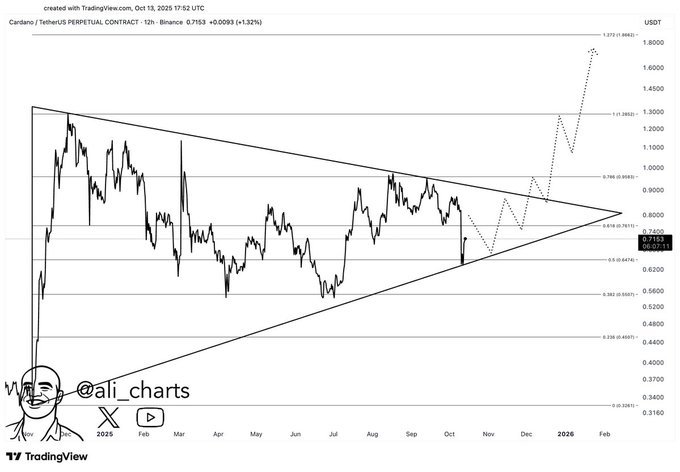
The pattern compresses price between descending highs and rising lows, forming a symmetrical triangle. This structure usually signals a volatility squeeze rather than a directional bias. Therefore, confirmation matters more than anticipation.
The chart anchors key Fibonacci retracements on the prior downswing, displaying intermediate checkpoints at ~$1.00 (0.786), ~$1.18 (1.0 extension), ~$1.31 (1.118), and ~$1.88 (1.272). The dotted path marks a breakout, a retest, and successive extensions.
Importantly, the timeframe is 12-hour candles on the ADA/USDT perpetual contract. As a result, intraday moves can overshoot levels before closing back inside the range. Traders typically look for candle closes and follow-through to validate breaks.
Bullish path: levels, structure, and confirmation
First, the thesis hinges on reclaiming and holding ~$0.90–$0.93, where the triangle’s upper trendline converges with recent supply. A decisive close above that area, followed by a firm retest that holds as support, would confirm momentum.
Next, the chart maps a stair-step advance. The initial waypoint sits near ~$1.00–$1.05. Then, if buyers maintain control, the path highlights ~$1.18 and ~$1.31 as extension checkpoints. These zones often attract partial profit-taking and fresh sellers.
Finally, the projection peaks at ~$1.88, which aligns with the 1.272 Fibonacci extension on the chart. That level represents a stretch target rather than a near-term pivot. Therefore, the move would likely unfold in stages and require supportive market breadth and liquidity.
Bearish risk: invalidation and downside magnets
However, failed breakouts occur frequently in compressed structures. If price wicks above the trendline but closes back below ~$0.90, the setup weakens. Rejection there would shift attention back to the triangle’s median and prior reaction lows.
Moreover, losing the rising lower trendline would invalidate the consolidation base. In that case, downside magnets emerge near ~$0.71 (0.618 retracement cluster on many ADA swings), ~$0.62 (0.5), and ~$0.55–$0.57 (former demand). Each step down would reflect fading momentum and risk-off flows.
Additionally, perpetuals introduce funding, open interest swings, and liquidation cascades. Those mechanics can exaggerate both breakouts and failures. Therefore, confirmation with spot flows and volume improves reliability.
ADA bullish flag signals 138% measured move to ~$1.64
Cardano’s daily chart, created Oct 15, 2025 (TradingView, Coinbase: ADAUSD), shows price at $0.6888 carving a downward parallel channel after a sharp July advance, forming a bullish flag. A bullish flag forms when a strong “pole” rally pauses in a tight, falling channel that slopes against the prior trend; traders watch for a breakout above the channel to resume the move. Here, ADA rebounded from the lower flag boundary and now faces the upper rail near $0.80–$0.85, which aligns with the 50-day EMA at $0.8051. The 14-day RSI hovers around 38, and a turn higher through its average would strengthen momentum signals.
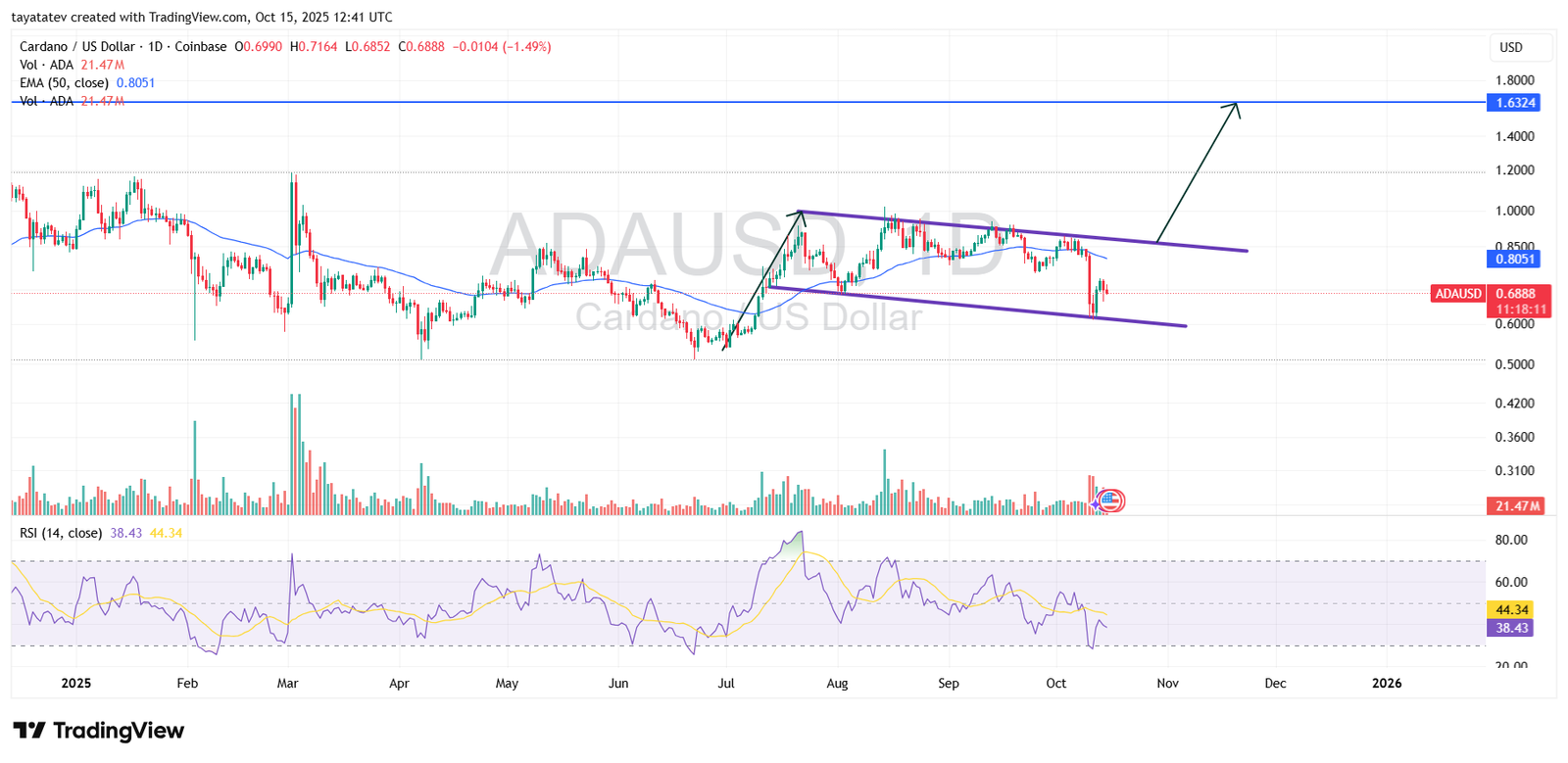
If ADA confirms by closing above the flag’s top and holding that level, the pattern’s measured move projects the prior pole’s magnitude from the breakout point. That projection implies roughly a 138% advance from the current $0.6888, targeting about $1.64—confluent with the chart’s marked resistance near $1.6324. Until a clean break and follow-through appear, price remains inside the flag; however, structure, alignment with the 50-day EMA, and the prior rally collectively frame a textbook continuation setup toward the $1.60s on confirmation.


