Ripple moved on three fronts today: corporate treasury software, African custody, and pre-launch security testing for the XRPL Lending Protocol. Together, these steps extend Ripple’s enterprise stack while keeping the focus on infrastructure, not price.
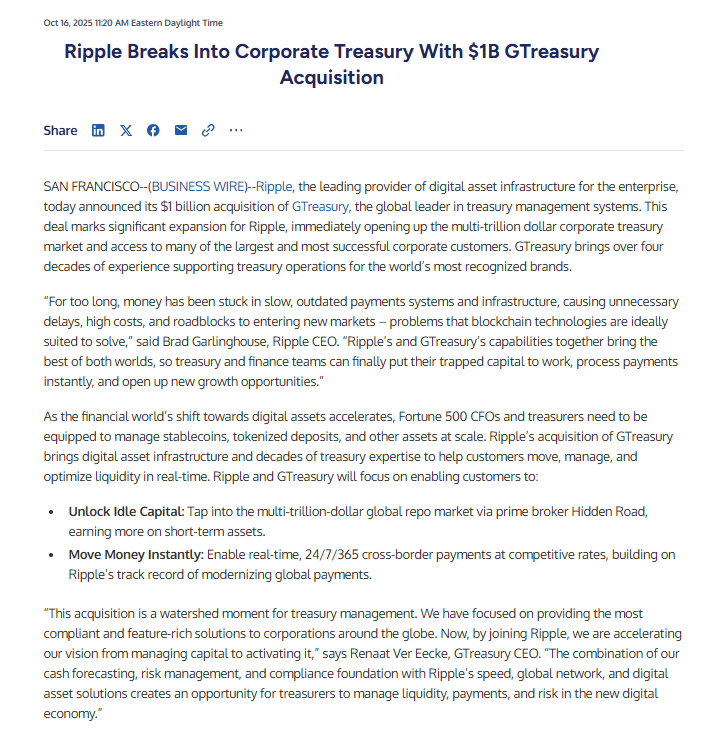
Ripple agreed to acquire GTreasury for $1 billion, placing its payments and stablecoin infrastructure alongside software that large companies already use to manage cash, risk, and compliance. The companies said the deal should close after regulatory approvals. This marks one of Ripple’s largest enterprise moves of 2025.
GTreasury sits inside daily treasury operations for global firms, from liquidity and FX to audit and reporting. By owning that entry point, Ripple can wire its rails directly into existing approval chains instead of asking finance teams to adopt new tools from scratch. Reporting today frames the strategy as an enterprise distribution play through familiar systems.
Additionally, sector coverage noted how a treasury-software foothold could create a path for Ripple’s dollar stablecoin, RLUSD, to interact with corporate flows where policy allows. While adoption depends on each company’s risk rules and local regulation, the distribution channel is now built into a widely used platform.
Africa custody: Absa selects Ripple tech for institutional safekeeping
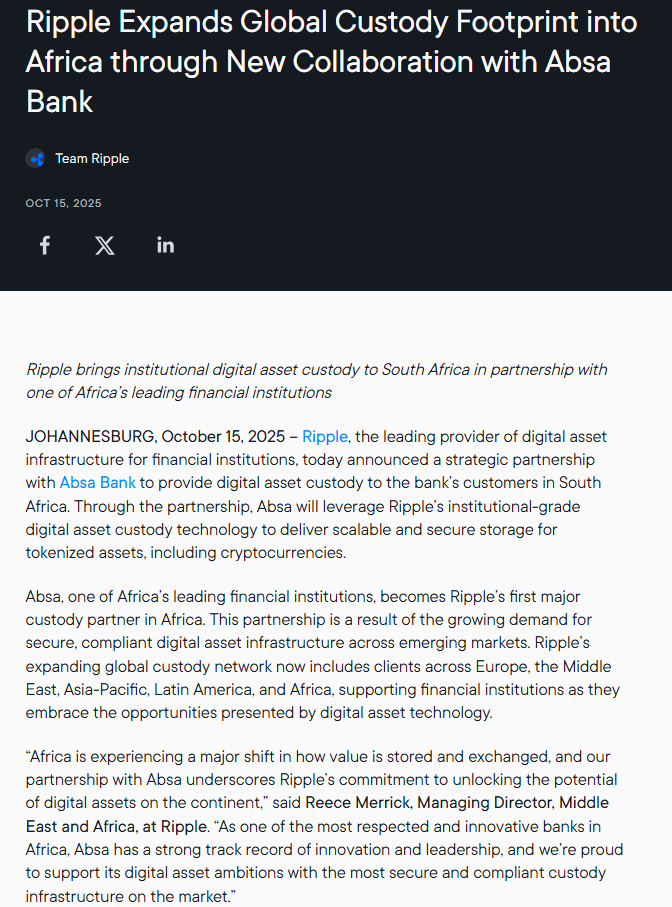
Absa Bank, one of South Africa’s largest lenders, announced a partnership to use Ripple’s institutional-grade custody technology. The bank plans to offer secure storage for tokenized assets, including cryptocurrencies, to its clients. The move brings Ripple’s custody stack to a major African market.
- Advertisement -
Ripple Absa Custody Partnership. Source: Ripple Web
The parties presented custody as infrastructure for regulated institutions rather than a retail trading play. In practice, banks integrate custody with client onboarding, controls, and reporting, which allows asset managers and corporates to hold digital assets under bank-grade oversight. Today’s coverage places the project within that institutional context.
Moreover, analysts pointed to South Africa’s evolving rules for crypto service providers as a tailwind for bank-hosted solutions. Under that backdrop, Absa’s choice signals growing demand for compliant safekeeping and sets a reference point for peers across the region.
XRPL Lending Protocol: $200K “Attackathon” sets firm dates before launch
Separately, Ripple and Immunefi scheduled a $200,000 Attackathon to stress-test the upcoming XRPL Lending Protocol. The education phase runs Oct. 13–27, and live testing runs Oct. 27–Nov. 24/29 per program pages and coverage. The full pool unlocks if researchers land at least one valid bug; otherwise, a smaller pool rewards high-quality insights.
The target protocol aims to bring fixed-term, uncollateralized loans onto the XRP Ledger for institutional use. Because the design introduces credit risk into on-chain settlement, the organizers emphasize adversarial review before production. The structure concentrates reviewers, documentation, and triage in a defined window.
Furthermore, the event requires step-by-step proofs of concept and KYC for payouts, aligning with standards used in larger web-security programs. The timeline gives builders and risk teams clear dates to plan internal testing and follow-up patches ahead of any go-live decision.
Ripple plans $1B XRP treasury via SPAC: report
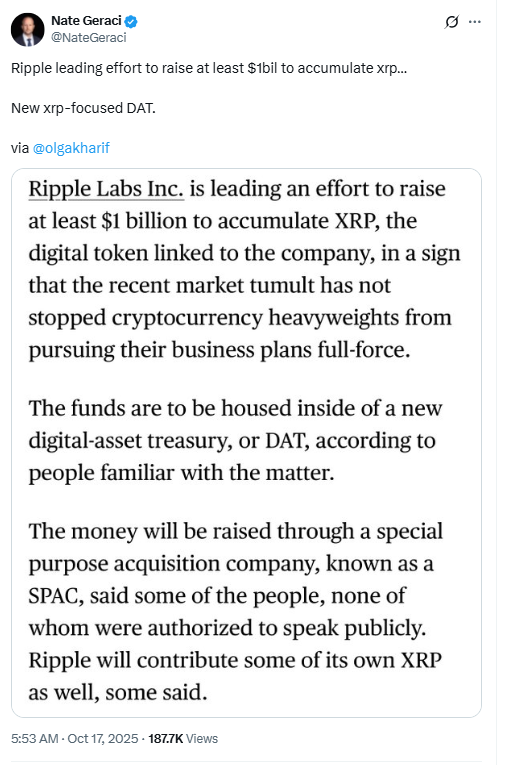
Bloomberg reports that Ripple aims to raise roughly $1 billion through a SPAC to buy XRP for a new digital-asset treasury. The structure would fund a dedicated DAT holding newly purchased XRP, with Ripple also contributing from its existing stash. Sources say terms remain fluid and could change before signing, and Ripple declined to comment.
The plan would centralize a sizable XRP reserve under a formal treasury mandate. Consequently, it signals institutional framing around custody, governance, and potential yield management rather than ad-hoc token movements. Moreover, it positions Ripple as the primary steward of an XRP treasury product amid growing corporate interest in on-chain assets.
- Advertisement -
Separately, the reported effort arrives as rivals build Bitcoin and Ether treasuries at scale. Therefore, Ripple’s move would seek to close a perception gap by creating a flagship XRP treasury vehicle. The SPAC route, if confirmed, offers speed and public-market signaling while preserving flexibility on the final structure.
Context: holdings, escrow, and corporate finance push
Ripple already holds over 4.5 billion XRP, with a further ~37 billion in on-ledger escrow that unlocks monthly. Typically, some unlocked tokens return to escrow, while others fund operating needs. In this context, a distinct DAT would formalize balance-sheet strategy and separate programmatic reserves from enterprise use cases.
Finally, third-party plans hint at emergent XRP treasury demand. Trident Digital Tech targets up to $500 million, Webus flagged $300 million, and VivoPower outlined a $100 million reserve. Together, these signals point to a competitive landscape for institutional-scale XRP holdings, with Ripple’s proposed DAT aiming to set the reference standard.
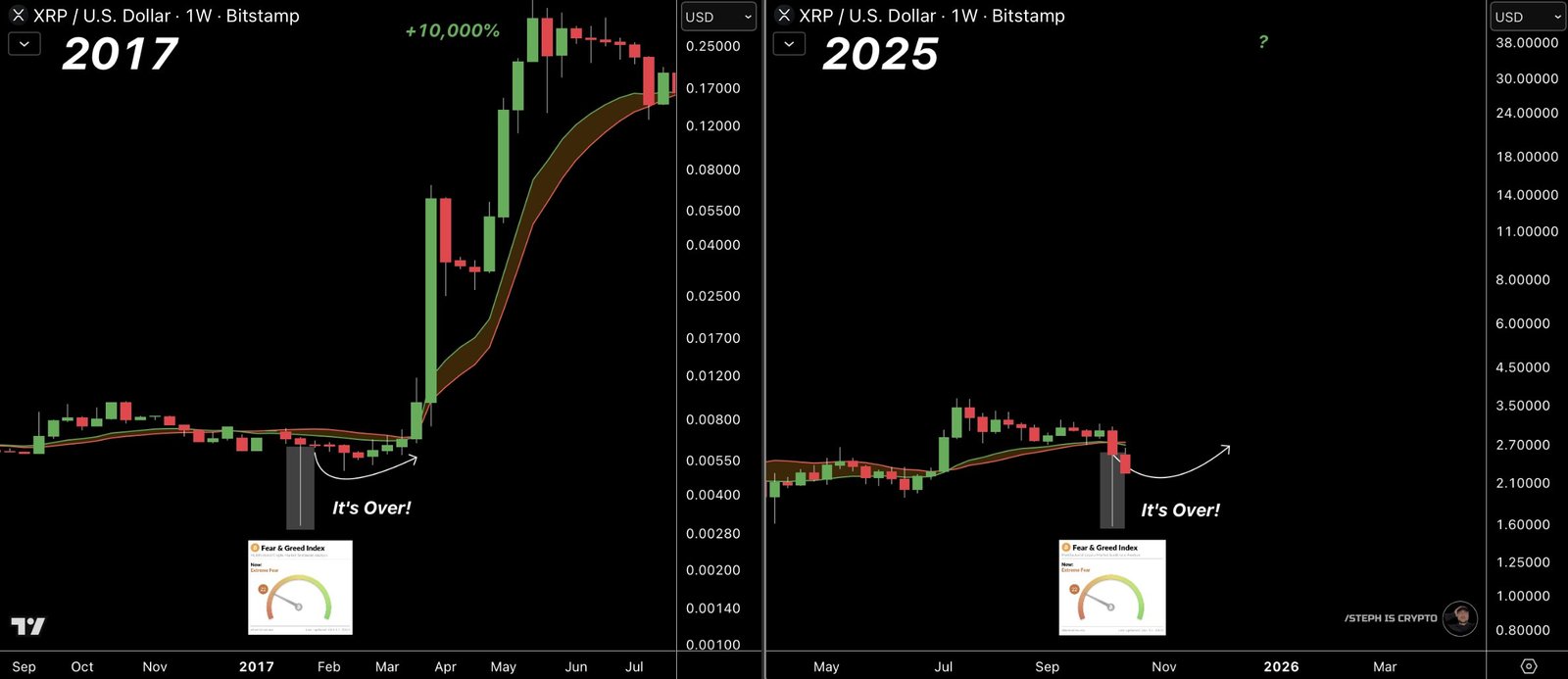
XRP sentiment mirrors a 2017 “it’s over” setup, chart compares capitulation zones
The side-by-side weekly charts place 2017 on the left and 2025 on the right, each highlighting a red-to-green ribbon of short-term moving averages and a shaded “capitulation” box. In both frames, price slips below the ribbon as fear peaks, shown by an Extreme Fear gauge at the bottom. The annotation “It’s Over!” marks that emotional low, not a technical signal, to show how crowd sentiment often bottoms before trend changes become visible.
Next, the 2017 panel shows how candles stabilized near that shaded zone, then reclaimed the moving-average ribbon with strong momentum. The message is comparative, not predictive: the creator is pointing to a historical pattern where extreme pessimism preceded a trend shift. By placing the same label and fear gauge on the 2025 panel, the graphic suggests today’s mood resembles that earlier washout period.
Finally, the 2025 panel adds an arrow from the current shaded zone toward the moving-average ribbon, implying a potential path if sentiment normalizes. However, the chart stops short of targets or timing. Instead, it frames a cycle narrative: capitulation, stabilization, and only then any sustained move. In short, the post argues that “it’s only over when you sell” because sentiment extremes can coincide with late-stage downside, while structure and trend confirmation come afterward.
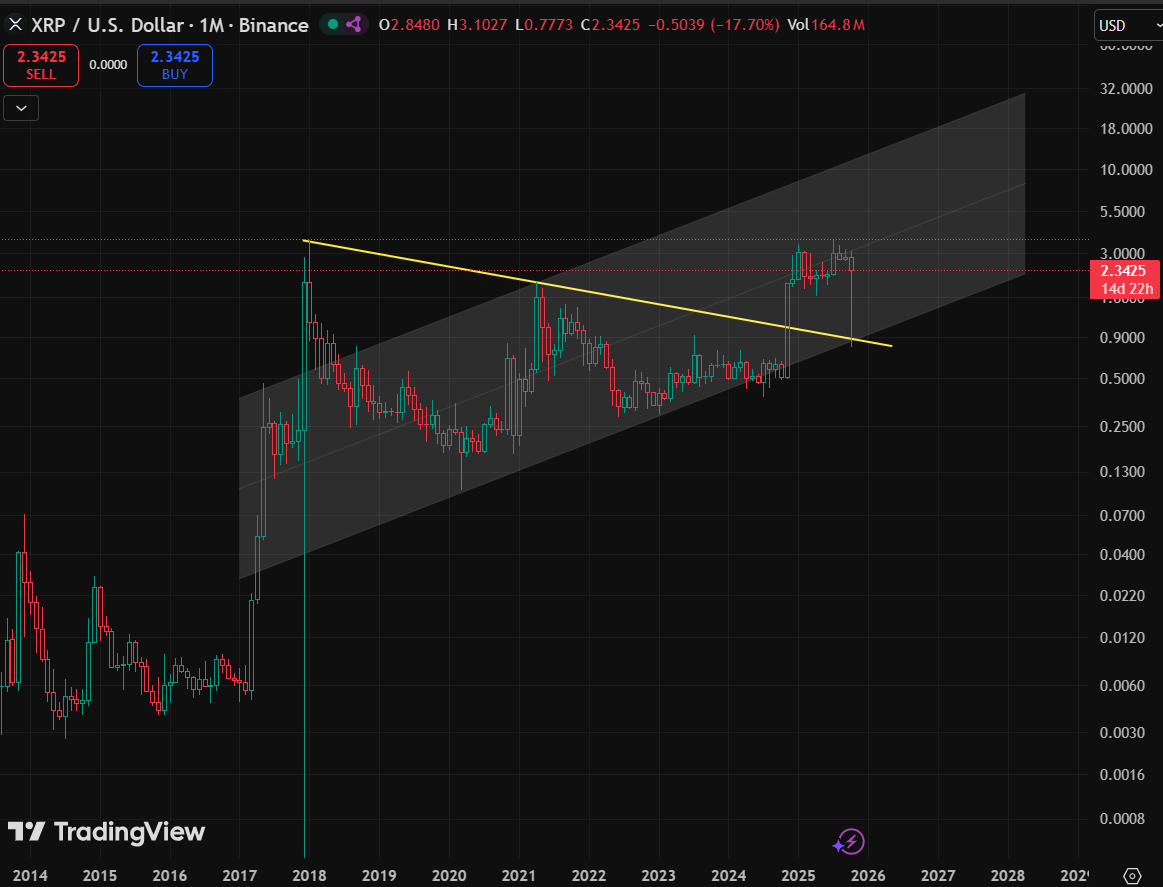
The monthlyXRP/USDT chart (Binance) highlights a clean technical sequence: a breakout above a multi-year descending trendline, followed by a sharp pullback that tags the same line from above. Price action remains inside a rising regression/channel that has guided the advance since 2020, so the structure still reads as “retest within an up-channel,” not a breakdown.
First, the yellow trendline connects the 2018 peak to subsequent lower highs. XRP cleared that line earlier this year, then reversed and stabbed back toward it with a long red candle. That wick tests former resistance as new support—a common post-breakout behavior on higher timeframes. The bounce noted in the post aligns with that retest narrative.
Next, the gray channel frames risk levels. The midline capped the prior rally; the upper rail marks extension risk; and the lower rail defines structural support. As of now, candles continue to print within the channel body, which keeps the broader up-structure intact. Volume expansion on the pullback underscores a “reprice and retest” move rather than a slow bleed.
Finally, confirmation hinges on the monthly close. A close back above the trendline and channel midline would validate the retest and re-establish momentum. Conversely, a decisive monthly close below the reclaimed trendline—and especially below the channel’s lower boundary—would invalidate the bounce case and shift structure risk lower. The post’s “same bounce” observation fits the textbook retest pattern; the candle close will decide whether it holds.
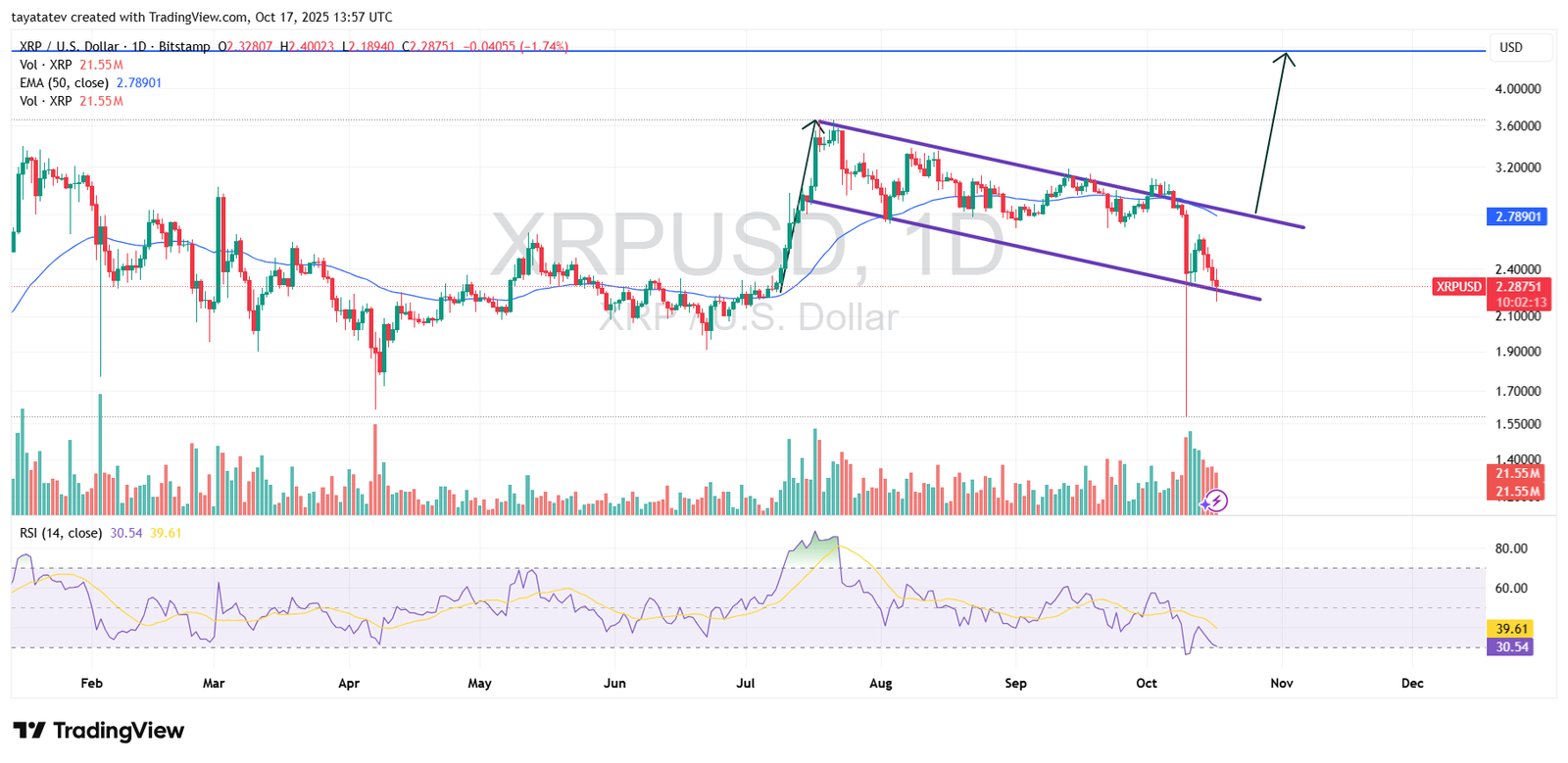
XRP daily chart flags a potential bullish continuation; measured move implies ~96% upside to ~$4.48
The chart shows XRP trading near $2.29, sliding along the lower rail of a downward-sloping channel while the 50-day EMA sits at ~$2.79 above price. Volume expanded on the recent selloff, and RSI ~30 signals oversold conditions. The purple rails outline a falling channel that began after July’s vertical rally—visually and structurally consistent with a bullish flag forming after a strong pole.
XRP Bullish Flag Daily. Source: TradingView
A bullish flag pattern appears when price makes a steep advance (the pole) and then consolidates in a downward-tilted, parallel channel (the flag). This counter-trend drift typically works off overbought readings while supply gets absorbed. The pattern confirms only after price breaks out above the flag’s upper trendline with strong volume and, ideally, reclaims a key moving average. In this setup, a decisive daily close back over the upper rail and the 50-day EMA (~$2.79) would satisfy the technical confirmation most traders look for.
If confirmed, the textbook measured move projects by adding the pole’s height to the breakout level. Your overlay also annotates a +96% objective from today’s spot. Using the current $2.29 print, a 96% advance implies ~$4.48 as the pattern target. Moreover, the drawn arrow and the horizontal guide near the low-to-mid $4s align with that projection, reinforcing the idea that the prior impulse could resume once momentum flips back above resistance.
However, confirmation matters. Until price clears the upper rail and the 50-day EMA, the flag remains a consolidation rather than a breakout. A daily close below the lower rail would weaken the pattern and risk a deeper retest toward prior support, while a swift reclaim of $2.79–$2.90 with expanding buy volume would strengthen the continuation case toward the ~$4.48 measured target.
Tatev Avetisyan is a Markets Writer and Analyst at CoinChapter, covering cryptocurrency markets, policy, and regulation. With over seven years of experience in business and marketing development, she has spent the past two years specializing in digital assets and has authored more than 2,000 articles on crypto markets and regulatory developments.She contributes as a guest writer to leading industry publications and is a prominent Web3 advocate in Armenia through Web3Armenia. Her work reflects a broader focus on artificial intelligence and Web3 technologies.
Tatev maintains a diversified crypto portfolio, with Bitcoin as her primary holding above CoinChapter’s $1,000 disclosure threshold.