



KernelDAO named Chainlink its official oracle and is integrating Chainlink’s Cross-Chain Token (CCT) standard so KUSD and Kred can move natively between BNB Chain and Ethereum via CCIP. The teams disclosed the integration in new posts, detailing CCIP-secured transfers and additional Chainlink services for transparency. This is an infrastructure update, not a trading item.
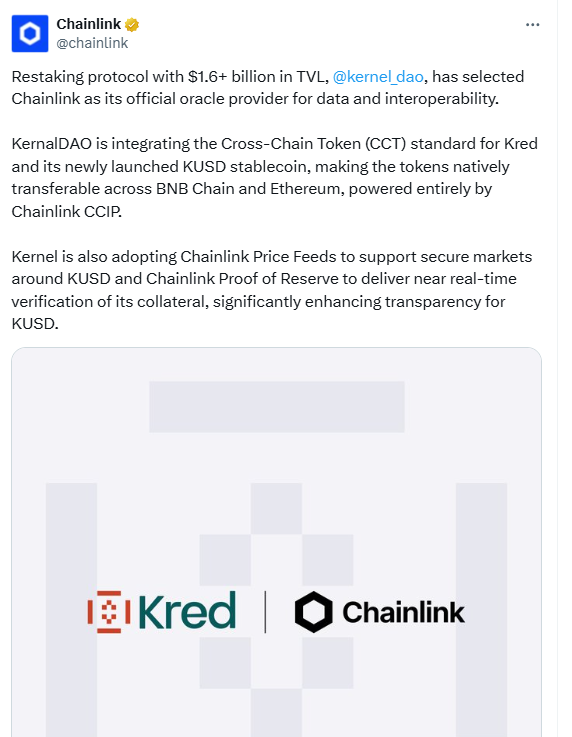
With CCT, KernelDAO can issue tokens that travel across chains without wrapped assets. CCIP handles the messaging and transfer controls, while CCT defines the token’s cross-chain behavior. As a result, KUSD and Kred can maintain a single, canonical supply and avoid liquidity fragmentation. Chainlink added that Proof of Reserve and Price Feeds will support monitoring and market integrity around KUSD.
KernelDAO framed KUSD and Kred as rails for real-world credit and payments. The project is moving from restaking into credit-linked stablecoin use cases and wants standardized interoperability for fintech partners. Therefore, it leaned on Chainlink’s CCIP and CCT to simplify multi-chain issuance and settlement while keeping controls at the token level. Today’s posts align with KernelDAO’s earlier “Internet of Credit” vision and recent KUSD launch materials.
Whale wallets pull LINK from exchanges
Whale accumulation of Chainlink accelerated today as two large wallets withdrew more than 128,000 LINK from exchanges within 14 hours. The on-chain data, shared by Lookonchain shows both wallets increasing their holdings instead of keeping funds on trading platforms.
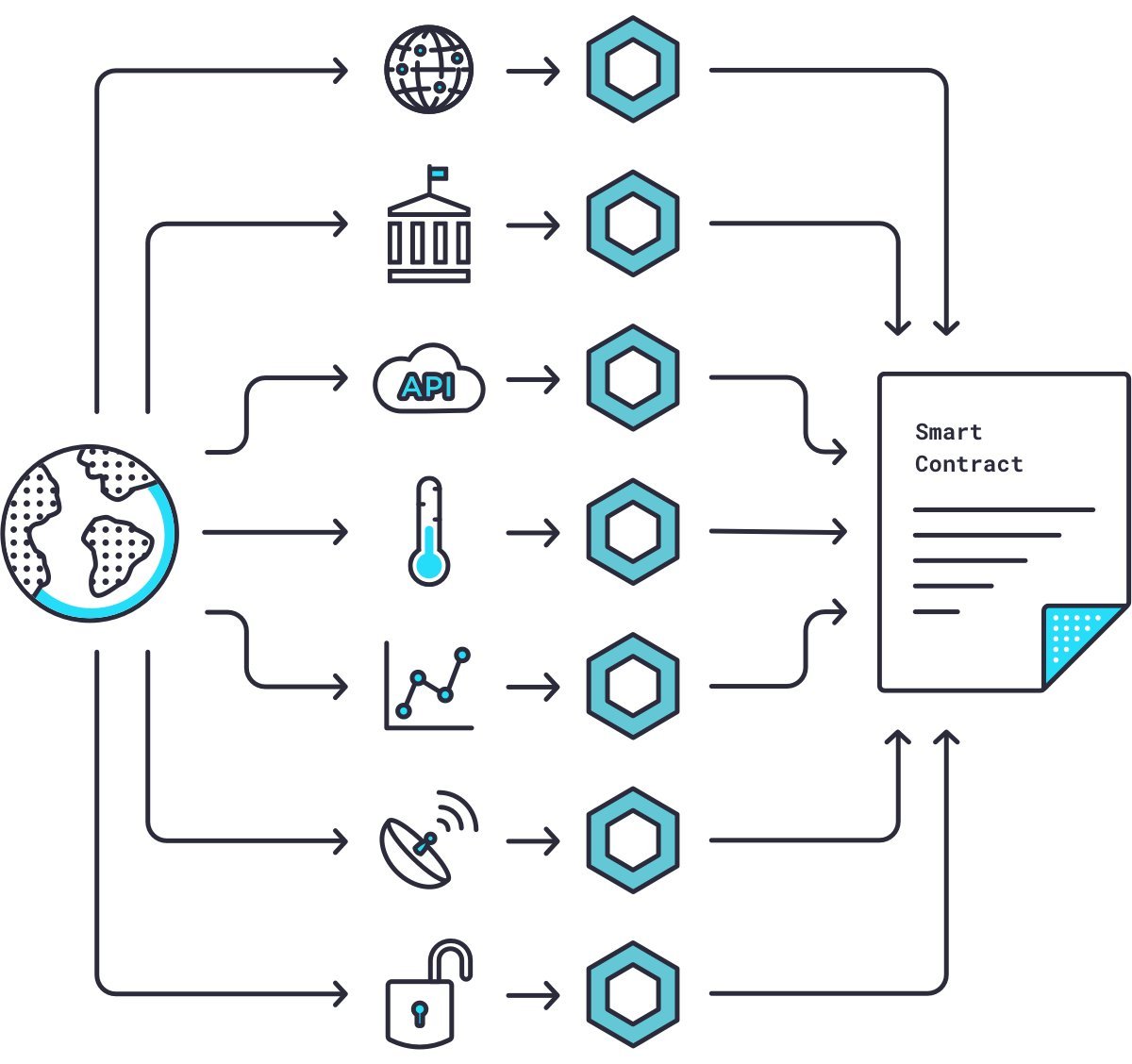
The first whale now controls about 1.1 million LINK, while the second holds roughly 307,000 LINK. Together, the two wallets account for over $24 million worth of tokens at today’s valuations. The withdrawals reduced available exchange supply, which often signals a long-term holding strategy rather than short-term trading activity.
On-chain trackers frequently interpret sustained exchange outflows as a sign of growing holder conviction. While the move does not guarantee future market direction, it reflects current behavior among high-value LINK holders who continue moving tokens into self-custody.
Whales accumulate 13M LINK as altcoins fade
Chainlink showed relative strength today while many altcoins lagged. Analyst Ali reported that whale wallets added more than 13 million LINK over the past two weeks as the broader market sold off. The chart, built on Santiment data, tracks the 100,000–1,000,000 LINK cohort and highlights a steady rise in holdings through the drawdown. The activity points to accumulation rather than distribution.
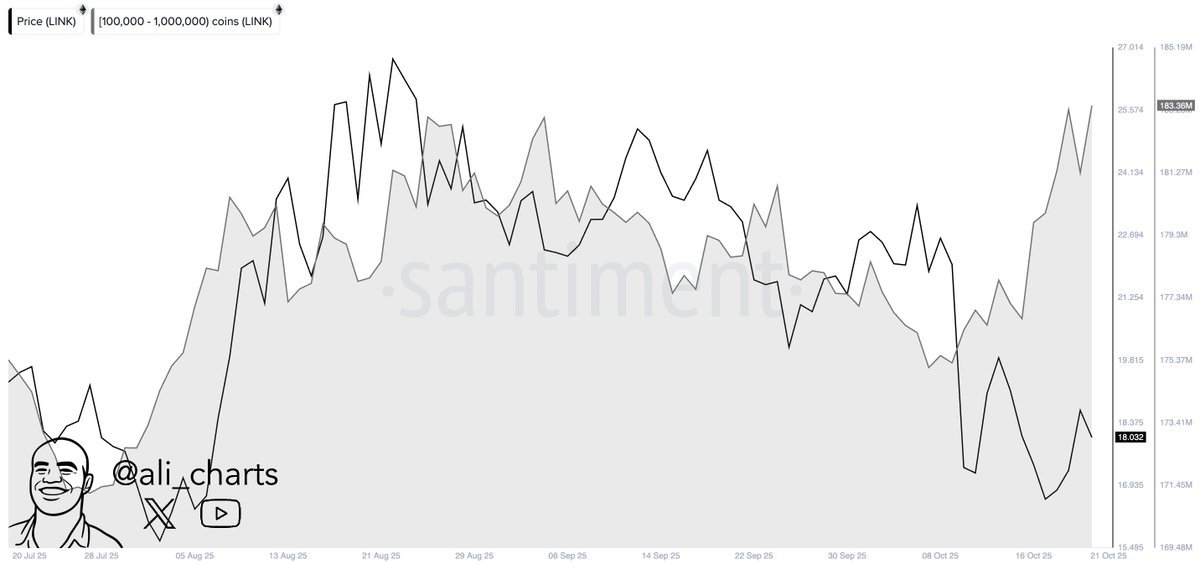
The behavior matters because large holders often buy into weakness and reduce exchange supply. As balances climb, pressure on immediate sell liquidity can ease, and sentiment can stabilize. Moreover, consistent whale inflows tend to align with later periods of enhanced network and developer headlines, which support non-price narratives investors watch during risk resets.
Looking ahead, the setup favors a constructive path if accumulation persists and exchange reserves continue to thin. A reversal would appear if these wallets start returning tokens to trading venues or if on-chain activity cools. Therefore, watch three signals in sequence: whale cohort balances, exchange flows, and new address growth. If the first two stay positive and the third improves, LINK has room to outperform into the next rotation.
Cost-basis heatmap flags $16 as heavy LINK support
On-chain data shows 54.47 million LINK accumulated around the $16 cost basis, forming a dense support zone. The Glassnode heatmap, highlighted by analyst Ali, concentrates holder entries in a narrow $16.10–$16.20 range. This cluster signals many buyers now sit near breakeven, which often stiffens bids during pullbacks.
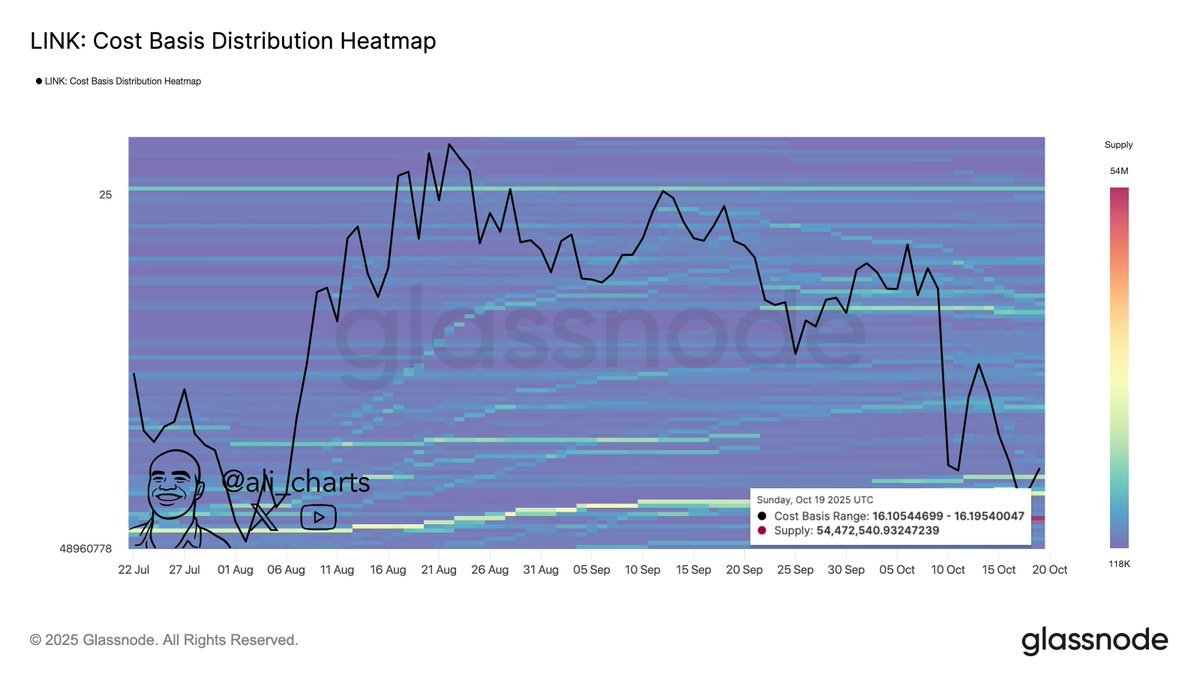
The distribution matters for behavior. When price retests $16, a large cohort is incentivized to defend positions rather than sell. As a result, dips into this band can absorb supply faster, while rallies above it free holders from near-term pressure. In addition, the zone gives traders a clear invalidation level for risk control.
Looking ahead, the market’s reaction at $16 becomes the tell. If LINK holds this shelf and exchange reserves continue to fall, upside follow-through becomes more likely. However, a decisive break below the band would flip those same wallets into potential supply. Therefore, watch retests of the $16 area and accompanying exchange-flow prints to confirm direction.
LINK eyes breakout as symmetrical triangle nears completion
Analyst Ali says Chainlink is trading inside a long-running symmetrical triangle, with price coiling toward a decisive point. The pattern has compressed for more than a year, forming lower highs and higher lows that now converge around a key resistance near $25. Symmetrical triangles often precede expansion after periods of shrinking volatility, making the next clean breakout especially significant.
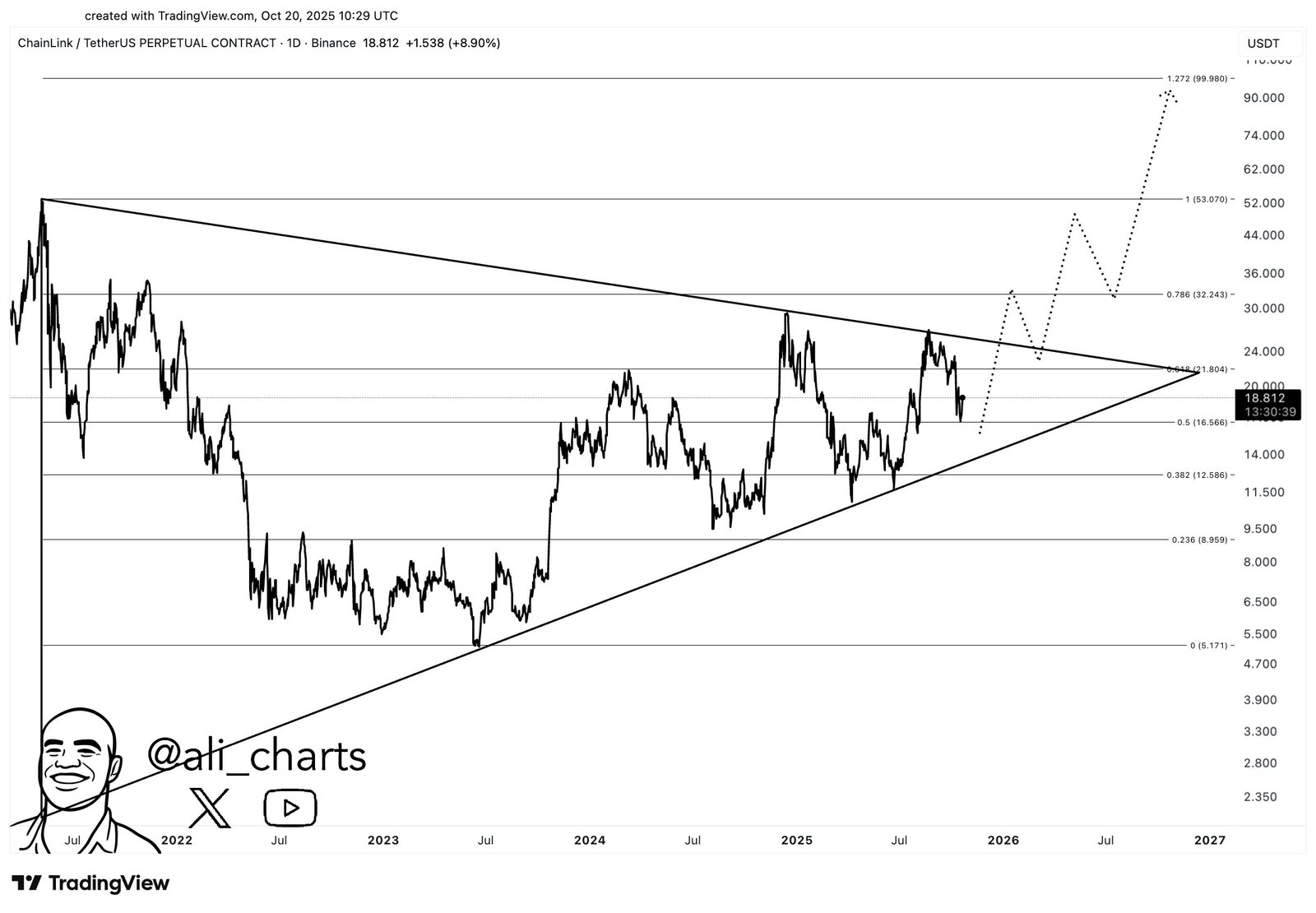
Ali notes that a sustained move and daily close above $25 would mark the first major resistance break since summer. That level has repeatedly capped rallies, so reclaiming it would signal that buyers finally absorbed overhead supply. In that scenario, the chart opens a path toward the Fibonacci levels shown in the projection, where $32 and $53 stand out as sequential technical checkpoints.
If momentum accelerates and volume confirms, Ali believes the structure could even support a longer-term push toward the $90–$100 region. However, the bullish case depends on holding higher lows and avoiding a breakdown back into the lower range. As a result, all eyes remain on the $25 ceiling and whether LINK can flip that line from resistance into support.
Trader says LINK setup hit plan; risk trimmed to break-even
Trader Blue Shadow reported that a previously shared “squiggle” path on the 1-hour LINK/USDT chart played out almost exactly. He moved stop-losses to entry, making the trade risk-free, and indicated a bias for “higher.” The chart shows a reclaim of the mid-range band after a sweep of support, then a projected grind back into the prior supply zone.
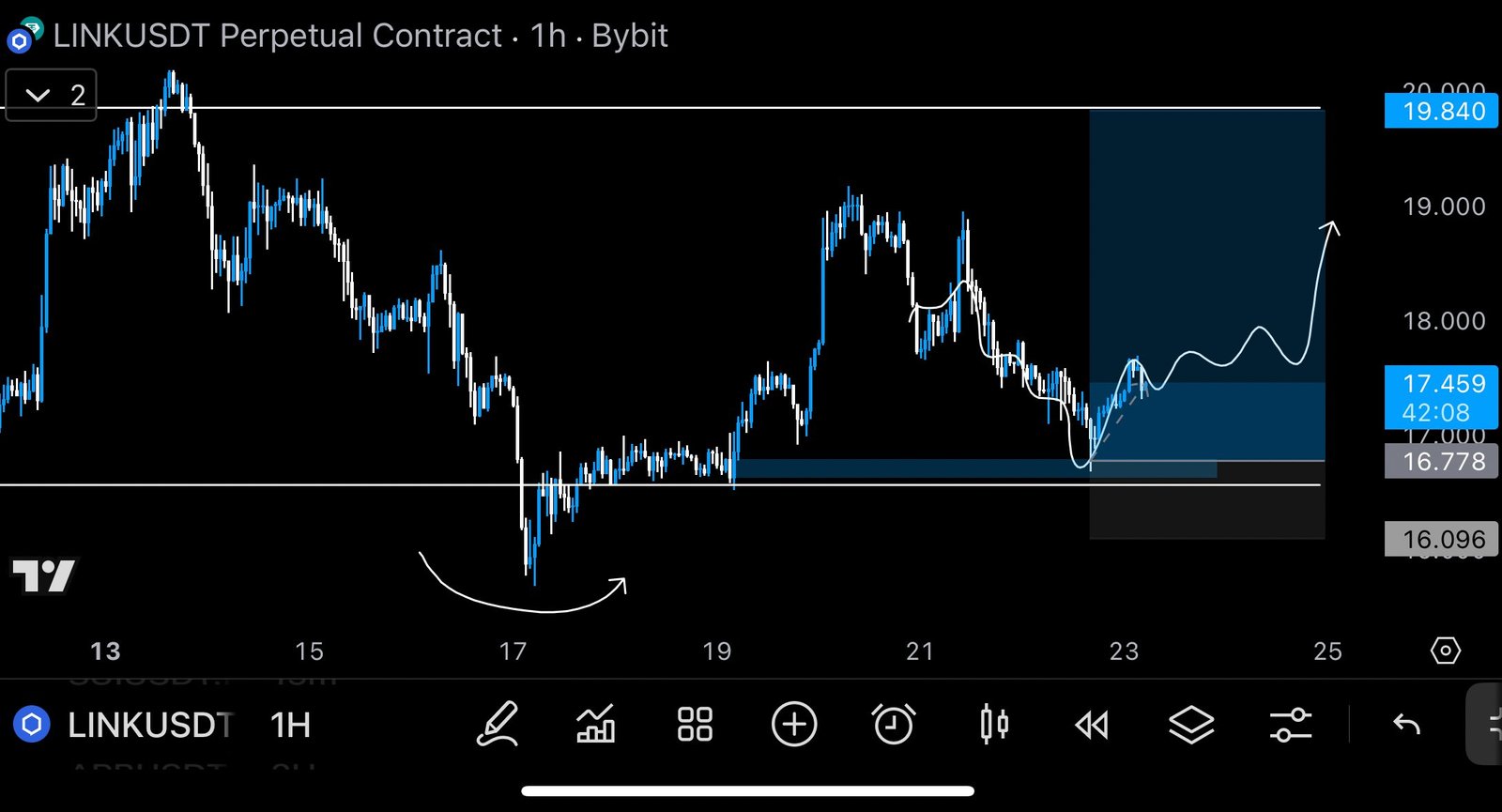
The update matters for tape context. Moving stops to break-even signals reduced downside exposure while keeping upside open. It also reflects a common risk practice after a support recovery: secure the base, then let momentum work. If buyers hold the reclaimed band and continue printing higher lows, the scenario favors continuation toward the previous reaction high.
However, a clean drop back below the reclaimed zone would invalidate the short-term path and force repositioning. Therefore, watch the mid-range retest and intraday higher-low structure. If both hold, the trader’s “higher” bias remains consistent with the chart.


