


Ethereum’s next upgrade, Fusaka, is slated to reach the Hoodi testnet on Oct. 28, the final public rehearsal before mainnet activation targeted for December. Developers already ran the upgrade on Holesky and Sepolia, using the sequence to validate parameters and client readiness. Public posts and developer recaps align on the October test schedule and the December window.
PeerDAS sits at the center of Fusaka. It scales data availability for rollups by letting nodes sample data instead of downloading everything, which aims to expand L2 capacity without raising hardware requirements. Technical explainers from client operators and staking providers describe PeerDAS as the most consequential change in this release.
Project communications point to Dec. 3 as a working mainnet date, with the caveat that testing outcomes on Hoodi can shift timing. Multiple ecosystem briefings repeat that sequence: Holesky and Sepolia first, Hoodi as the last dress rehearsal, then mainnet if checklists clear.
What changes for builders and node operators under Fusaka
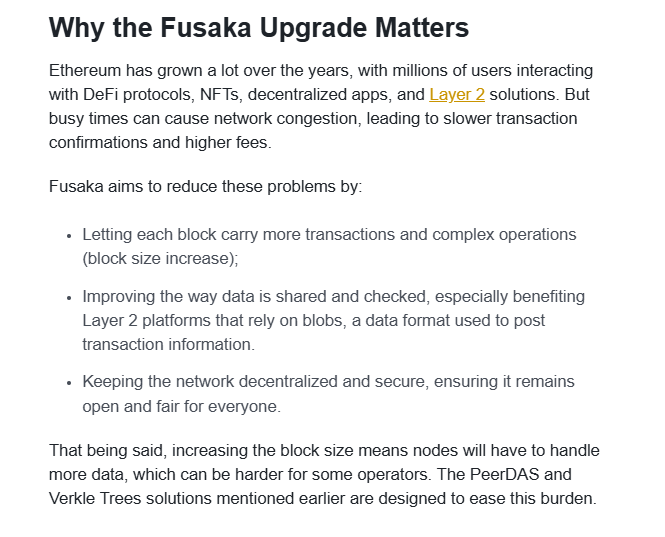
For builders, Fusaka’s PeerDAS promises more blob space for L2s, which should ease throughput constraints that surfaced after proto-danksharding. Docs summarize the goal as a roughly order-of-magnitude increase in data availability capacity, routed through peer sampling rather than universal downloads. That design seeks to keep participation accessible while scaling.
Client teams have also tested gas-related behaviors during the Fusaka cycle. Developer notes reference adjustments and discussions around gas accounting and submission flows that accompany the broader capacity push. These changes aim to smooth operational edges discovered in earlier EIPs.
Testnet planning matters for migration. Community posts outline the Holesky → Sepolia → Hoodi timetable, with Hoodi positioned as the final proving ground before mainnet. That cadence is meant to stage upgrades across independent validator sets, reducing correlated risks and isolating faults before production.
Core dev call tracks testing and repricing topics
At All Core Devs Execution call #223 on Oct. 23, participants reviewed Fusaka test status and debated approaches to gas repricing precision. Notes mention potential solutions such as a broad rebase of gas units versus fractional accounting, with trade-offs for tooling and existing contracts. The thread situates these items alongside the Fusaka schedule.
These meetings coordinate client readiness ahead of Hoodi’s activation. They also set expectations for what, if anything, slips beyond the Fusaka scope to later upgrades. The documented agenda shows attention on blob submission paths and performance benchmarks.
Public recaps emphasize that mainnet timing follows testnet outcomes. The Oct. 28 Hoodi date therefore functions as a checkpoint: if clients converge on stable behavior, the December activation proceeds; if not, engineers adjust and retest.
Ethereum Foundation consolidates treasury security with Safe
Separately, the Ethereum Foundationcompleted a migration of its treasury to Safe smart accounts in October. Announcements described a full move to multisig custody, citing operational security and alignment with widely used account standards. Coverage placed the transferred value above $600 million at the time of the switch.
The shift puts the foundation on infrastructure adopted across the ecosystem. Safe’s model allows granular signer policies and auditing, features that large treasuries tend to require. The change landed days before the Hoodi testnet event, giving stakeholders a clearer picture of both governance operations and protocol progress.
Operational moves like this do not alter protocol rules, but they influence confidence and process hygiene. By finalizing the migration ahead of Fusaka’s last test stage, the foundation signaled a preference for predictable custody while the network readies a capacity upgrade.
Testnets realign around Hoodi and Sepolia after Holesky changes
Ethereum’s testnet landscape is also shifting.Reports indicate Holesky is being wound down for certain roles after it served early Fusaka trials, with activity moving toward Hoodi for validator-heavy testing and Sepolia for broader developer needs. The rebalancing reflects lessons from scale tests and aims to give clearer lanes for future upgrades.
Hoodi’s introduction provides a fresh validator set and scheduling clarity for protocol work. That helps teams isolate upgrade behaviors without legacy state complicating diagnostics. Sepolia then absorbs application-facing checks, keeping tooling and dApp flows current.
This division supports the December timeline. With Hoodi dedicated to protocol rehearsal and Sepolia to app workflows, client teams can compare outcomes across domains before green-lighting mainnet parameters.
Analyst says ETH can hit $10K; timeline depends on fundamentals
Ali Charts stated that Ethereum could reach $10,000, while warning it may take longer than many expect. The claim signals a bullish long-term view rather than an imminent target. Framing it as a path, not a date, matters because a $10,000 price implies roughly a $1.2 trillion market value at ~120 million ETH supply—levels that demand sustained adoption, not a short squeeze.
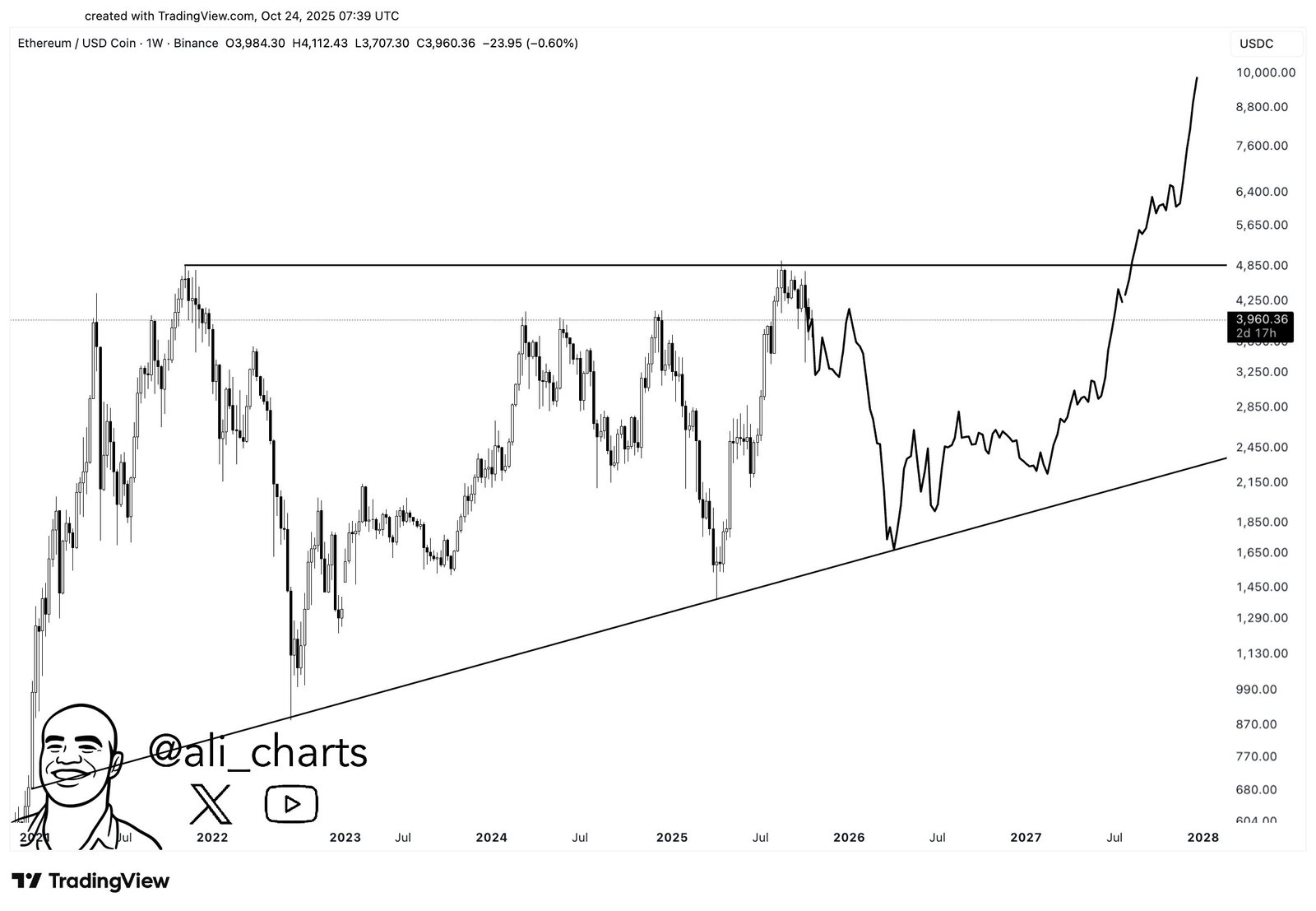
Several pillars would need to line up. First, network capacity must keep scaling so Layer 2s can settle more activity without spiking fees; upgrades like Fusaka/PeerDAS target exactly that by expanding data availability for rollups. Second, real usage must keep rising across DeFi, stablecoin settlement, and tokenized assets, which drives fee revenue and supports staking economics. Third, structural demand—such as spot ETF flows, corporate or sovereign pilots, and continued staking/withdrawal dynamics—can reduce circulating supply and steady volatility over time.
However, timing stays uncertain. Macro conditions, regulatory outcomes, and execution risk across client teams and rollups can slow the trajectory. Competition from alternative smart-contract platforms, plus security or UX setbacks, would also weigh on adoption. Therefore, the thesis is directionally possible, but the clock depends on delivery: scaling upgrades working in production, sticky on-chain activity, and durable, regulated capital entering the asset.
Analyst highlights Ethereum support trend and EMA50 hurdle
Lark Davis said Ethereum is holding a key trendline support, pointing to a structure that has remained intact since early 2025. The ETH/USD chart shows buyers repeatedly defending the ascending line, which keeps the broader uptrend valid. As long as price trades above this support, the market maintains a bullish technical bias even after recent pullbacks.
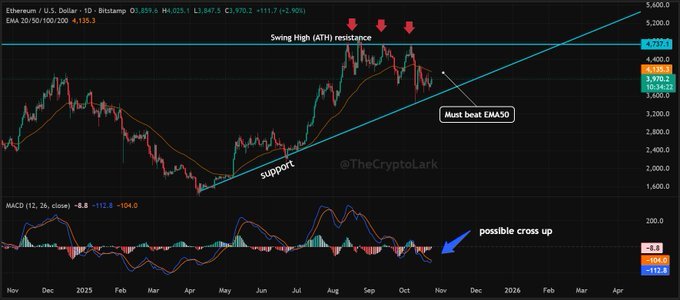
However, Davis noted that Ethereum must reclaim the daily EMA50 to regain momentum. The moving average sits below the all-time-high swing resistance, creating a two-level barrier traders are watching. If Ethereum breaks above the EMA50 first, it opens a path for another test of the major resistance zone marked by repeated rejections on the chart. A clean breakout over that horizontal line would signal strength and shift sentiment from recovery to expansion.
Meanwhile, the MACD is showing signs of a potential bullish cross. This signal often indicates improving momentum and can support an upside attempt if price action aligns. Still, confirmation requires follow-through, because the market has rejected at the same swing level several times in previous months. For now, support remains intact, resistance is defined, and momentum indicators are hinting at a possible shift that traders will monitor closely.


