


Cardano (ADA) founder Charles Hoskinson said that the decentralized finance (DeFi) sector remains structurally undervalued, arguing that activity on Cardano-based decentralized exchanges (DEXes) could expand sharply once missing infrastructure components are in place.

Hoskinson made the remarks while responding to on-chain data shared by a Cardano stake pool operator highlighting recent trading activity in NIGHT, the native token of the privacy-focused Midnight sidechain. The exchange between the two centred on the gap between centralized exchange volumes and decentralized trading on Cardano.
Infrastructure Limits DeFi Scale, Cardano Founder Says
According to the data referenced, NIGHT recorded roughly $4.2 billion in daily trading volume across centralized exchanges during the latest session. By contrast, trading on Cardano’s decentralized platforms totalled about $4.3 million, based on DEX Screener figures.
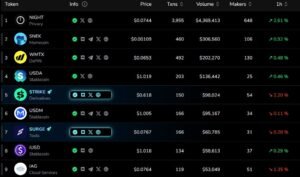
Although modest in absolute terms, NIGHT still ranked as the most actively traded token on Cardano DEXes during the period. The next closest asset, SNEK, recorded approximately $306,560 in decentralized trading volume, showing the limited liquidity currently available across Cardano’s DeFi ecosystem.
The disparity mirrors patterns seen during Midnight’s recent rollout, when NIGHT debuted across multiple centralized platforms — including Binance’s Alpha environment — while on-chain activity lagged behind exchange-driven volume.
Responding to the figures, Hoskinson said the disparity shows infrastructure constraints rather than a lack of demand. He reiterated that Cardano’s DeFi ecosystem still lacks two critical components: a widely adopted, reliable stablecoin and mature cross-chain bridges.
Without dependable stablecoins, Hoskinson said, traders struggle to hold value on-chain or manage risk effectively. He added that advanced trading strategies remain difficult to execute on Cardano’s decentralized exchanges.
Hoskinson also pointed to the absence of strong cross-chain bridges. He said this limits capital inflows from larger ecosystems such as Ethereum and Solana. As a result, Cardano’s DeFi markets remain relatively isolated.
Projection Framed as Conditional, Not Immediate
Against this backdrop, Hoskinson said decentralized exchange volumes on Cardano could expand significantly if infrastructure improves. He linked that potential growth to wider stablecoin adoption and better cross-chain connectivity. Hoskinson suggested volumes could increase by as much as 100× under those conditions. However, he did not provide a timeline or specific benchmarks for such growth.
Hoskinson characterized the current environment as an early or accumulation phase, where activity remains subdued while foundational infrastructure continues to develop. He framed his comments as a long-term view on DeFi capacity rather than a short-term market forecast.
The comments come at a time when Cardano continues to gain visibility in institutional products, particularly through its inclusion in multiple crypto index exchange-traded products, despite the absence of a standalone ADA spot ETF.
That contrast — institutional exposure on one hand, limited DeFi liquidity on the other — shows the disconnect Hoskinson referenced. While Cardano’s network and ecosystem tokens are increasingly visible in broader markets, on-chain trading activity has yet to scale at the same pace.


