



XRP is closing December under pressure, trading near $1.85 and down roughly 15% on the month, but analysts argue the weakness may be masking a larger volatility setup. With a record $7.1 trillion global options expiry approaching, market watchers say forced position unwinds could jolt crypto prices—potentially setting up a repricing phase for XRP into 2026.
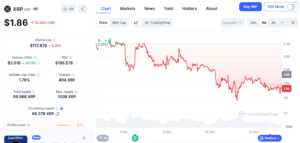
Market analyst Zach Rector said XRP’s range-bound action reflects derivatives pressure rather than fading demand. He expects a brief downside move to clear over-leveraged positions, followed by a recovery that could put XRP on a path toward the $3–$5 range by 2026 if adoption and institutional flows persist.

XRP Options Expiry Puts Focus on Leverage
Rector pointed to the scale of the upcoming options expiry—spanning global markets—as a near-term catalyst that could force large traders to reduce risk. In that scenario, XRP could dip toward the $1.60–$1.70 zone as leveraged longs unwind. He characterized such a move as a temporary shakeout, arguing it would reset positioning rather than signal a structural breakdown.
Derivatives-driven volatility has been a recurring feature of XRP trading this quarter, with price movements often disconnected from spot demand.
Ripple executives continue to frame XRP’s long-term value around utility. David Schwartz has reiterated that XRP’s health should be measured by its liquidity depth and real-world financial use, noting that the asset maintains deep global liquidity designed for settlement and cross-border activity. That emphasis has increasingly resonated with institutional allocators evaluating blockchain assets as infrastructure rather than speculative trades.

ETF Inflows Diverge From Broader Market
Institutional behavior supports that view. While Bitcoin and Ethereum exchange-traded products have seen intermittent outflows, spot XRP ETFs have recorded uninterrupted demand since launching in mid-November.
Products from issuers including Canary Capital, Bitwise, Franklin Templeton, Grayscale, and 21Shares have collectively drawn about $1.14 billion in net inflows, with assets under management near $1.25 billion. The group has yet to post a single day of net outflows, indicating sustained absorption of sell pressure.
Canary Capital’s CEO said early inflows came mainly from retail investors. He further added that inquiries from pension funds and insurance firms are increasing.

Retail sentiment, meanwhile, remains cautious. Data from Santiment shows elevated negative social media commentary around XRP. Historically, similar sentiment extremes have coincided with local recoveries when institutional accumulation continues despite retail skepticism.
Looking further ahead, analysts also point to Japan as a potential adoption catalyst. Japanese banks already work with Ripple through SBI Holdings, and XRP has been tested for cross-border transfers in parts of Asia.

While no policy shift has been confirmed, proponents argue that sustained FX volatility could increase demand for neutral settlement assets, supporting gradual, utility-driven demand rather than speculative spikes.


