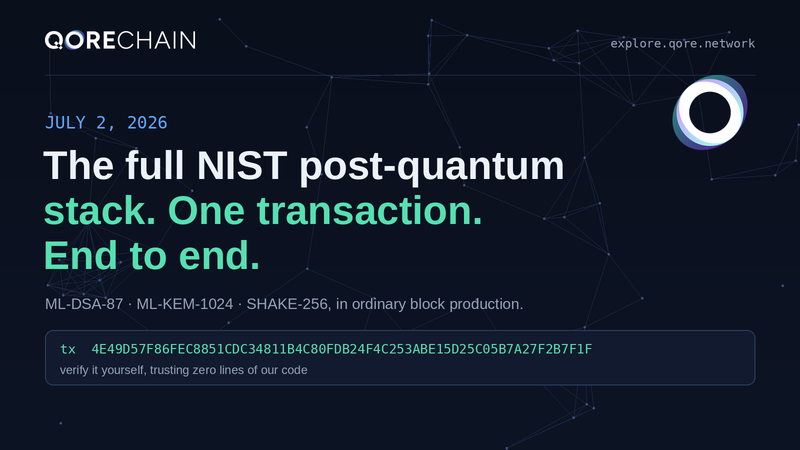
There are two kinds of milestones in crypto: the kind that gets announced, and the kind that gets committed to a block. On July 2, 2026, QoreChain produced the second kind. Post-quantum signatures on a blockchain are not new in themselves; hash-based schemes have protected specialist chains for years. What had not happened, to the project’s knowledge, is what this transfer did: it moved through ordinary block production signed, encapsulated and hashed exclusively with the complete NIST-standardized post-quantum stack at its highest security levels, ML-DSA-87 (FIPS 204) for the signature, ML-KEM-1024 (FIPS 203) for key encapsulation and SHAKE-256 (FIPS 202) for hashing, making it the first transaction in blockchain history secured end to end by the full standardized suite. And it asks for no faith: it sits under transaction hash 4E49D57F86FEC8851CDC34811B4C80FDB24F4C253ABE15D25C05B7A27F2B7F1F on explore.qore.network, where the signature is byte-compatible with any standard ML-DSA-87 verifier. Anyone can pull it off the explorer and check it with an independent library, trusting zero lines of QoreChain’s code.
Seventy four days of post-quantum blocks later, the network behind that transaction gets its market. QOR begins trading on MEXC on August 20, 2026, at 13:00 UTC in the QOR/USDT pair, with withdrawals opening August 21 at 13:00 UTC. MEXC introduced the listing as a first in market debut through its Kickstarter programme, in which participants share an airdrop of 3,000,000 QOR ahead of the open.
The distinction QoreChain keeps drawing is between quantum security as a slide and quantum security as a property of consensus, and it proposes a one-line test for telling them apart: delete the post-quantum signature and see whether the chain still accepts the transaction. On most self-described hybrid designs it does, which means the quantum-vulnerable scheme still gates every state transition and the post-quantum field is decoration. On QoreChain’s native transaction lane the answer is no: without a valid ML-DSA-87 signature at NIST security level 5, a transaction does not validate, is not gossiped between nodes and never reaches a block. The classical co-signature that rides alongside exists for tooling compatibility, not for security.
The same candour extends to the parts still in motion, because on an Apache-2.0 codebase, pretending lasts exactly as long as it takes a skeptic to read the repository. Forcing lattice signatures onto the EVM on day one would break every existing wallet and every secp256k1 assumption in the tooling, so the EVM lane verifies classical signatures today, deliberately, while the post-quantum machinery is already live around it: ML-DSA verification and key-status precompiles that Solidity contracts can call at addresses 0x0A01 and 0x0A02, on-chain post-quantum key registration, and a governance-controlled enforcement mode that moves each lane from optional to required in phases through 2026, behind a long migration window. The project’s own QoreX wallet signs in hybrid mode already. The cryptography was never the hard part; migrating a live chain without stranding its users is, which is why the rollout is staged rather than a flag day.
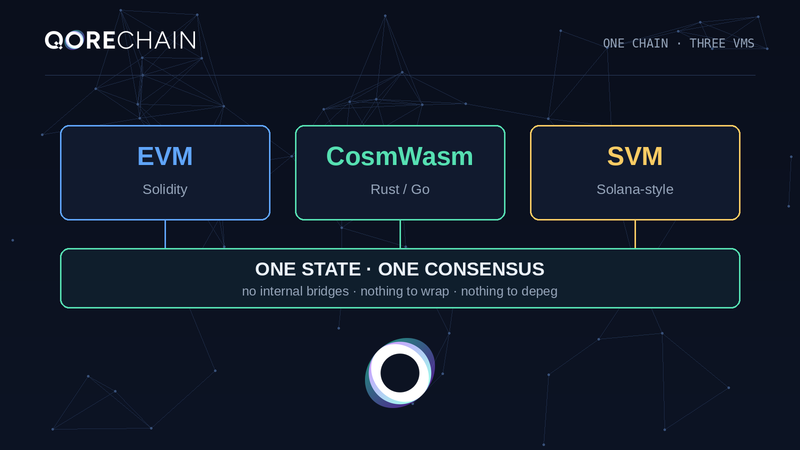
The architecture underneath is the other quiet heresy. QoreChain runs three execution environments, EVM, CosmWasm and SVM, against one state layer and one consensus layer. A Solidity contract and a CosmWasm module are not two chains passing messages through a relayer committee; they are two programs writing to the same ledger, in the same block, atomically. Between the three environments there is nothing to bridge, nothing to wrap and nothing to depeg. Assets originating on other networks still cross a bridge to arrive, but the everyday structural bridging between execution environments, the layer where the industry’s largest exploits have lived, simply does not exist here.
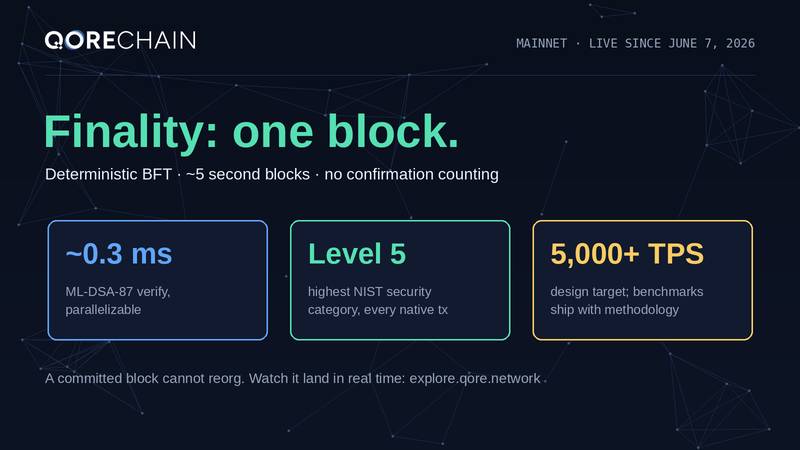
Performance follows the same discipline: numbers a stranger can reproduce beat numbers a marketer can print. Finality on QoreChain is deterministic. Consensus is BFT, a committed block cannot reorg, and finality takes exactly one block, roughly five seconds on mainnet, with no confirmation counting. On throughput, the design target is 5,000 or more transactions per second with full ML-DSA-87 verification on every native transaction, at roughly 0.3 milliseconds per signature verification, parallelizable, with about seven kilobytes of additional transaction envelope that block sizing deliberately accounts for. The team also draws a line most of the industry ignores: throughput on a live chain is a demand figure, not a capability figure, and its multi-node benchmark results will be published together with their methodology, so they can be re-run rather than quoted.
On audits, QoreChain splits the question the way an engineer would. The algorithms are not the project’s to audit: ML-DSA-87, ML-KEM-1024 and SHAKE-256 are final NIST standards, and the chain’s signatures verify against any independent implementation of them. The chain-level claim, that the post-quantum check is the one gating validity, does not require the project’s word either: the node is open source and the enforcement path is a few hundred readable lines. A third-party audit of the codebase is underway, and the firm’s name will be published together with the signed report, not before, because naming a firm to win an argument before the work is done is precisely the marketing the project set out to avoid. Until then, security@qore.network is open and findings are credited. As the team puts it: an audit report is also marketing until you can read the code it audited. QoreChain’s, you can read now.
“Crypto’s default mode is to announce the future and hope nobody checks,” said Liviu Epure, Founder, VP and CTO of QoreChain. “We inverted it. The first transaction secured end to end by the complete NIST post-quantum stack was not a launch event with a countdown. It was a Thursday. That is what real infrastructure feels like: already running, already verifiable, and slightly boring by the time the market notices. The next decade of this industry belongs to the chains that can survive their own community reading their code.“
The sequencing was deliberate, and it inverts the industry’s default order of operations. The standard playbook launches a token on someone else’s network first, collects the market’s money, and only then finds out whether the team can build what the deck promised. QoreChain shipped the entire stack before asking the market for anything: a public testnet and a live mainnet, an auditable Apache-2.0 codebase, application SDKs, Rollup Development Kit and the production post-quantum cryptographic library published across npm, PyPI, Maven, Go modules and crates.io, and the QoreX wallet as browser extensions for Chrome, Firefox and Safari on macOS and as mobile applications for Android and iOS. All of it was public, installable and demonstrable before the network’s native coin listed on an exchange. The market is not being asked to fund a promise; it is being invited to price something that already exists.
Token distribution follows the same verification-first design: allocations from the community rounds are delivered into on-chain vesting accounts enforced by the protocol, and team allocations carry a twelve-month cliff with nothing unlocked at listing.
About QoreChain QoreChain is a quantum-safe, AI-native Layer 1 blockchain developed under the Qore Chain Association, a Swiss association based in Rolle, a member of the PKI Consortium, alongside Microsoft, DigiCert, IBM and Thales, and of the Crypto Valley Association. The full developer stack, including the node implementation, the Rollup Development Kit and the production post-quantum cryptographic library, is distributed under Apache-2.0 through GitHub, npm, PyPI, Maven, Go modules and crates.io. More at qorechain.io.
This announcement is for informational purposes only and does not constitute an offer to sell or a solicitation of an offer to buy any token or security in any jurisdiction. The QoreChain Association makes no representation regarding the future market price or performance of QOR. The Kickstarter event is operated solely by MEXC under its own terms.
Disclaimer: The information provided in this press release is not a solicitation for investment, nor is it intended as investment advice, financial advice, or trading advice. Investing involves risk, including the potential loss of capital. It is strongly recommended you practice due diligence, including consultation with a professional financial advisor, before investing in or trading cryptocurrency and securities. Neither the media platform nor the publisher shall be held responsible for any fraudulent activities, misrepresentations, or financial losses arising from the content of this press release.