


Digital marketing entrepreneur Neil Patel has warned investors against treating Shiba Inu (SHIB) as a viable long-term investment, pointing to weak utility, declining momentum, transparency issues, and the project’s large token supply.
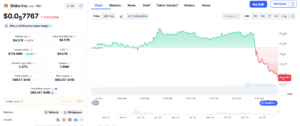
Shiba Inu trades near $0.000007767 at the time of writing, down 90.72% from its all-time high of $0.00008845 reached in October 2021. While some holders argue the decline presents a buying opportunity, Patel rejected comparisons to past market cycles.
Patel Questions SHIB’s Investment Case
Patel said Shiba Inu does not address a real-world problem and relies on attention-driven trading rather than functional use. He grouped SHIB with assets that move primarily during broader crypto market rallies instead of generating demand through internal fundamentals.
He contrasted SHIB with Bitcoin and Ethereum, saying Bitcoin is tied to monetary policy debates while Ethereum supports applications such as real-world asset tokenization. Patel said Shiba Inu does not offer a comparable function.
According to Patel, SHIB’s price action depends on market-wide conditions rather than ecosystem progress. He said updates across the Shiba Inu ecosystem have not translated into sustained demand for the token.
Patel cited Shibarium, the Shiba Inu metaverse, and the project’s decentralized exchange as examples of developments that have not produced lasting price impact. He said adoption across these initiatives remains limited based on available data.
He also said the energy that drove SHIB’s rally during the pandemic period has faded. Patel described the decline in community participation as consistent with the token’s extended price drawdown.
Patel advised investors to consider assets with clearer use cases. He pointed to Bitcoin as an option that addresses structural problems in the global financial system rather than relying on speculative trading cycles.
Transparency Questions Remain Unresolved
Patel’s comments echo criticism previously raised by parts of the Shiba Inu community. Some critics have questioned the project’s governance structure and the use of pseudonymous developers.
These concerns followed disclosures from K9 Finance DAO, Shiba Inu’s official liquid staking partner. K9 Finance said SHIB developers stopped responding to messages related to recovery efforts following the Shibarium Bridge exploit. The K9 Finance team said it may reassess its relationship with the ecosystem if affected users do not receive compensation.
Patel also cited Shiba Inu’s token supply as a structural limitation. SHIB has a circulating supply of roughly 589 trillion tokens. Critics argue that the size of the supply restricts upside potential and undermines long-term price targets.
Large-scale token burns remain uncertain. Most SHIB tokens are held by investors, and existing burn mechanisms rely on voluntary participation rather than protocol-enforced reductions.
Patel said these factors outweigh Shiba Inu’s speculative appeal and urged investors to approach the token with caution.


