



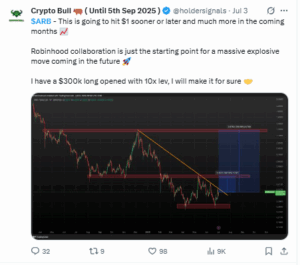
Analysts say Arbitrum’s native token ($ARB) will reach $1 “sooner or later.” One analyst claims to have opened a $300,000 long position using 10x leverage to back this target. At the time of these posts, $ARB traded near $0.33 — about 67% below the $1 target. This statement follows a recent rebound that did not break any major resistance. No confirmed new partnership or upgrade directly supports this forecast so far.
The recent price spike began on June 29 when Robinhood Crypto promoted what it called its “biggest crypto announcement of the year” at Cannes. The event featured Ethereum co-founder Vitalik Buterin, Robinhood Crypto’s Johann Kerbrat, and A.J. Warner from Offchain Labs. The announcement triggered speculation that Robinhood could integrate Arbitrum’s technology into its planned blockchain infrastructure for European stock trading.
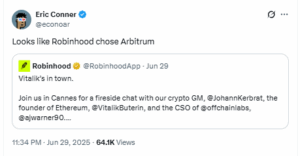
Former Ethereum developer Eric Conner posted that ‘Robinhood chose Arbitrum,’ which spread speculation of a direct partnership. The rumor pushed ARB up by about 17% before early investor wallets moved more than 16 million tokens to centralized exchanges within 12 hours. The timing pointed to classic “buy the rumor, sell the news” behavior, which erased most of the gains.
Big TVL Can’t Offset Whale Supply Risk
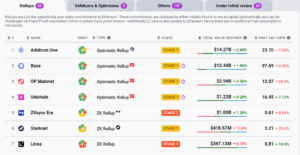
Arbitrum remains the largest Ethereum Layer 2 by total value locked. It holds over $2.5 billion in TVL, ranking above Optimism, Base, zkSync, and Starknet. TVL measures how much capital is locked for decentralized finance and scaling.
However, large token supply continues to weigh on price structure. The maximum supply is about 10 billion ARB, with roughly 5 billion in circulation. Arbiscan data shows the Arbitrum DAO Treasury holds about 27% of total supply, while a Binance wallet holds around 4.3%. After the June rumor rally, early investor wallets moved more than 16 million ARB to exchanges, showing that large holders can quickly add new supply when price jumps.
On-chain user activity does not back the $1 target for now. Arbitrum’s daily active addresses peaked near 75,000 when price traded above $2. Today, daily active wallets average about 7,000 to 8,000 — more than 80% below peak levels.
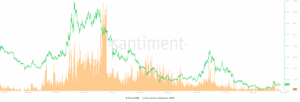
DeFiLlama data shows that DEX volumes, chain fees, and chain revenue have remained mostly flat since 2022 highs. Usage has not yet matched the levels needed to reverse the downtrend.
ARB Price Chart Holds Lower Highs, Base Shows No Breakout
The daily chart from TradingView shows ARB inside a downtrend channel that has lasted more than a year. ARB Price keeps forming lower highs and lower lows. At press time, ARB trades near $0.33, holding just above its Immediate Base near $0.32.
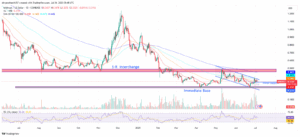
This base has acted as a floor since May but has not proven strong enough to confirm a trend reversal. The Relative Strength Index remains around 50, showing neutral momentum with no clear breakout signal.
Above current levels, the chart outlines an S-R Interchange zone near $0.44 to $0.45. Price would need to gain about 35% from here to test this resistance before facing the 200-day Exponential Moving Average near $0.448. If the chart does not close above these levels, the downtrend remains intact.
Daily trading volume for ARB sits near $240 million, below its 30-day average of about $300 million. This shows that no large new buying wave has appeared yet. Over the past month, $ARB dropped about 9%, slightly outperforming Optimism’s 15% drop in the same period. Ethereum trades stable near $2,554, giving Layer 2 networks a neutral macro backdrop but no extra boost.
Break $0.45, Reclaim 200-Day EMA or $1 Stays Far
For ARB to reach $1, price must hold the Immediate Base near $0.32, break above the S-R Interchange near $0.45, and close above the 200-day EMA with daily volume higher than its recent average. Supply held by the DAO Treasury, large wallet concentrations, and flat usage continue to weigh on price action. No major governance proposal or upgrade is confirmed this month. Without new catalysts and stronger demand on-chain, the $1 target stays unconfirmed.
Chart structure, user trends, large holder supply, and revenue trends show why the target remains speculative for now.


