



Sony’s Connectia Trust applied for a U.S. national banking charter to issue stablecoins and provide crypto custody. The filing signals a regulated route that aligns with Astar’s partnership network. It places compliant rails beside Astar’s stack.

Startale, Astar’s core developer, co-builds Soneium with Sony. That tie gives Astar a direct path into Sony’s enterprise distribution once approvals arrive. The charter process remains pending, but the intent is clear.
Consequently, Astar’s enterprise positioning tightens. A licensed stablecoin issuer in the same orbit as Soneium would anchor payments, settlement, and custody across Astar’s ecosystem.
Phase-2 roadmap advances through public governance
Astar moved “Evolution Phase-2” from planning to an open RFC. The thread outlines token mechanics, interoperability, and the Burndrop concept. The team collects feedback before posting a final proposal.
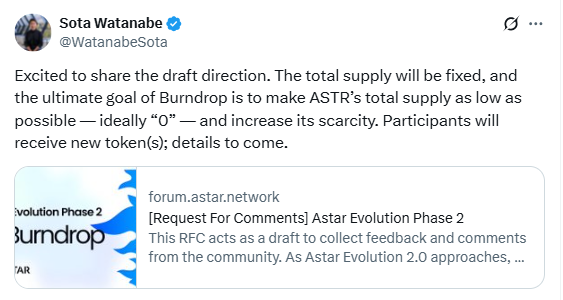
Phase-2 follows the earlier “1.5” step that aligned Astar with Soneium and the OP Superchain. The goal is a cleaner design with fewer overlapping components. It centers ASTR around cross-chain utility and governance.
The process stays transparent. Community discussion precedes implementation, and the proposal will formalize next steps after review.
Soneium replaces zkEVM as core execution path
Astar deprecated its zkEVM and directs builders to Soneium. The change removes duplicated execution layers and simplifies documentation and tooling. Developers migrate or deploy on Soneium going forward.
Soneium targets consumer and enterprise workloads. It delivers a single, supported environment instead of split pathways. That clarity reduces integration friction.
The shift also concentrates ecosystem resources. One execution track helps unify liquidity, support, and onboarding.
Astar’s cross-chain plan leans on Chainlink CCIP. CCIP allows assets and messages to move across networks with standardized security. It replaces fragile custom bridges.
This approach matches industry priorities. Institutions demand verifiable controls for cross-chain movement. CCIP provides a common framework that Astar can adopt quickly.
Together with Soneium, CCIP forms the backbone for Astar’s multi-network operations. It keeps developers focused on products rather than bespoke bridging.
Market climate supports enterprise-grade chains
Regulatory work around stablecoins and institutional rails continues to shape today’s market. That environment favors ecosystems that connect to compliance and banking infrastructure. Astar’s Sony link fits that trajectory.
Layer-2 competition remains intense, yet distribution matters as much as features. Astar’s corporate access offers a distinct route to adoption. It emphasizes onboarding partners over retail campaigns.
As enterprises test tokenized workflows, they seek networks with governance clarity and cross-chain reach. Phase-2 and CCIP position Astar to meet those requirements.
Operational notices highlight airdrop scheduling and migration steps tied to the zkEVM sunset. These items are procedural, not feature launches. They keep users aligned with the current stack.
Treasury and committee posts continue to document mandates and allocations. This reporting explains how resources fund growth and liquidity programs. It also sets expectations on risk controls.
With Phase-2 underway, Astar’s near-term focus is consolidation and interoperability. Execution shifts to Soneium, while governance steers token design and cross-chain utility.
Claims of treasury dumping spark controversy around ASTER
A post by Wimar.X on X alleged that the AsterDex treasury sold 450 million ASTER tokens, claiming the move was worth roughly $600 million and tied to prior airdrop fee revenues. The post further accused major players of influencing supply and liquidity, stating that treasury actions pressured the market and concentrated control. The claims circulated widely on social media and added tension to ongoing debates about token distribution and transparency.
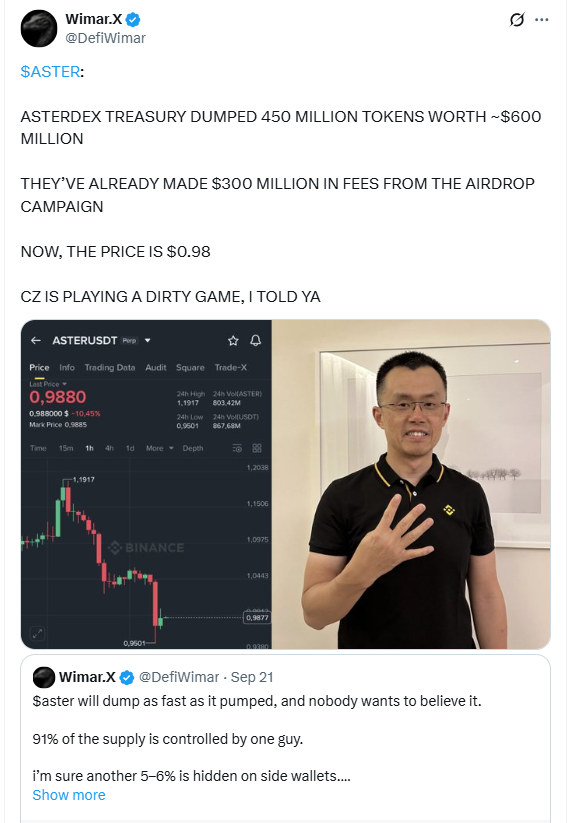
The author also referenced a chart showing ASTER trading below the one-dollar mark, using it as evidence of a sharp retracement following earlier gains. In addition, the post revived centralization concerns by alleging that more than 90% of the supply sits under one party’s influence. These comments amplified community speculation around treasury behavior, exchange incentives, and internal decision-making.
As of now, the allegations remain unverified, and no official statement has addressed the specific numbers shared in the post. However, the discussion highlights a clear theme: market participants want clarity on treasury movements, unlock schedules, and governance safeguards. Until a formal response arrives, the community debate is likely to continue across social channels.
ASTER tests trend line as support holds
Crypto King’s 4-hour chart shows ASTER pressing a descending trend line into horizontal support near $0.92. Sellers lost momentum as candles tightened along that base, while wicks into support were bought. This behavior often signals exhaustion at the end of a short-term down move.
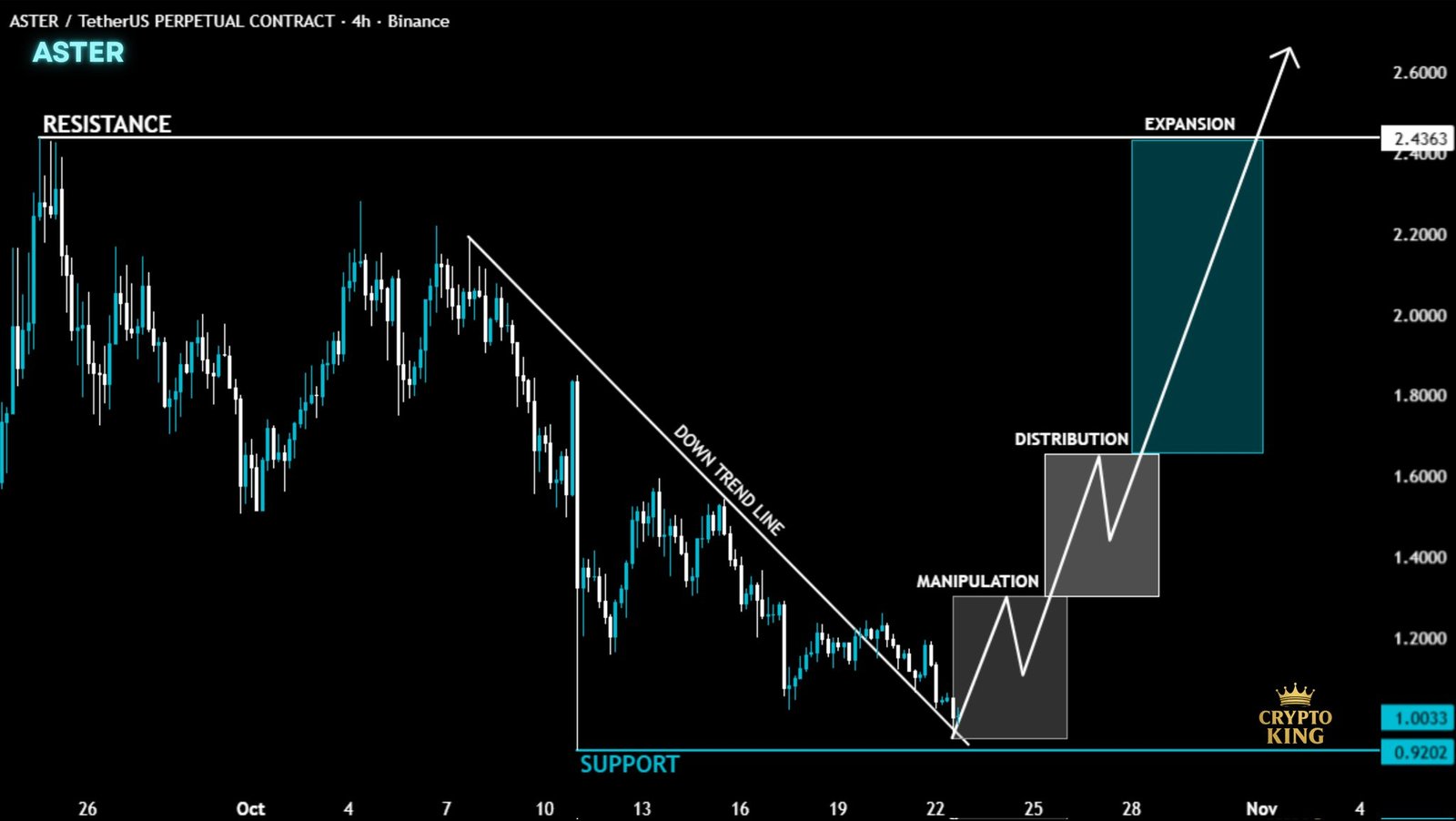
The chart outlines a simple trigger: a clean break above the downtrend line, followed by a retest that holds as support. If buyers defend that retest, momentum can shift from supply to demand. The graphic labels the early bounce as “manipulation,” then maps a higher-low sequence into a “distribution” box, illustrating how structure could rebuild before any expansion.
The author marks $2.43 as the upside objective and keeps $0.92 as the invalidation area. Those levels frame risk and reward, not certainties. Therefore, confirmation matters: watch for sustained closes above the trend line, shrinking downside wicks at the retest, and rising participation on green candles. Together, these signals would support the reversal case shown on the chart.
ASTER RSI nears oversold as momentum compresses
The 14-period RSI sits near 32, pressing the lower band of the neutral zone. Momentum cooled steadily through mid-October, and the oscillator failed to hold above 50 on recent bounces. Therefore, sellers still control the short-term tape.
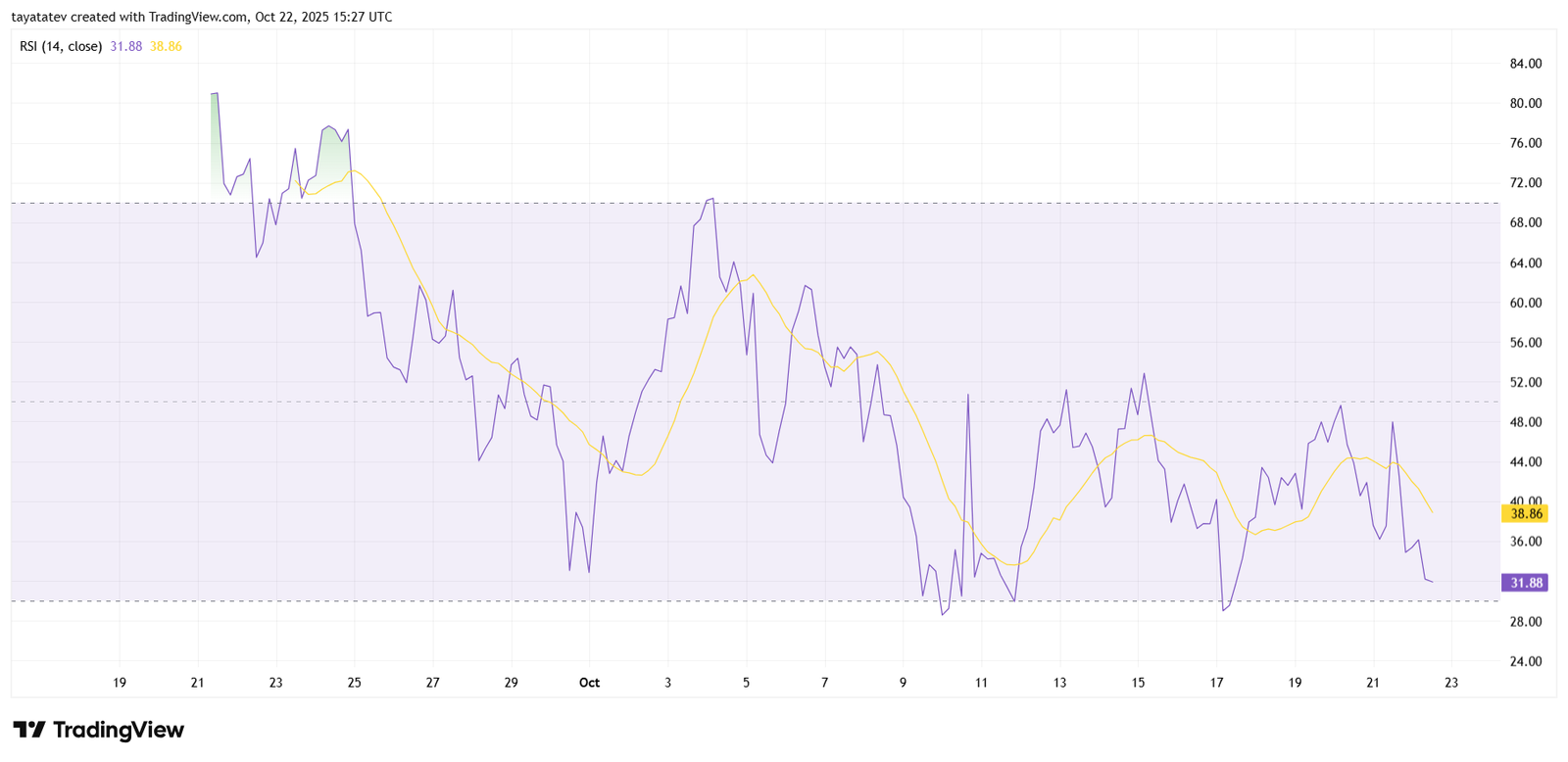
However, the RSI’s moving average (yellow) is flattening around 39–40, which often precedes a direction change. If RSI reclaims 40 and then 50 with higher lows, momentum would shift from defense to repair. Until then, repeated fades below 40 keep pressure on the underlying trend.
Watch two signals next. First, a clean RSI break and hold above its moving average would confirm improving force behind bids. Second, any bullish divergence—RSI making a higher low while price prints a lower low—would flag exhaustion. Absent those, sub-40 RSI readings imply continued risk of drift or further tests of support.


