



Australia’s corporate regulator released updated ASIC crypto guidance and set clear steps for compliance. Firms offering crypto services that count as financial products must apply for an AFSL license and join AFCA membership by June 30. The update appears in Information Sheet 225 and aligns Australia crypto regulation with existing financial laws.
The ASIC crypto guidance moves qualifying services into the AFSL license regime. It also requires dispute handling through AFCA membership. The rule establishes a near-term pathway while Parliament considers broader changes.
The Treasury consultation on draft legislation finished on Friday. That process supports Australia crypto regulation by extending finance-sector laws to crypto service providers. Until then, the ASIC crypto guidance governs how firms seek an AFSL license and maintain AFCA membership.
Bitcoin not a financial product under Australia crypto regulation
John Bassilios, partner at Hall & Wilcox, drew a key line in the ASIC crypto guidance. Under the update, Bitcoin not a financial product remains the position, alongside gaming NFTs and tokenized concert tickets. That boundary affects AFSL license needs.
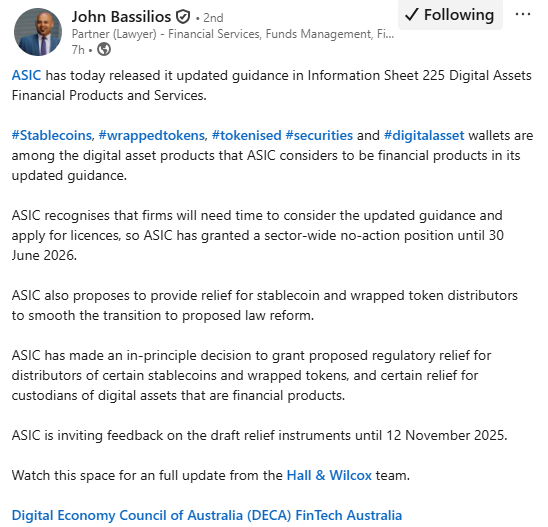
“If you’re an exchange and you only deal in Bitcoin, then you don’t need to apply for a license based on that guidance,”
he said. The statement clarifies how Australia crypto regulation applies when assets fall outside the financial product test.
This classification limits obligations for pure-Bitcoin venues. However, exchanges must still assess each asset against the ASIC crypto guidance. Consequently, Bitcoin not a financial product does not remove other duties that may apply elsewhere.
Stablecoins, wrapped tokens, and tokenised securities fall inside AFSL license scope
The ASIC crypto guidance lists stablecoins, wrapped tokens, tokenised securities, and digital-asset wallets as financial products. Therefore, providers dealing in these assets require an AFSL license and AFCA membership. This list anchors Australia crypto regulation in practical categories.
According to John Bassilios, the scope can include yield-bearing stablecoins, tokenised real estate, and tokenised bonds. It can also capture staking as a service where terms include minimum balances or lock-up periods. Structure, not labels, drives the classification under the ASIC crypto guidance.
ASIC also gave in-principle relief for some stablecoin and wrapped token distributors. The relief aims to smooth the shift while Treasury consultation advances. It does not override the need for an AFSL license where the guidance applies.
Implementation risks: expertise, banking access, and insurance capacity
Steve Vallas, CEO of Blockchain APAC, said the ASIC crypto guidance sets a demanding standard.
“ASIC has chosen to operationalise policy ahead of law reform,”
he noted. He added that interpretation now fills gaps while Australia crypto regulation evolves in Parliament.
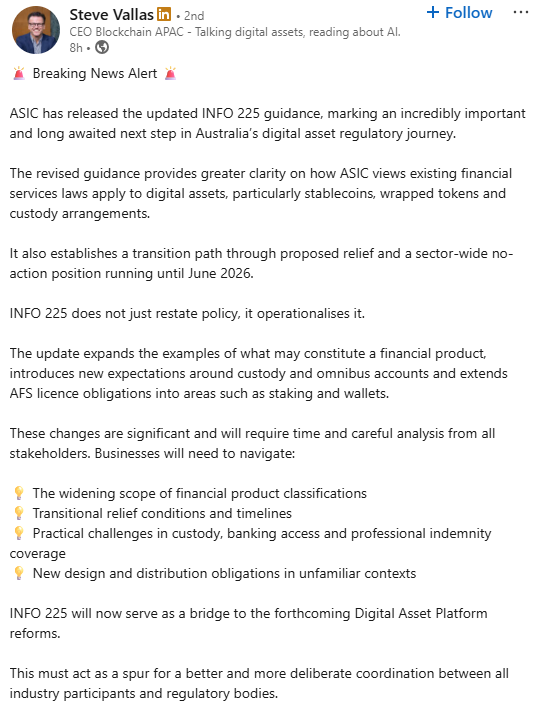
Vallas pointed to resourcing as the near-term risk. He cited limited recognised local expertise, banking access, and insurance capacity. These constraints can slow uptake of AFSL license requirements and AFCA membership obligations.
“Without practical solutions, compliance risks shifting from a legal challenge to a logistical one,”
he said. Under the ASIC crypto guidance, firms may meet policy on paper yet struggle with execution due to service availability.
Industry reaction: long-awaited clarity and ASIC processing concerns
Amy-Rose Goodey, CEO of the Digital Economy Council of Australia, said the sector waited for this ASIC crypto guidance. “It gives us an indication and that visibility on ASIC’s position, how they’re going to treat the businesses within the digital asset sector, which we were not fully across until this point,” she said. Her remarks reflect the push for predictable Australia crypto regulation.
Goodey raised concerns about ASIC capacity to process AFSL license applications at scale. Timely decisions will matter as firms align with AFCA membership rules and the ASIC crypto guidance. Volume could rise quickly before the June 30 date.
She described a transition stage across the industry. Businesses are restructuring and reviewing which permissions they need under Australia crypto regulation. That work runs alongside the Treasury consultation and any subsequent law changes.


