


Avalanche and Toyota Blockchain Lab are designing infrastructure for autonomous robotaxi fleets. The project introduces a blockchain layer called the Mobility Orchestration Network (MON).
The proof-of-concept is based on Avalanche’s multichain framework and Interchain Messaging (ICM). It aims to enable secure data sharing for vehicle financing, ride sharing, insurance, carbon credit tracking, and ownership transfers in secondary markets.
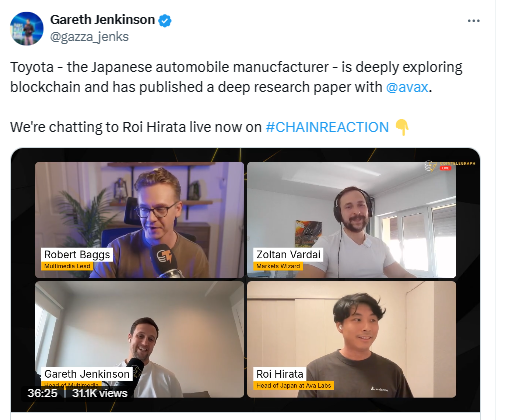
Roi Hirata, head of Japan at Ava Labs, explained that the network would “orchestrate trust and unlock mobility’s value.” The MON system is positioned as a foundation for future robotaxi operations onchain.
Robotaxi Infrastructure Designed for Onchain Business Models
The MON network connects blockchain to the financial and operational structure of robotaxis. During Cointelegraph’s Chain Reaction live X spaces show, Hirata described how payments and leasing could be managed through blockchain.
“The payments, the leasing, you can actually start your own robotaxi services by raising funds onchain, with some kind of security token system,”
Hirata said.
This setup allows investors to raise funds onchain and monitor robotaxi operations directly through blockchain records. The system could support fully onchain business models for autonomous fleets.
Avalanche and Toyota Blockchain Emphasize Regulatory and Manufacturing Role
Despite the proof-of-concept, Avalanche and Toyota Blockchain noted challenges remain. Hirata stated that regulators and manufacturers need to support blockchain-based recordkeeping for mobility.
“There’s always an official record in different countries, different formats. So having that and the manufacturer working together on a blockchain is the most key task that we have to tackle,”
Hirata said.
Manufacturers present greater onboarding challenges than regulators, and coordinating official records with blockchain ledgers remains essential for robotaxi infrastructure.
Tokenizing Mobility as a Blockchain Trend
The Avalanche and Toyota Blockchain project signals tokenizing mobility as a new sector for blockchain adoption. Tokenization could help manage vehicle ownership, usage, and financing across decentralized applications.
Mobility systems involve multiple layers, making tokenization on blockchain critical for areas such as insurance, carbon credits, and ride sharing. Avalanche’s blockchain framework is being tested to handle these demands.
Other groups are also developing tokenized assets on Avalanche. Grove, a credit protocol backed by Steakhouse Financial, is targeting $250 million in tokenized real-world assets. The effort includes collaboration with Janus Henderson, a global asset manager overseeing $373 billion.
Avalanche and Toyota Blockchain Highlight Mobility Use Cases
Meanwhile, Avalanche and Toyota Blockchain’s MON initiative shows how blockchain can expand into the mobility sector. The network aims to connect vehicle ownership, financing, and service records directly to blockchain.
By linking decentralized infrastructure with transportation, the MON system positions autonomous robotaxis as a next stage for blockchain-based mobility. The proof-of-concept outlines both the technical requirements and potential scale of tokenized mobility on Avalanche.


