



On June 22, 2025, Bitcoin (BTC) miner revenue dropped to $34 million — the lowest since April 20. CryptoQuant’s Miner Profit/Loss Sustainability metric shows miners are now the most underpaid they’ve been since July 2024. The sharp revenue decline is driven by weaker transaction fees and reduced block rewards after the April halving.
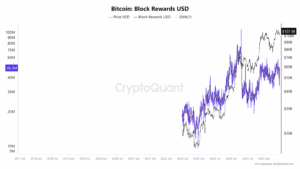
Despite this income squeeze, miners are not selling their BTC. Instead, they are quietly accumulating — signaling long-term conviction over short-term pressure. A similar pattern occurred in early 2024 before Bitcoin surged from $45K to over $70K.
Bitcoin Miner Outflows Down 74% Since February
Rather than selling into weakness, miners have tightened supply. Outflows from miner wallets have dropped from 23,000 BTC per day in February 2025 to just 6,000 BTC now. Direct transfers to exchanges remain low. Meanwhile, wallet addresses holding 100–1,000 BTC have increased their reserves from 61,000 BTC in March to 65,000 BTC by late June — the highest level since November 2024.
This behavior echoes late 2022, when BTC fell to ~$16K after the FTX collapse. Despite low prices, miner outflows dropped, accumulation picked up, and Bitcoin rebounded to $30K by mid-2023.
While miner outflows remain low, operational stress is showing up in the network’s hashrate. Since June 16, Bitcoin’s total hashrate has fallen by 3.5% — the largest drawdown since July 2024.

This is modest compared to what happened in mid-2021, when China banned Bitcoin mining. At that time, hashrate collapsed by more than 50% — from 180 EH/s to below 90 EH/s between May and July. Despite the revenue shock, miners didn’t liquidate heavily. Instead, Bitcoin bottomed near $30K in July 2021 and rallied to $69K by November. That cycle showed how miner resilience amid network stress can precede a major recovery — a pattern that may be reemerging in 2025.
One reason miner revenues remain low is the collapse in fee markets. After a temporary spike in Q2 due to inscription traffic, total daily fees have dropped below $5 million. Without robust fee income, miners rely heavily on block rewards — which have also declined due to the halving.
Hashprice and Exchange Reserve at Multi-Year Lows
The hashprice — which measures miner earnings per unit of hashrate — has dropped to multi-year lows. This means that even as difficulty remains high, miners are earning less BTC per terahash than at any other time since 2020.
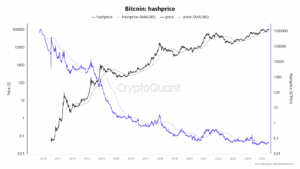
This confirms the growing imbalance between operational costs and reward potential — and yet, miners continue to hold.
While miner behavior signals a refusal to sell, the broader market shows this tightening supply. According to CryptoQuant, BTC balances on centralized exchanges have declined from over 3.2 million in July 2022 to just 2.4 million in June 2025 — a 25% drop. With fewer coins available on exchanges, any rise in demand could quickly overwhelm circulating supply.
Adding to the demand side, U.S.-listed spot Bitcoin ETFs posted a net inflow of $547.7 million on June 25, following redemptions earlier in the month. Over the last 10 trading days, ETFs have attracted more than $1.1 billion — averaging $113 million per day.
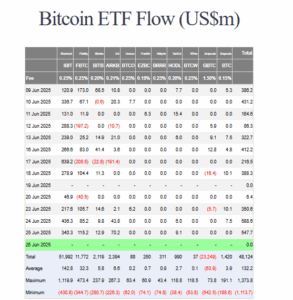
ETF demand played a key role in the Q1 2024 rally, absorbing miner-supplied BTC while reserves were already falling. That dynamic seems to be building again.
Beyond ETFs, corporations are also stepping in to acquire Bitcoin directly. On June 26, Metaplanet Inc. — a Japanese public company — acquired 1,234 BTC, bringing its total to 12,345 BTC. The company has outlined a strategy to accumulate 210,000 BTC by 2027. Corporate treasuries like Metaplanet absorb additional supply and reinforce long-term hoarding trends.
Is a Bitcoin Supply Squeeze Already Underway?
Bitcoin’s supply dynamics are tightening from multiple directions. Miners remain underpaid, transaction fees are low, and hashprice has dropped to multi-year lows. Despite these pressures, miner outflows have not increased. In fact, reserves are rising steadily. At the same time, Bitcoin balances on centralized exchanges have fallen sharply, while ETFs and corporate treasuries continue absorbing what’s left of the available supply.
This combination has occurred before. In mid-2021, when China banned Bitcoin mining, the network’s hashrate collapsed by over 50%. Yet miners didn’t sell. Instead, they held their coins, and Bitcoin doubled in price — rising from around $30K in July to nearly $69K by November.
In late 2022, following the FTX collapse, Bitcoin plunged to ~$16K. But as miner outflows slowed and accumulation resumed, the market began recovering. By mid-2023, BTC had returned to the $30K level.
More recently, in early 2024, miners began increasing their reserves just as ETF inflows gained momentum. The result was a strong rally — Bitcoin surged more than 55%, moving from $45K in January to over $70K by April.
If demand continues to grow, especially from institutional channels, today’s miner accumulation could again act as the trigger for another supply-driven breakout.


