


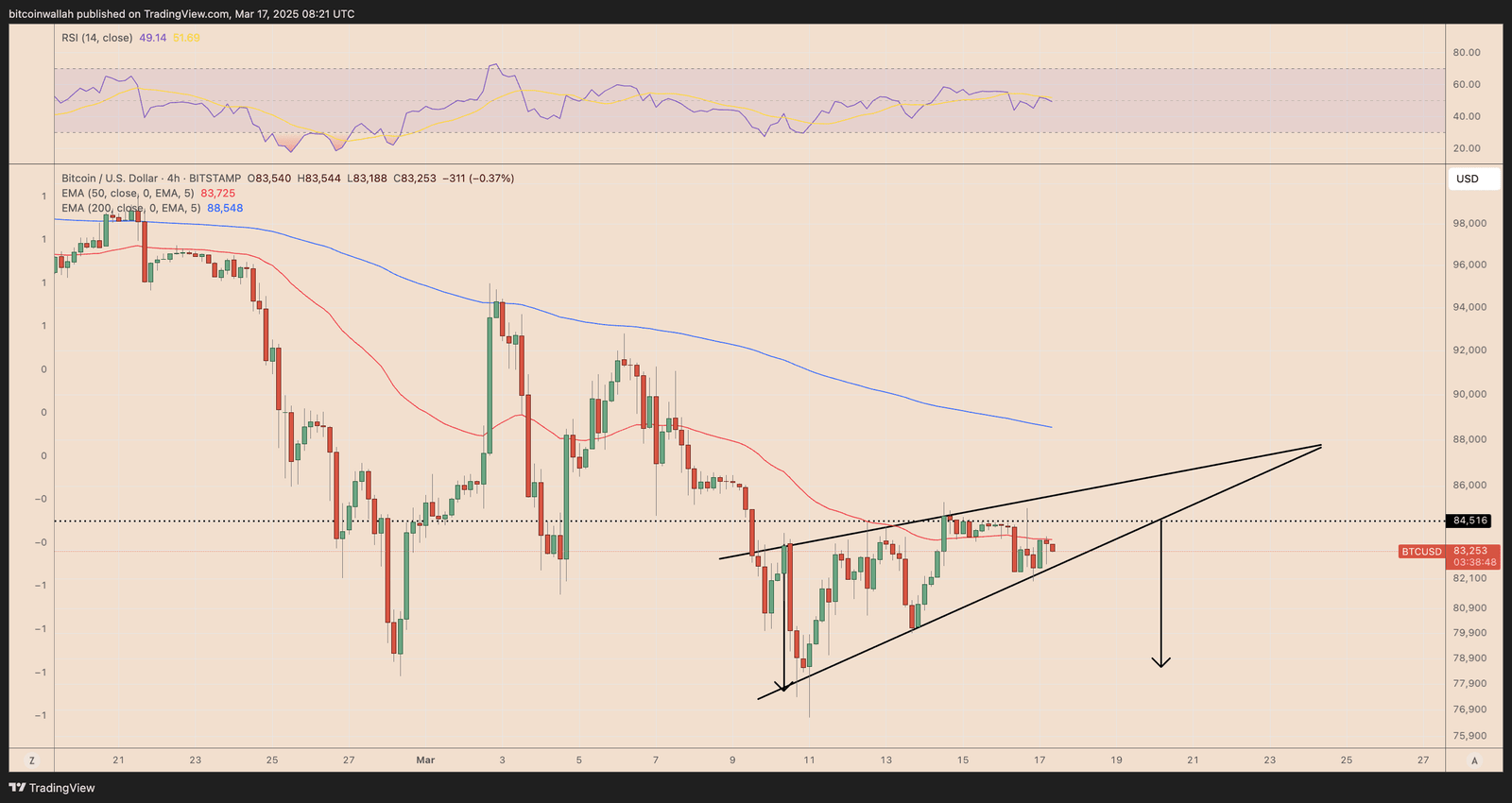
YEREVAN (CoinChapter.com) — Bitcoin (BTC) is trading near $83,253 after failing to break above key resistance levels. A rising wedge pattern, a bearish technical indicator, signals a potential decline below $80,000 in the coming days. The pattern, which has been forming since March 9, suggests weakening momentum, with Bitcoin facing rejection near the 50-day exponential moving average (EMA) at $83,725.
If Bitcoin fails to hold its current levels, the measured move projection points to a decline toward $78,000-$79,000. Meanwhile, the 200-day EMA at $88,548 remains a major resistance zone, restricting Bitcoin’s upside potential.
ECB Official Warns Against Pro-Crypto Policies
Bitcoin’s decline coincides with criticism from European Central Bank (ECB) Governing Council member François Villeroy de Galhau, who warned that Trump’s pro-crypto policies could trigger a financial crisis. In an interview with La Tribune Dimanche, he claimed that the U.S. is “sowing the seeds of future upheavals” by encouraging crypto-assets and non-bank finance.
Villeroy contrasted this with Europe’s stricter regulatory approach, arguing that the EU faces no such risks. He also advocated for the euro’s stronger international role, proposing a European savings and investment union to attract global capital.

US CPI Slows, Impacting Fed Rate Policy and Bitcoin
The latest US Consumer Price Index (CPI) report showed inflation rising at its slowest pace in four months. February CPI increased 0.2%, down from 0.5% in January, while Core CPI, excluding food and energy, also rose 0.2%. A drop in car and gas prices contributed to the slowdown, offering relief to American households.
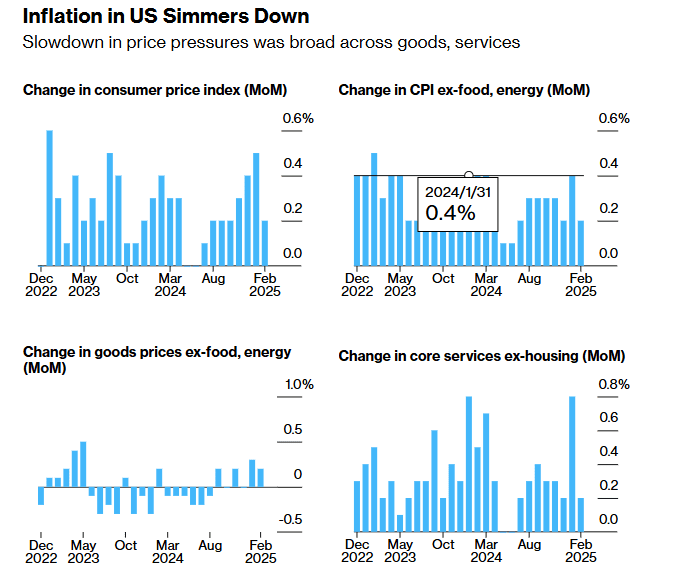
However, economists warn that rising tariffs could reverse this trend, increasing costs on food, clothing, and other goods. Kathy Bostjancic, chief economist at Nationwide, stated that while the CPI report is positive, it is “old news” and does not indicate lasting disinflation momentum.
For Bitcoin, slower inflation reduces the urgency for the Federal Reserve to raise interest rates, which could support risk assets in the short term. However, if tariffs push inflation higher, the Fed may tighten monetary policy, strengthening the US dollar and pressuring Bitcoin further.
Regulatory Uncertainty Adds Risk to Bitcoin’s Outlook
Trump has positioned himself as a strong Bitcoin advocate, recently signing an executive order to establish a Strategic Bitcoin Reserve. At the same time, the SEC has dropped multiple lawsuits against crypto firms under his administration.
While these moves have boosted optimism in crypto markets, growing criticism from global regulators could undermine institutional confidence. If Bitcoin fails to hold technical support levels, the bearish wedge pattern could accelerate a decline toward the $78K-$80K range.


