



YEREVAN (CoinChapter.com) — Bitcoin miners faced lower production in January 2025 as Bitcoin mining difficulty increased. The difficulty of confirming transactions and mining new Bitcoin reached 110 trillion (T), marking an all-time high. Since the Bitcoin halving on April 20, 2024, difficulty has surged 27.8%, making it harder to mine new blocks. Many miners upgraded equipment and adjusted operations to manage the rising computational power requirements.
While most mining firms struggled with declining production, Riot Platforms recorded a 2.1% increase in Bitcoin output, standing apart from the industry trend.

Hut 8, Marathon Digital, and Bitfarms Report Declining Bitcoin Production
Bitcoin miners saw their production decrease as network difficulty climbed. Hut 8 mined 65 BTC in January, a 27% drop compared to the previous month. Marathon Digital (Mara) also reported a decline of 12.5%, while Bitfarms recorded a 4.7% decrease in production.
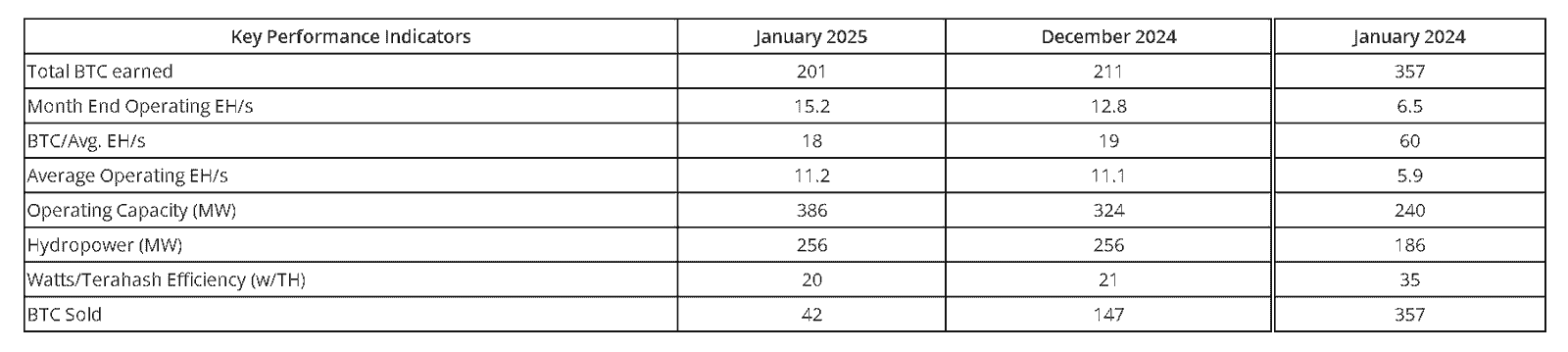
Bitfarms monthly Bitcoin production. Source: Bitfarms
The growing difficulty in mining new blocks forced miners to allocate more resources to maintain operations. Companies without access to cost-efficient infrastructure or advanced mining rigs faced steeper production declines.
Riot Platforms Expands Bitcoin Mining Capacity
Riot Platforms managed to maintain Bitcoin production by expanding its operations. In January, the company launched a 1-gigawatt mining facility in Texas, increasing its overall mining capacity. The expansion contributed to steady output despite rising network difficulty.
Riot Platforms CEO Jason Les confirmed that new mining rigs and immersion cooling systems helped improve hash rate performance. He stated:
“The Corsicana Facility reached a deployed hash rate of 15.7 EH/s towards the end of the month. We also continue to see strong results from newly deployed miners and immersion systems reflected in the significant improvement in our operational hash rate and utilization rates.”
Meanwhile, Hut 8 CEO Asher Genoot announced ongoing infrastructure upgrades that are expected to boost mining capacity in the near future.
BTC Hashrate and Mining Difficulty Show Slight Drop
In January 2025, Bitcoin’s mining difficulty reached an all-time high of 110 trillion (T), making it more challenging for miners to confirm transactions and mine new blocks. However, in the final week of January, the difficulty decreased by 2.12% to 108T, marking the first decline in nearly four months. This adjustment provided some relief to miners after eight consecutive increases.
The Bitcoin hashrate, which measures the total computational power securing the network, stood at approximately 832 exahashes per second (EH/s) during this period. Recent cold weather across the U.S. led some mining companies to temporarily reduce operations, contributing to the decline in difficulty. As conditions improved, these companies began resuming capacity, with Bitcoin’s three-day average hashrate rebounding above 800 EH/s following the adjustment.
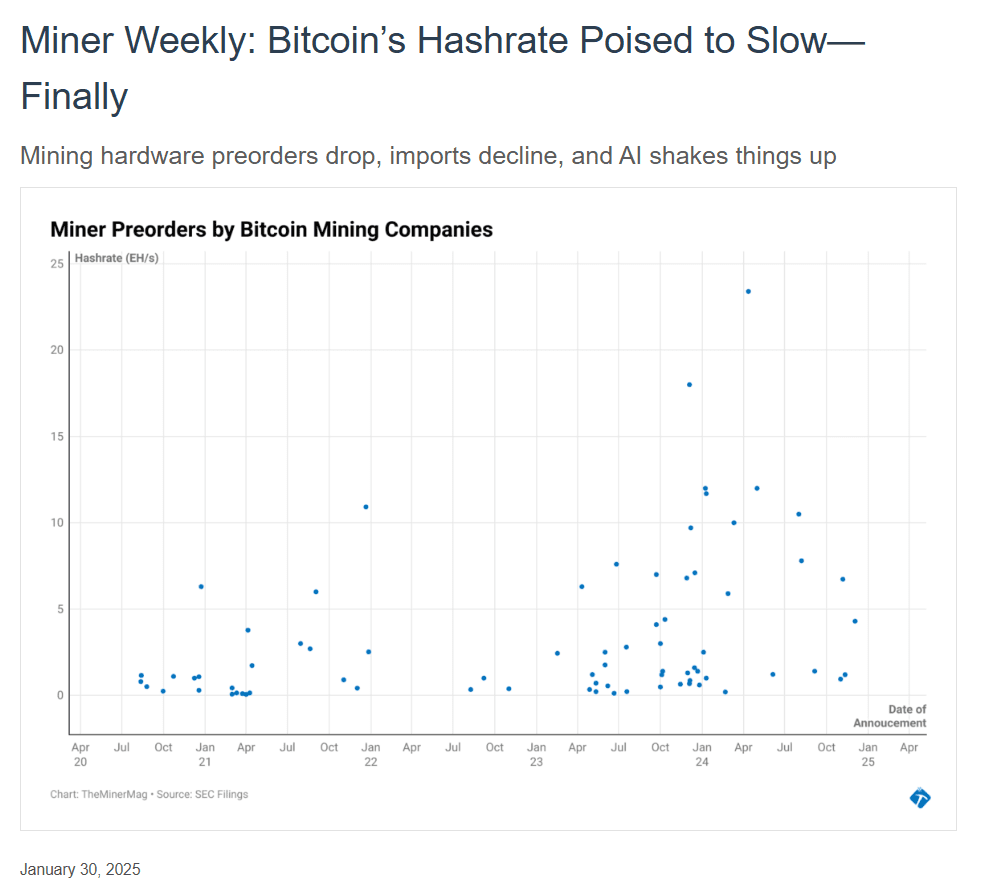
Additionally, data indicates that institutional mining firms had increased hardware purchases in the third and fourth quarters of 2023, leading to a significant post-halving hashrate surge. However, hardware purchasing activity cooled down in the second half of 2024, suggesting that the rapid growth in mining competition may be slowing. This trend is supported by a decline in exports of leading machines—including WhatsMiner, Avalon, and Antminer—to the U.S. in the latter part of 2024.
In response to evolving market dynamics, some mining firms are diversifying their operations. For example, Riot Platforms recently paused a 600-megawatt Bitcoin mining expansion in Texas. The company is reserving that capacity for potential AI/high-performance computing hosting. Similarly, Bitfarms signed a binding letter of intent with HIVE to sell its unfinished 200 MW Bitcoin mine in Paraguay for $85 million in cash. The company plans to reinvest the proceeds into its 1-gigawatt U.S. expansion, which includes Bitcoin and AI/HPC infrastructure.
The Bitcoin mining industry continues to adapt to shifting network conditions as firms deploy more efficient mining hardware and adjust operations.


