



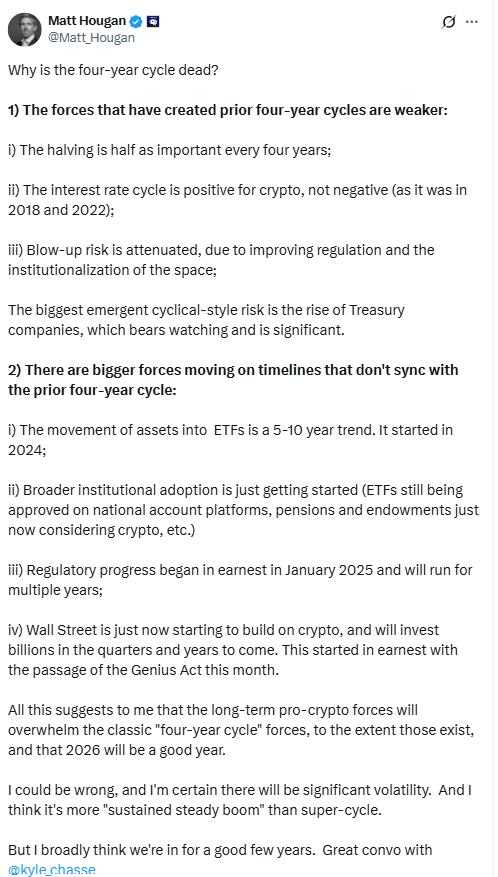
Matt Hougan, Chief Investment Officer at Bitwise Asset Management, says 2026 will likely be a strong year for Bitcoin. In a recent X video posted on July 25, Hougan stated,
“I bet 2026 is an up year.”
He added,
“I broadly think we’re in for a good few years.”
The comments challenge the widely accepted four-year cycle theory. According to this theory, Bitcoin’s price peaks within 12 to 18 months after each halving. The most recent halving took place in April 2024, cutting the mining reward to 3.125 BTC. Based on past behavior, some analysts expect the market to peak around October 2025.
However, Hougan disagrees. He argues the halving has become “half as important” every four years. The reason, he says, is the diminishing size of the reward relative to total Bitcoin supply. That effect, once significant, now carries less weight in today’s larger market.

Bitwise Cites Lower Risk and Rate Shift as Key Bitcoin Drivers
Hougan also mentioned changing macroeconomic conditions as part of his reasoning. Since April, former U.S. President Donald Trump has urged Federal Reserve Chair Jerome Powell to cut interest rates. Lower rates often push investors away from traditional savings assets, making risk assets like crypto more attractive.
In the video, Hougan said,
“The interest rate cycle is positive for crypto.”
He added that improving regulatory clarity has also reduced volatility.
“Blow-up risk is attenuated, due to improving regulation and the institutionalization of the space,”
he said.
That institutional growth, according to Hougan, is still in its early stage. Because of that, he believes the upside for Bitcoin remains open, regardless of the halving timeline. He added,
“The long-term pro-crypto forces will overwhelm the classic ‘four-year cycle’ forces, to the extent those exist.”
One potential risk Hougan highlighted is the rise of Bitcoin treasury companies. These are firms that hold large Bitcoin positions on their balance sheets. “Bears watching and is significant,” he said.
VanEck Warns on Treasury Companies as Risk Builds
Asset manager VanEck also raised concerns about Bitcoin treasury firms. In a recent report, VanEck said companies issuing new stock or taking on debt to accumulate Bitcoin may face high exposure. If Bitcoin’s price drops sharply, these companies could find themselves overleveraged.
VanEck noted that many of these firms are built on the assumption of continuous price appreciation. That strategy becomes risky during corrections. The report aligns with Hougan’s concerns about this trend being a structural risk rather than a short-term volatility issue.
As Bitcoin adoption expands, corporate strategies around it may influence market behavior in ways not previously seen. These developments, according to both Bitwise and VanEck, complicate the typical halving-driven model.
Institutional Shift Changes Whale Behavior, Says CryptoQuant CEO
Ki Young Ju, CEO of on-chain analytics firm CryptoQuant, made similar comments last week. He declared that the four-year cycle “is dead,” saying old patterns no longer apply.
“My predictions were based on it — buy when whales accumulate, sell when retail joins. But that pattern no longer holds,”
he posted on X. Ju explained that in the last cycle, long-term holders sold to retail investors. This time, “old whales sell to new long-term whales,” showing a shift in investor profiles.
Ju pointed to rising institutional adoption as a key driver. While the earlier market cycles were often retail-dominated, the current phase involves larger, long-holding entities.
Rekt Capital Still Sees October as Possible Peak
Not all analysts agree with Bitwise and CryptoQuant. Rekt Capital, a crypto analyst known for historical pattern analysis, suggests the four-year cycle could still play out.
In a post earlier this month, he said Bitcoin might peak in October 2025 if the 2020 cycle repeats. That timeline places the peak roughly 550 days after the April 2024 halving, mirroring previous cycles.
Rekt Capital cautioned that if Bitcoin follows this historic route, the time left for price expansion may be limited. This view contrasts with Hougan’s projection of continued growth through 2026.
Bitcoin Price Holds Above $118K Amid Ongoing Debate
At the time of publication, Bitcoin was trading at $118,169, marking a 10.17% gain over the past 30 days, according to Nansen. The price reflects a steady increase but remains below its all-time high of $123,840 from March 2025.
With differing forecasts from firms like Bitwise, VanEck, CryptoQuant, and analysts like Rekt Capital, market participants face competing narratives. While some believe Bitcoin has entered a new institutional era, others still rely on the halving cycle as a guide.
Bitwise’s Hougan summed up his position by acknowledging uncertainty.
“I could be wrong, and I’m certain there will be significant volatility,”
he said. However, he still maintained that 2026—not 2025—may bring Bitcoin’s next major price movement.
Bitcoin Forms Falling Wedge Pattern With 13% Breakout Target
On July 27, 2025, Bitcoin created a falling wedge pattern on the 4-hour chart against the U.S. Dollar, according to data from Bitstamp via TradingView. A falling wedge is a chart formation that slopes downward and signals a potential bullish reversal or continuation. It forms when the price makes lower highs and lower lows, but the slope of the lows is less steep than the highs, creating a contracting structure. Traders usually view this pattern as a sign that selling pressure is weakening and a breakout to the upside could follow.
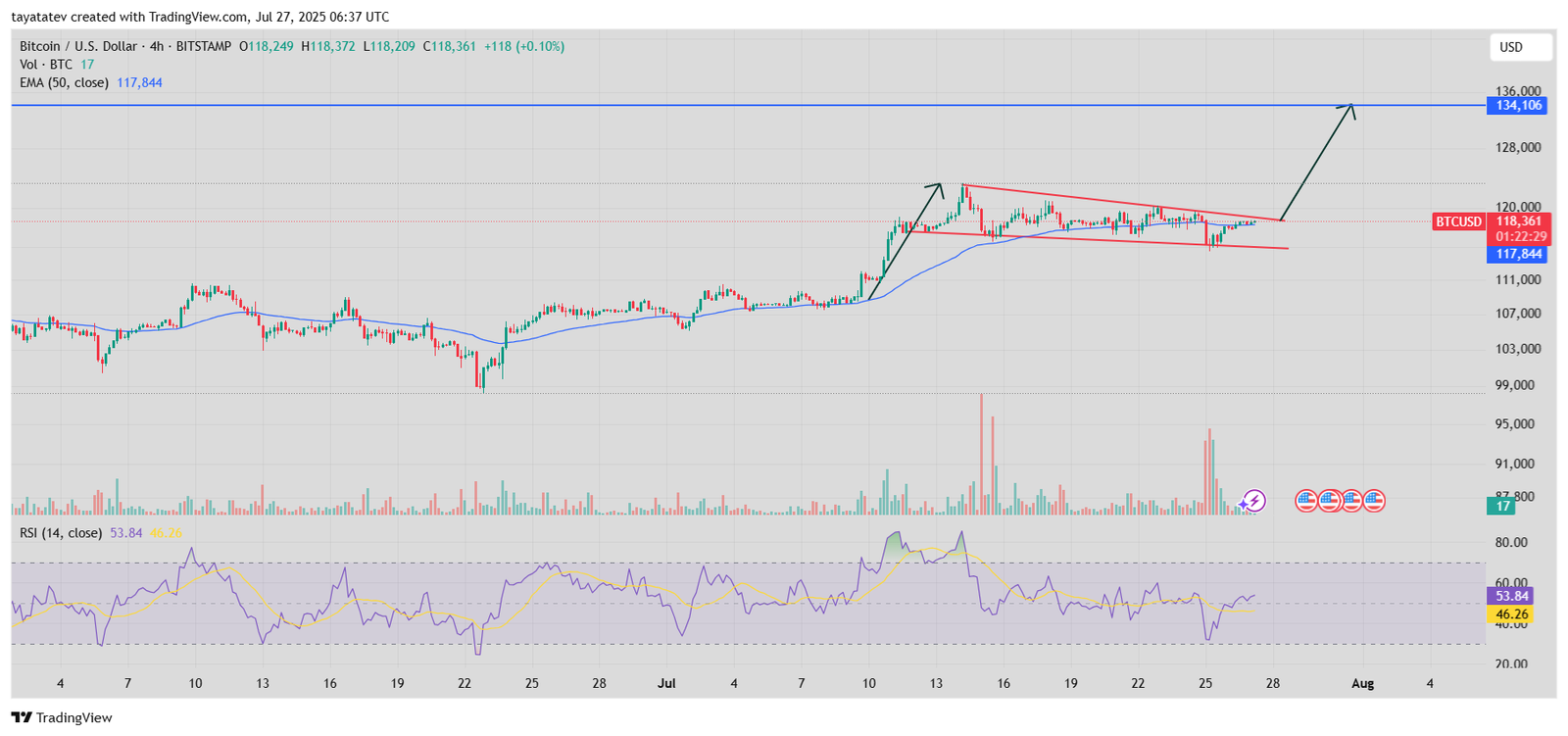
In the current setup, Bitcoin trades at $118,361, slightly above the 50-period Exponential Moving Average (EMA), which stands at $117,844. The wedge formed after a sharp rally that peaked around $122,000, followed by a consolidation phase that led into the wedge structure. Price action now shows compression within the pattern, nearing its apex. The chart also shows two red trendlines converging downward and a breakout arrow that projects a bullish move.
If the wedge breaks to the upside, the projected breakout target would be near $134,106. This figure represents a 13% increase from the current level of $118,361. The upside target was calculated by measuring the height of the wedge at its widest point and projecting it from the breakout area.
The Relative Strength Index (RSI), which measures momentum, currently reads 53.84, indicating that Bitcoin is in a neutral zone. This level leaves room for upward movement without being overbought. The RSI also crossed above its signal line of 46.26, which supports the possibility of a bullish breakout. Volume remains moderate but shows a slight uptick, suggesting interest may be building.
If Bitcoin maintains support above the 50-period EMA and breaks above the upper trendline of the wedge, the price could confirm the breakout. A successful move above this resistance would likely shift short-term momentum in favor of buyers. For now, traders are watching the $118,400–$119,000 zone closely, as a decisive move above this level could trigger the expected 13% rise.


