



Bitcoin’s recent all-time high of $112,000 may be less about geopolitics and more about Japan’s deepening bond crisis, according to Bitwise’s European Head of Research André Dragosch. The firm argues that rising yields on long-term Japanese bonds signal growing sovereign credit risks. This is prompting institutions to seek alternatives like Bitcoin, which operates independently of sovereign debt markets and is free of counterparty risk.
Long-Term Debt No Longer Looks Safe
On May 20, the 30-year Japanese Government Bond (JGB) yield surged to 3.185%, the highest in decades, before settling at 3.115% later in the week. Japan’s debt-to-GDP ratio now exceeds 250%—a structural imbalance Dragosch describes as unsustainable.

“Because yields are increasing, sustainability becomes more of an issue, meaning credit risk increases, meaning yields increase even more,” he said. “And so you end up in this kind of fiscal debt doom loop.”
Government bonds typically serve as safe-haven assets. But sharp yield increases often shows growing market concerns about a nation’s fiscal credibility. In Japan’s case, those fears are materializing across maturities, despite the Bank of Japan’s efforts to suppress long-term rates through yield curve control.
“It’s not just about Japan anymore. Volatility in the JGB market is bleeding into global fixed income, especially U.S. Treasuries,” Dragosch added.
This repricing of risk is now intersecting with digital asset flows. Bitcoin’s positioning as a stateless, supply-capped asset has made it attractive amid sovereign credit instability.
Institutions Are Quietly Buying Bitcoin
Bitcoin’s shift from speculative asset to macro hedge is being reinforced by direct institutional participation. Tokyo-listed MetaPlanet Inc. announced in April that it had purchased 117 BTC for its corporate treasury, citing yen volatility and inflation concerns. The firm has since announced plans to continue allocating capital into Bitcoin on a quarterly basis.
Meanwhile, BlackRock’s spot Bitcoin ETF, IBIT, has become one of the largest accumulators in the market. Since its January 2024 launch, IBIT has steadily absorbed inflows from institutional allocators, family offices, and macro-focused hedge funds.
These purchases are not isolated. They come as U.S. spot Bitcoin ETFs near a historic inflow record. As of May 23, cumulative inflows stood less than $1.3 billion away from surpassing November 2024’s record of $6.49 billion.
On-chain data further validates the institutional accumulation trend. Total Bitcoin exchange reserves have fallen to 2.4 million BTC, the lowest level since mid-2021. That’s down more than 25% from early 2022 levels.

Bitwise: Bitcoin (BTC) Could Target $200K
Bitwise believes macro conditions could support a further rally—especially if sovereign risk concerns deepen and Bitcoin continues attracting institutional flows. Dragosch suggests that in a scenario where corporate and ETF accumulation accelerates, BTC could target $200,000 in the coming quarters.
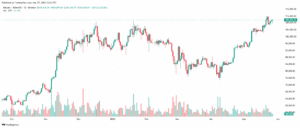
At the time of writing, Bitcoin is trading just under $110,000—up 28% year-to-date.
The broader macro environment supports this thesis. In Japan and parts of the Eurozone, the yield curve is steepening. Fiscal tightening remains politically constrained, and regulatory delays—such as the postponed implementation of the Fundamental Review of the Trading Book (FRTB) in Europe—are loosening credit risk controls.
At the same time, U.S. fiscal policy continues to drive debt issuance. With inflation still sticky and Treasury yields trending higher, market participants are increasingly looking to Bitcoin as a strategic alternative—not just a speculative one.


