


Reaching $1 isn’t just about hype for Dogecoin (DOGE) — it is about mathematics. For DOGE to climb from $0.20 to $1, its market capitalization would need to exceed $140 billion—a level greater than Solana’s all-time peak. That scale makes the $1 target extremely difficult to achieve under current conditions.
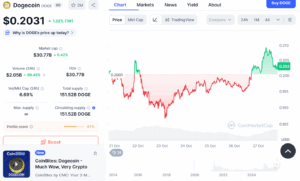
Dogecoin’s supply sits around 151 billion coins, with about 5 billion new tokens minted annually. The constant expansion limits scarcity and makes every price rally dependent on fresh capital inflows. At the current market capitalization of roughly $30 billion, achieving $1 would require an increase of more than 400% in total value within two months. That would be an almost unprecedented move for a large-cap crypto asset.
DOGE Price Structure Holds, But Momentum Is Weak
DOGE price continues to trade inside an ascending channel that has been active since early 2025. The lower boundary near $0.18 acts as reliable support. The upper boundary near $0.30 has repeatedly capped upward movement.
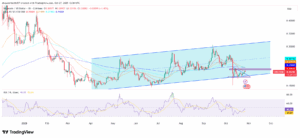
The 20-day exponential moving average (EMA) is at $0.206, the 50-day EMA at $0.219, and the 200-day EMA around $0.218—all above the current price. That alignment confirms weak buying pressure. The relative strength index (RSI) stands at 46, showing a neutral trend with no breakout momentum.
A close above $0.22 would be the first sign of short-term recovery. A breakout above $0.30 could extend gains toward $0.40–$0.45, but any failure to hold above $0.18 risks a drop toward $0.15.
Market forecasts remain divided. Some analysts see Dogecoin reaching between $1.14 and $1.69 if a broad “altcoin season” arrives between November 2025 and January 2026. These scenarios assume a repeat of the speculative mania last seen in 2021.
Institutional Signals Add Legitimacy, Not Liquidity
In September 2025, the House of Doge, a corporate arm of the Dogecoin Foundation, partnered with Bitstamp by Robinhood to create an official Dogecoin Treasury. Bitstamp was named the primary trading venue for the Treasury. This signals a step toward institutional oversight.
However, the partnership has not yet resulted in higher liquidity or trading volumes. DOGE’s market participation remains heavily retail-driven. Additionally, institutional engagement is still limited compared with larger assets such as Bitcoin and Ethereum.
Bitcoin’s surge above $125,000 in October has improved overall crypto sentiment, but funds have not yet rotated strongly into meme coins. Without broad speculative flows, DOGE lacks the market-wide momentum that typically fuels its rallies.

The coin’s current setup suggests stability but not acceleration. Unless capital rotates into high-risk assets, DOGE’s trading behavior will likely remain range-bound.
For Dogecoin to reach $1, three conditions must align: a confirmed breakout above $0.30, a sustained altcoin season that drives liquidity toward meme tokens, and a concrete utility expansion through adoption or payment integration.
In the absence of these triggers, Dogecoin is likely to stay below $0.50 by year-end. Even a strong fourth-quarter rally would likely stall between $0.50 and $0.65, which analysts view as the upper boundary of a realistic target.


