


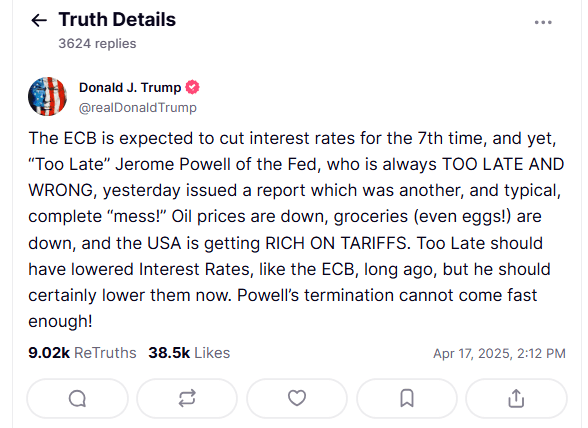
His remarks came a day after Powell warned that the Trump administration’s sweeping tariffs could trigger economic instability. At the same time, the U.S. Supreme Court is considering a separate case that could have implications for the independence of federal agencies, including the Federal Reserve.
Trump’s attack followed Powell’s April 16 speech at the Economic Club of Chicago, where the Fed Chair described the administration’s trade actions as “very fundamental policy changes” that are “significantly larger than anticipated.” He said the central bank now faces challenges it has not seen in decades.
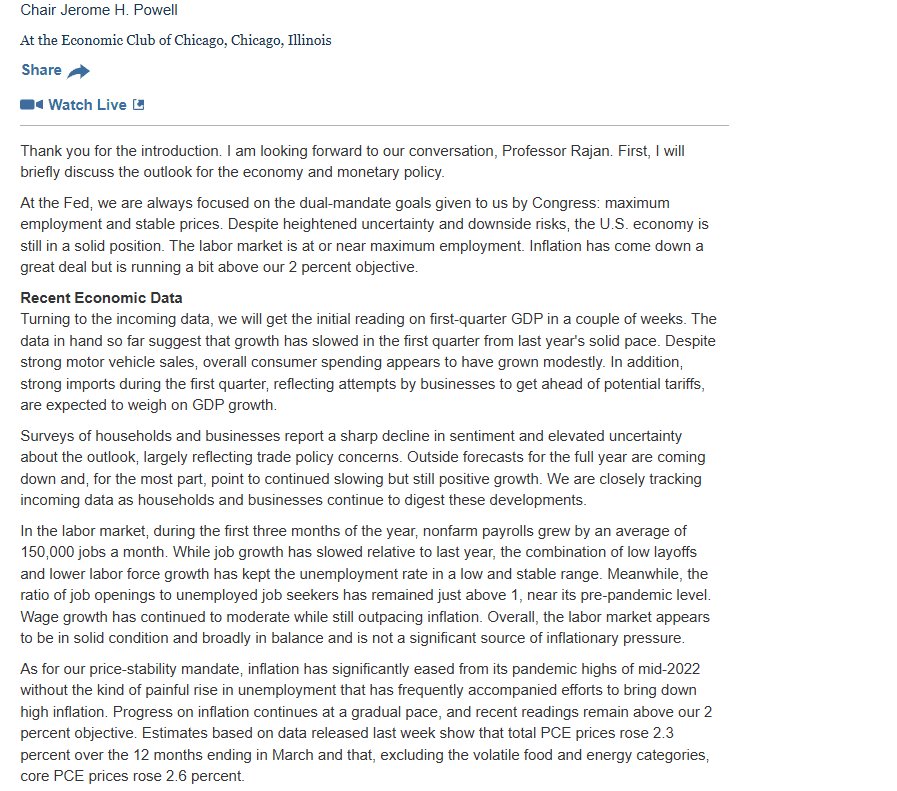
Powell did not name the president directly. However, his criticism came as Trump pressures the Fed to cut interest rates, arguing that the European Central Bank (ECB) is acting more decisively.
In an Oval Office meeting, Trump told reporters,
“If I want him out, he’ll be out of there real fast, believe me.”
Powell’s term runs through May 15, 2026. He was first nominated by Trump in 2017 and reappointed by President Joe Biden in 2022. U.S. law currently protects his role from removal without cause, shielding the central bank from political interference.
But that protection may be tested. A Supreme Court case now under review could reset the boundaries of presidential authority over independent agencies, potentially affecting whether a president can dismiss Powell before the end of his term.
Supreme Court Case May Shift Trump vs Powell Balance
At the center of the current legal debate is Humphrey’s Executor v. United States, a 1935 Supreme Court ruling that established that Congress can require a president to show cause—such as misconduct or neglect—before removing officials from independent agencies. That ruling still protects Powell’s position.
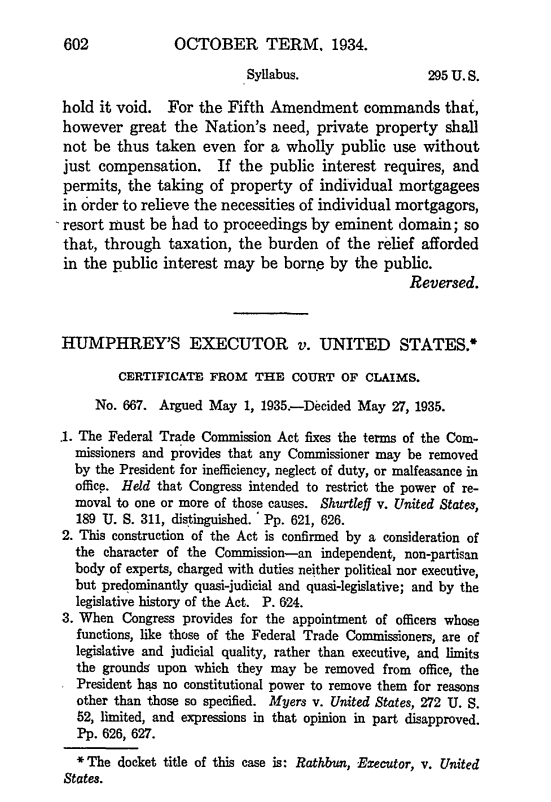
The Trump administration wants to overturn that precedent. It argues that presidents must have full authority to remove executive officials who oppose their agenda. Trump’s solicitor general, D. John Sauer, told the Court,
“The president should not be forced to delegate his executive power to agency heads who are demonstrably at odds with the administration’s policy objectives for a single day.”
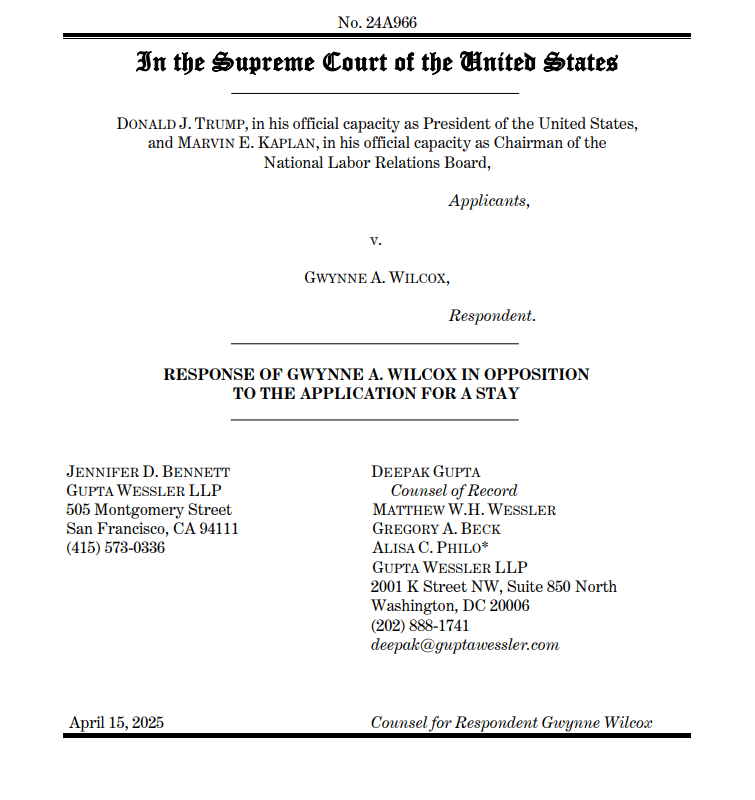
The immediate case before the Court involves the National Labor Relations Board (NLRB) and the Merit Systems Protection Board (MSPB), where Trump fired Democratic officials and replaced them with appointees aligned with his views. Former NLRB chair Gwynne Wilcox warned in a brief to the Court,
“The independence of the Federal Reserve would become uncertain—a situation that would have dire repercussions for the market.”
Chief Justice John Roberts has already signed a temporary order allowing Trump to keep both officials removed while the case moves forward. A final decision could come soon, possibly opening the door to broader removals at other agencies.
Trump is Putting Fed Independence Under Pressure
Despite repeated attempts by Trump to assert authority over Powell, the Federal Reserve has remained independent. Powell told reporters in 2023 that “removing a Fed chair is not permitted under the law,” adding that he intended to serve out his full term.
The Fed’s board consists of seven members. All are appointed by the president and confirmed by the Senate, but can only be removed “for cause,” meaning clear legal or ethical violations, not policy disagreements. The law does not define “cause” precisely, but courts have interpreted it to exclude firings based on conflicting economic views.
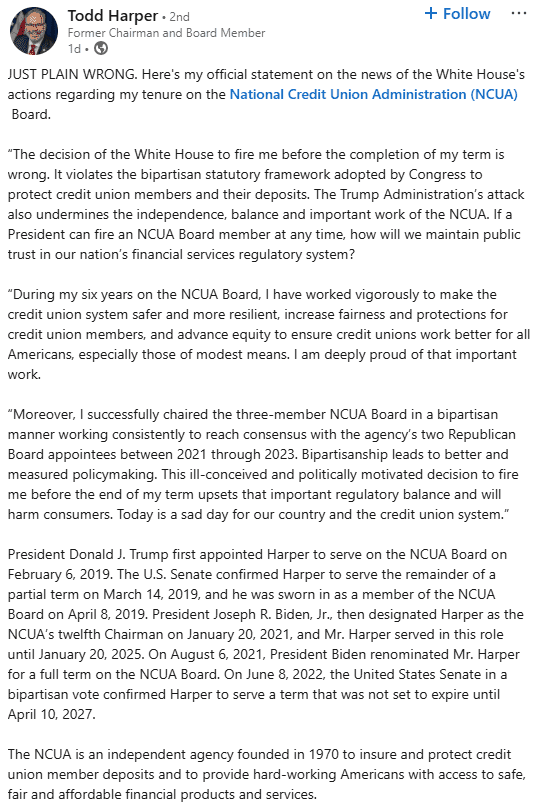
In recent years, Trump’s attempts to test this boundary have included firing members of other independent commissions. In March and April 2025, he dismissed two Democrats on the Federal Trade Commission (FTC) and two on the National Credit Union Administration (NCUA) board. One of the dismissed NCUA members, Todd Harper, said the move “violates the bipartisan statutory framework adopted by Congress to protect credit union members and their deposits.”
Legal analysts say these actions may be part of a larger strategy to redefine presidential authority. Jaret Seiberg, an analyst at TD Cowen Research Group, wrote,
“The president is establishing the precedent that he has total discretion over financial regulators, which could include the Federal Reserve.”
Still, the Fed’s legal standing remains stronger than other agencies, at least for now. In a 2020 decision about the Consumer Financial Protection Bureau (CFPB), Chief Justice Roberts stated that the Fed is “in an entirely different league.” He cited its multi-member board and unique funding model as reasons to preserve its independence.
Justice Samuel Alito echoed that position separately, writing that the Fed’s structure reflected “an intensely-bargained compromise between those who wanted a largely private system and those who favored a government-controlled national bank.”
The Trump administration has emphasized that distinction. In a recent brief to the Court, Sauer wrote that concerns about the Fed’s autonomy were misplaced.
“Respondents focus heavily on other agencies such as the Federal Reserve Board,” he said, but “ignore [the Court’s] observation that the Federal Reserve’s tenure protection presents a distinct question with a unique historical pedigree.”
Trump vs Powell is Boosting Market Uncertainties
Trump’s repeated calls to fire Powell have raised alarms among economists and investors. They argue that weakening the Fed’s independence would harm its credibility and damage the U.S. economy. The central bank’s ability to control inflation and unemployment hinges on making decisions free from political pressure.
Trump’s Treasury Secretary, Scott Bessent, voiced a different view from the president. In a January confirmation hearing, Bessent told Congress that “monetary policy is a jewel box that’s got to be preserved.” In an interview with Bloomberg, he added that disrupting the Fed’s autonomy could unsettle markets already stressed by tariff uncertainty.
Ray Dalio, founder of Bridgewater Associates, went further. He warned that the economy might already be nearing recession due to Trump’s aggressive trade policy. Powell has echoed those concerns, noting that new tariffs “put the Fed in uncharted waters.”
Despite the pressure, Powell and other Fed officials have relied on economic indicators to set interest rates. Inflation remains above the Fed’s 2% target, and rate cuts have paused for now. In contrast, the ECB has slashed rates multiple times in the past year.
ECB President Christine Lagarde defended Powell, saying,
“I have a lot of respect for my esteemed colleague and friend Jay Powell. We have a steady solid relationship amongst central bankers.”
Legal Outcome Could Set Precedent
The Supreme Court does not rule directly on Powell’s status. Instead, it is deciding whether Trump can remove members of the NLRB and MSPB without cause while their cases are still pending. However, the broader constitutional question—how far a president’s removal powers extend—lies at the heart of the dispute.
Justice Clarence Thomas has already expressed interest in revisiting Humphrey’s Executor. In a 2020 opinion, he wrote,
“I would repudiate what is left of this erroneous precedent.”
Justice Neil Gorsuch joined him.
If the Court decides to reverse Humphrey’s altogether, the president could gain sweeping authority to dismiss agency officials, including at the Fed. That would mark a sharp break from nearly a century of precedent and could change the structure of federal governance.
Until then, Powell remains in place. He has made clear he will not resign voluntarily. The law still protects his position, and the current structure of the Federal Reserve prevents the White House from firing its chair without due cause.
Still, the legal landscape may change. If the Supreme Court backs Trump in the labor board case, the next test may be whether that same reasoning applies to the Fed.
For now, the question of whether Trump can fire Powell remains unanswered. However, the Court may soon provide an answer that could redefine the limits of presidential power.


