


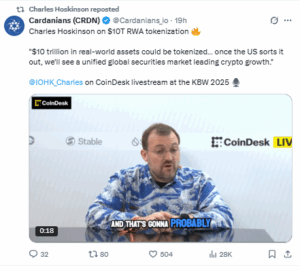
In an interview at Korea Blockchain Week, Cardano (ADA) founder Charles Hoskinson said the tokenization of real-world assets (RWAs) could reach $10 trillion over the next five years, but only if the United States delivers clear regulatory guidance.
Hoskinson said that while Asia has led consumer adoption of cryptocurrencies and decentralized applications, the U.S. remains critical because of its control over global capital markets.
Once we sort out how securities work on blockchains — disclosures, custody, broker-dealer rules, AML and KYC — we’ll create one unified securities market across the entire world. That’s what unlocks $10 trillion in tokenization.
he said.
SEC Yet to Define Tokenization Rules
The Securities and Exchange Commission has not yet established a comprehensive framework for tokenized securities. In July, Commissioner Hester Peirce said “tokenized securities are still securities,” and the blockchain-based products remain subject to existing laws. Nasdaq has filed to allow trading of tokenized securities on its primary market, while Robinhood has proposed a dedicated RWA exchange using Solana and Base. The White House is preparing a market structure report that is expected to cover tokenization and stablecoins.
The Cardano founder criticized U.S. policy delays, arguing that regulatory uncertainty has left the country behind jurisdictions such as Switzerland, Abu Dhabi, and the European Union, which have already created legal frameworks for tokenization. He said once the U.S. moves, other markets will align.
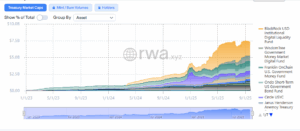
Despite regulatory gaps, institutional adoption has accelerated in 2025. BlackRock’s tokenized U.S. Treasury fund, BUIDL, has grown to $2.9 billion in assets under management and is accepted as collateral on trading platforms including Deribit and Crypto.com. BlackRock has also filed to issue distributed ledger shares of its $150 billion Treasury Trust fund via BNY Mellon.
Other firms are testing similar products. Goldman Sachs and BNY Mellon have launched tokenized money market funds using hybrid models that combine traditional recordkeeping with blockchain-based tokens. Securitize, which received investment from BlackRock, now manages nearly 70% of the tokenized U.S. Treasury market. Overall, the broader tokenized Treasury sector has expanded almost 400% in the past year, reaching about $7 billion in capitalization.
Asia Shows High Retail Adoption
Charles Hoskinson also emphasized Asia’s role in crypto adoption. He pointed to South Korea, where around 16 million people — 35% of the population — hold digital assets worth roughly $77 billion. He described the market as “retail-driven,” contrasting it with Western markets where institutions dominate.
Other countries in the region are also advancing tokenization pilots. Singapore’s Monetary Authority has run Project Guardian with major banks to test tokenized bonds, foreign exchange, and asset management products. Japan’s SBI Digital Markets is building a regulated structure for cross-border distribution of tokenized securities. Hong Kong has adopted a “same business, same risks, same rules” approach, though Chinese regulators recently asked local brokers to pause RWA activity,
Charles Hoskinson Says Privacy Remains a Barrier for Enterprises
Cardano founder said that beyond regulation, privacy remains a barrier to enterprise adoption of blockchain. He presented Midnight, Input Output’s new protocol, as a solution. Midnight allows private smart contracts with selective disclosure, enabling transactions to remain confidential to the public while being auditable by regulators or authorized parties.
“Almost every partner told us they tried blockchain but privacy killed the pilot. Midnight is built to fix that.”
Hoskinson said.
He argued that privacy-enabled infrastructure is essential for tokenizing assets such as securities, supply chain records, or medical data.
Hoskinson’s estimate of $10 trillion would equal about 10% of the global securities market, which is valued at more than $100 trillion. But the path is uncertain. Current tokenized assets often trade with low liquidity. Custody and cross-border rules are not yet aligned. Different countries are moving at different speeds, which makes it hard to build a single global system.
Even so, tokenized Treasuries and money market funds are showing that traditional finance is beginning to move on-chain. Hoskinson believes the U.S. will decide the pace of growth. “When the U.S. sets the rules, the rest of the world will align,” Cardano founder said.


