


Cardano (ADA) price steadied near $0.8 on Sept. 30 as the token continued its recent horizontal trend. ADA recovered from the recent market crash, though the token remained despairingly below the month’s high near $0.95, suggesting bears remained strong.
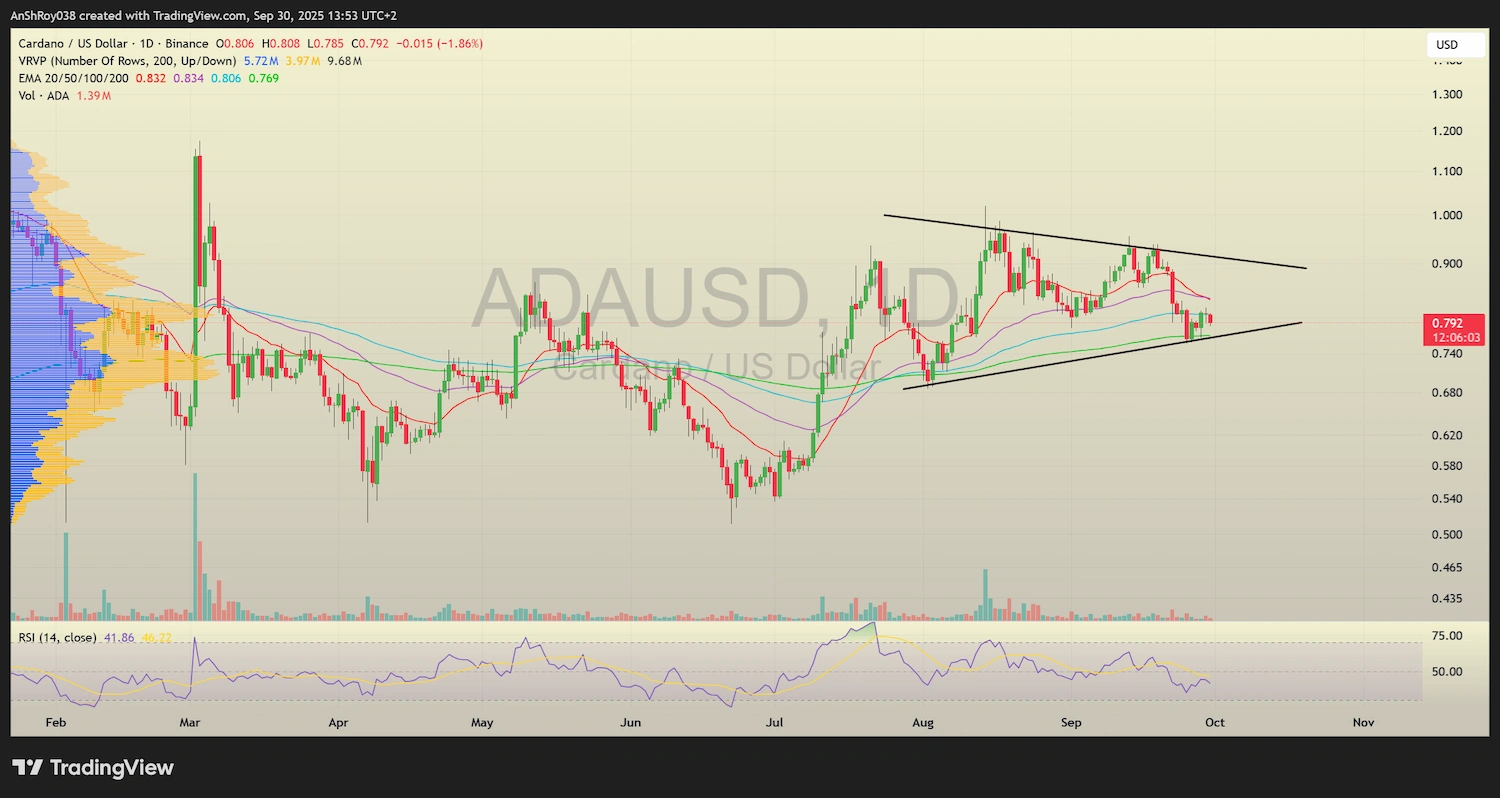
However, bulls rallied near the 200-day EMA support to prop up the token. Trading volumes showed renewed interest as ADA resisted broader market weakness. Analysts tracked the rebound, noting immediate resistance zones that could shape the next move.
Analysts Remained Bullish on Token’s Targets
Cardano’s latest rebound focused on resistance levels that could decide its near-term direction. Analyst Mintern argued that ADA could climb to $2 quickly, pointing to the consolidation range held through Sept. 2025.

The level aligned with a significant resistance band from previous cycles, offering a realistic target if momentum stayed intact. Moreover, another analyst, Aj, noted ADA’s bounce off the 200-day EMA and highlighted a pennant formation that could trigger a strong move.

The analyst claimed that a breakout could trigger a 66% run back to the Dec. 2024 peak, though failed to emphasize what cues the ADA USD pair needed to make the prediction come true.
Independent analyst Investor Jordan stressed Cardano ADA’s long-term strength, calling it one of the safest plays as long as it held the bull market support band on the weekly timeframe.

Jordan noted that ADA had respected the structure all year, grinding higher despite broader volatility. The analyst suggested that if support continued to hold, patience, not aggressive targets, could define the coin’s trajectory.
In contrast, Crypto Patel predicted ADA could rise as high as $10 this cycle. The claim had little basis in chart structure and sounded more like sentiment-driven optimism than a fact-based projection.

However, Patel’s resistance levels did coincide with the other analysts’ predictions for the Cardano token. While ADA price might one day reach $10, the chances of it happening in the immediate future seem unlikely.
These debates unfolded as the SEC’s generic listing standards reshaped ETF expectations.
SEC Shift Lifts ADA ETF Odds to Near Certainty
The discussion around ADA’s chart levels ran parallel to a regulatory shift that could prove decisive for its next phase. Eleanor Terrett first reported that the SEC had asked issuers to withdraw 19b-4 filings for ADA and other altcoin ETFs.

The development followed the adoption of generic listing standards, which removed the need for those filings in some instances. The move reshaped how quickly such products could reach the market, leaving issuers reliant only on S-1 approvals.
Bloomberg’s ETF expert Eric Balchunas responded with caution, noting that the change created uncertainty about launch schedules despite removing a key obstacle. He described the 19b-4 process as obsolete under the new framework but stressed that timing still depended on Corp Finance sign-offs.

Hours later, the ETF analyst’s tone shifted. Balchunas said the odds of ETF approval were now “really 100%,” adding that Solana’s fourth amendment filing showed approvals could drop at any moment. The remarks gave weight to the idea that ADA was not just a candidate but a near lock for eventual ETF listing.
The regulatory update marked a rare instance where analysts and policy watchers aligned on the same outcome. While ADA’s technical path remained contested, the SEC’s stance introduced a structural change. It left the market watching for S-1 clearance, a step that could transform ADA’s rebound into something larger.
How will Bitcoin and Ethereum react to a U.S. government shutdown? Read here to find out.


