



South Korea’s two largest exchanges, Upbit and Bithumb, opened CPOOL trading on October 22 at 16:30 KST. Their notices specify KRW pairs, with Upbit also adding BTC and USDT markets, widening settlement options at launch. The move adds a regulated, high-volume venue to Clearpool’s distribution.
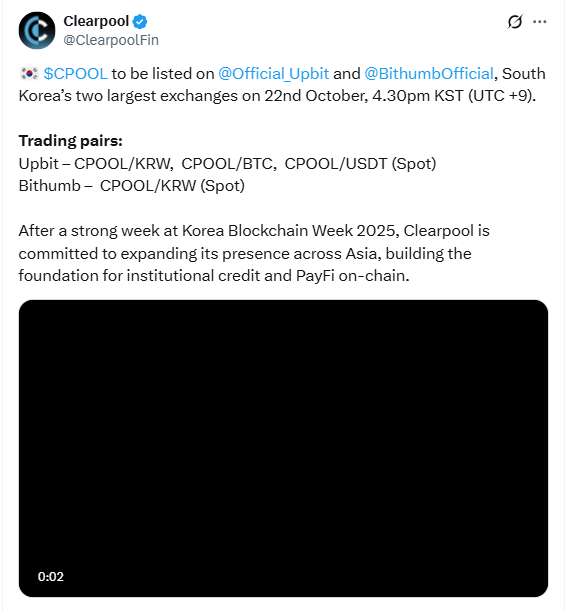
Clearpool also flagged the timing on X, aligning its message with the exchanges’ schedules. Public posts framed the event as simultaneous listings across both platforms, which helps funnel new users without splitting attention over different dates. Timing clarity matters for institutions that coordinate custody and compliance windows.
Moreover, third-party trackers reiterated the market-access angle for Korean users. While commentary focused on trading activity elsewhere, the core non-price update is straightforward: fiat on-ramps in KRW are live, and additional quote pairs reduce friction for account funding and settlement.
What the Korean listings change operationally
KRW pairs bring domestic funding rails into Clearpool’s funnel. Local participants can now move between won balances and CPOOL without routing through offshore stablecoins first, which simplifies treasury workflows and shortens settlement paths. That step reduces operational drag for market makers and compliant funds.
At the same time, multiple quote assets on Upbit cut single-pair bottlenecks during peak activity. BTC and USDT books provide alternative liquidity routes if KRW depth thins, which can stabilize onboarding in the first days of access. This is an infrastructure detail, not a protocol change.
PayFi vaults and Plume integration move into production
Clearpool’s recent updates show a parallel track: building short-term, real-world credit rails. The team announced a strategic integration with Plume, an RWA-focused L1, to host PayFi Credit Vaults that route tokenized credit to vetted borrowers. The first vault is structured with Cicada as risk agent.
These vaults target payments financing—bridging settlement gaps in stablecoin flows—while keeping monitoring on-chain. Plume’s RWA specialization gives issuers and lenders a venue designed for compliant asset representation, which can matter once scale and audits enter the picture.
Media roundups emphasized that vaults on an RWA chain expand distribution for tokenized credit. In practice, lenders gain more choice of networks and tooling, while borrowers interact with a consistent underwriting framework. The Korean listings, therefore, sit alongside a credit product that already moved from planning to live.

Risk framework: Cicada and Prime for institutional flow
Clearpool’s institutional stack relies on formal risk roles. Posts outline Cicada Partners’ function in structuring and monitoring PayFi lending, administering Credit Pools, and standardizing disclosures for lenders. That model mirrors traditional credit committees but executes with on-chain records.
Prime, Clearpool’s wholesale venue, continues to serve whitelisted lenders and KYC’d borrowers through audited smart contracts. Documentation stresses direct origination to borrower wallets and no custody by Clearpool, which aligns with institutional mandates on asset control.
Earlier technical notes add context: the project has shipped across multiple networks and received ecosystem support while originating institutional loans. Those milestones predate today’s exchange access and underline that the protocol’s focus remains credit infrastructure, not secondary-market activity.
Analyst flags new growth phase after Korean listings
CPOOL’s weekly chart from Oct. 22, 2025 shows the asset holding an ascending trendline that has supported the structure since 2024. Price trades near $0.13, just below a mid-range resistance zone around $0.15. The chart outlines a potential higher-low formation, followed by a projected push toward the $0.30–$0.35 supply region if buyers maintain control. The visual map highlights clean zones of support and resistance, not a completed breakout.
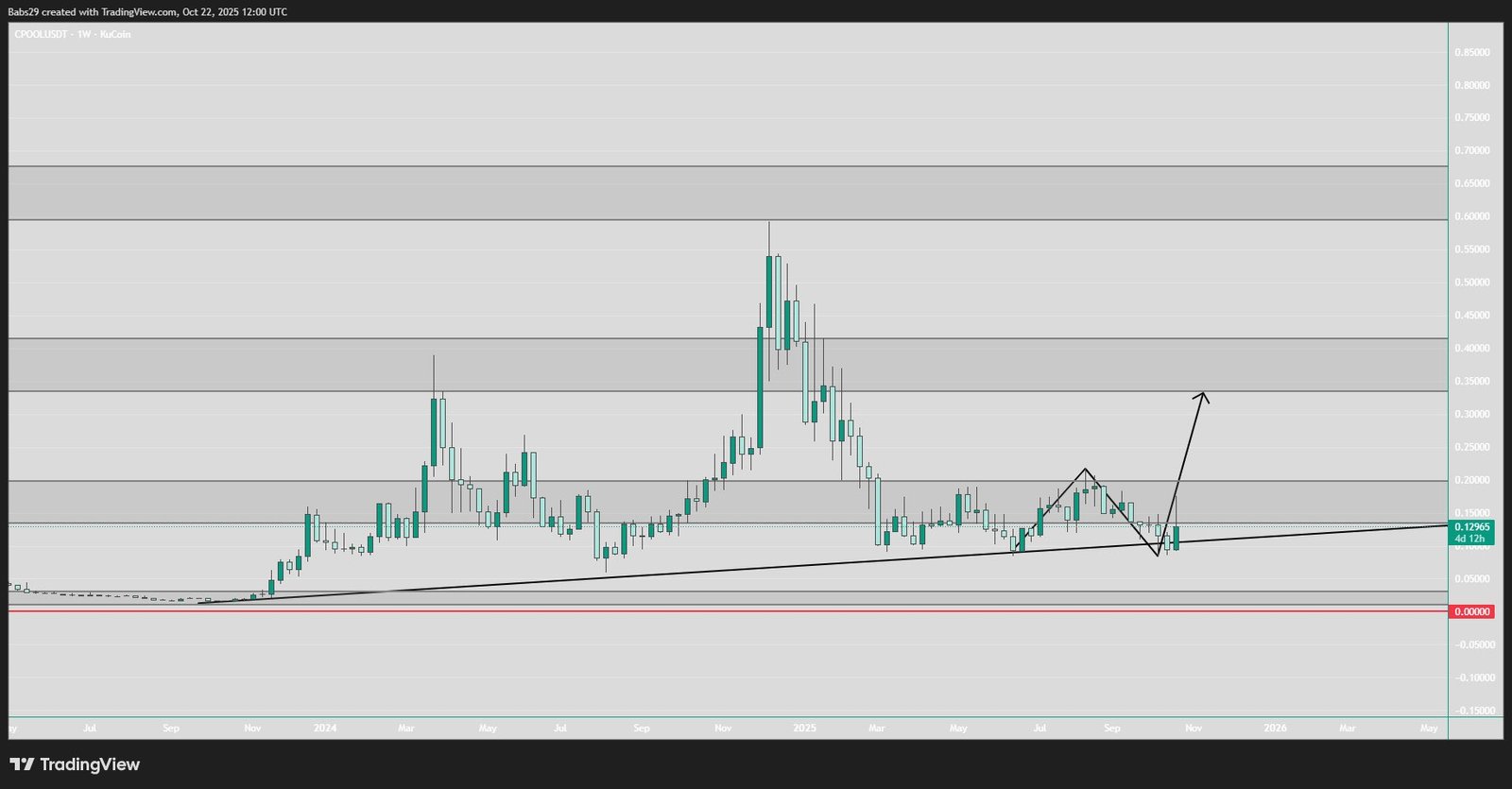
Analyst Sir Ismail (@Ismiles29) tied the technical outlook to current developments, pointing first to the Upbit and Bithumb listings. He framed the Korean access as a catalyst that could accelerate participation if momentum holds above support. The post also referenced Clearpool’s ongoing buyback program, suggesting that reduced circulating supply could tighten available liquidity if demand rises at the same time.
The analyst added that CPOOL has already climbed more than 120% from its prior low and marked $0.115 as the key level to defend. In his view, holding that floor keeps the “next leg” scenario intact, while any deeper sweep would offer a better accumulation zone before trend continuation. Overall, the chart emphasizes structure and levels: support near $0.115, resistance around $0.15, and a higher target band at $0.30–$0.35 if buyers confirm direction.
CPOOL double-bottom watch after rebound from $0.10
CPOOL/USD daily chart dated Oct 22, 2025, shows price rebounding off the $0.10 demand zone after months of sideways compression. The structure now sketches a potential double-bottom, with $0.10 acting as the base and a horizontal neckline forming near $0.15. In this setup, buyers defend prior lows while probing higher closes, which signals fading sell pressure.
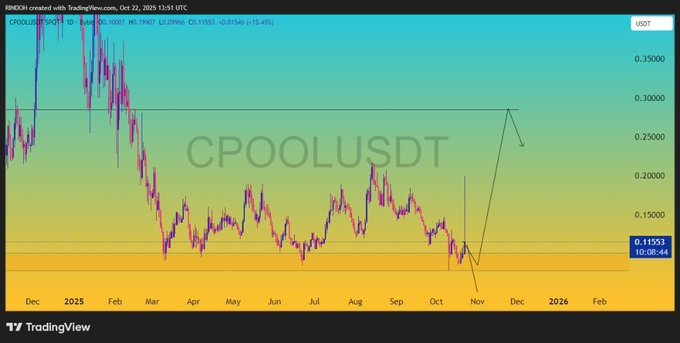
However, confirmation still hinges on levels. A decisive break and hold above ~$0.15 would validate the double-bottom and shift market structure from distribution to accumulation. Until then, the range remains intact, and failed attempts at the neckline can send price back toward support. Therefore, risk control centers on whether $0.10 continues to hold on retests.
Beyond confirmation, the chart flags $0.25–$0.30 as the next resistance band, where prior supply capped rallies through 2025. If momentum builds above the neckline, liquidity could gravitate toward that zone before any larger decision. Conversely, a daily close below $0.10 would invalidate the pattern and reopen downside. In short, watch the $0.15 break for signal; watch $0.10 for risk.


