



A crypto asset manager proposed cutting Hyperliquid’s HYPE supply by 45% to make the token easier to value. DBA Asset Management’s Jon Charbonneau outlined the plan on X, co-authoring it with researcher Hasu. The changes include revoking authorization for all unminted future emissions and community rewards, burning the Assistance Fund’s HYPE, and removing the 1 billion supply cap.
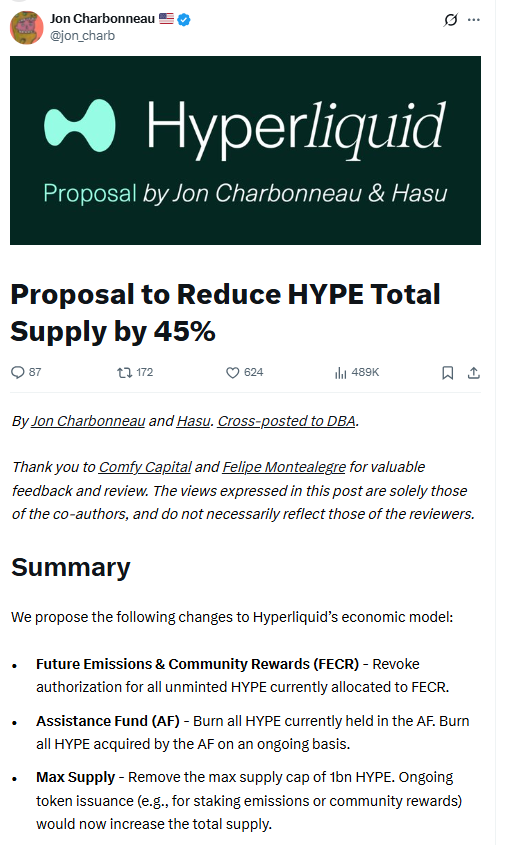
DBA said the move targets what it calls a market misvaluation driven by fully diluted valuation that counts unissued tokens. It argued that the excess supply depresses valuation and can bias future capital allocation. The firm added that Hyperliquid could still fund initiatives through new issuances if governance approves.
The proposal would slash 421 million HYPE from the future emissions and community rewards bucket and 21 million HYPE from the Assistance Fund. It would still require a governance vote inside Hyperliquid, where DBA is a major participant because it stakes HYPE and holds a material position.
What the proposal would change
Charbonneau’s post centers on three steps. First, he asks governance to revoke authorization for all unminted HYPE under future emissions and community rewards. Second, he calls for burning all tokens in Hyperliquid’s Assistance Fund. Third, he suggests removing the fixed 1 billion supply cap to decouple accounting from perceived overhang while keeping issuance under governance control.
He said these steps would address the gap between circulating valuation and fully diluted valuation. According to him, market participants penalize protocols when large unissued allocations sit on the sidelines. Therefore, clearing those buckets would present a cleaner supply profile without preventing targeted future funding.
DBA framed the proposal as investor-friendly while keeping flexibility. The plan, it said, preserves the ability to raise capital later by explicit governance issuance rather than pre-allocations. As a result, the team expects clearer pricing signals for both investors and stakers.
Support and criticism from investors
Some institutional crypto investors backed the idea. Dragonfly’s Haseeb Qureshi said the nearly 50% community allocation works like an amorphous pool with unclear plans. He argued that incentives are fine when transparent, yet setting aside about half the supply “to do whatever” is not.
Critics pushed back. Commentator Mister Todd called the plan “foolish,” saying future emissions are a powerful growth tool. Others recommended keeping reserves for potential fines or sanctions, citing regulatory risk as a reason to maintain unallocated tokens.

Charbonneau countered that the proposal does not remove the option to issue tokens for any need, including regulatory matters. He said it instead changes the accounting approach so that new issuances would be explicit and governed, not pre-authorized in large blocks that weigh on valuation.
Hyperliquid’s growth context
The proposal arrives amid rising interest in Hyperliquid’s ecosystem. Last week, the exchange revealed USDH, a new United States dollar stablecoin, and opened a governance vote to select the issuer. Paxos, Frax, Sky, Agora, and Native Markets participated, with Native Markets winning that vote.
Charbonneau said USDH could become a significant revenue driver once deployed. Stablecoin flows and settlement volumes often reinforce activity across derivatives venues. Therefore, he expects the new product to strengthen the protocol’s fee base when it goes live.
Operationally, Hyperliquid reported $330 billion in trading volume in July with a team of 11 people. The figure positions the platform among the industry’s most efficient operators by output per headcount, a data point supporters highlighted when discussing the proposal.
Market reaction and unlock overhang
HYPE set a new all-time high of $59.30 on Thursday while the broader market moved sideways to lower. However, the token retreated more than 22% to $46.08 afterward as sentiment cooled. The pullback followed profit-taking and portfolio shifts among funds.
Notably, Arthur Hayes-led Maelstrom Fund sold its entire HYPE position. Hayes cited expected selling pressure from roughly $12 billion in token unlocks across the market over the next 24 months. He pointed to the unlock cycle as a headwind for risk assets, including HYPE.
The supply proposal now sits with governance. If approved, it would remove large pre-authorized pools while allowing future targeted issuance. In turn, the market will watch whether cleaner accounting and stablecoin expansion can offset the near-term pressure from broader unlock dynamics.
HYPE rises inside channel on Tuesday, September 23, 2025
HYPE/USD traded at 48.48 United States dollars on Tuesday, September 23, 2025, on the one day chart. Price rode the 50 day Exponential Moving Average at 48.40 while candles stayed inside a clearly drawn rising channel that has guided the uptrend since early June. The lower boundary held higher lows, and the upper boundary capped a series of modest higher highs, keeping momentum constructive despite last week’s pullback.
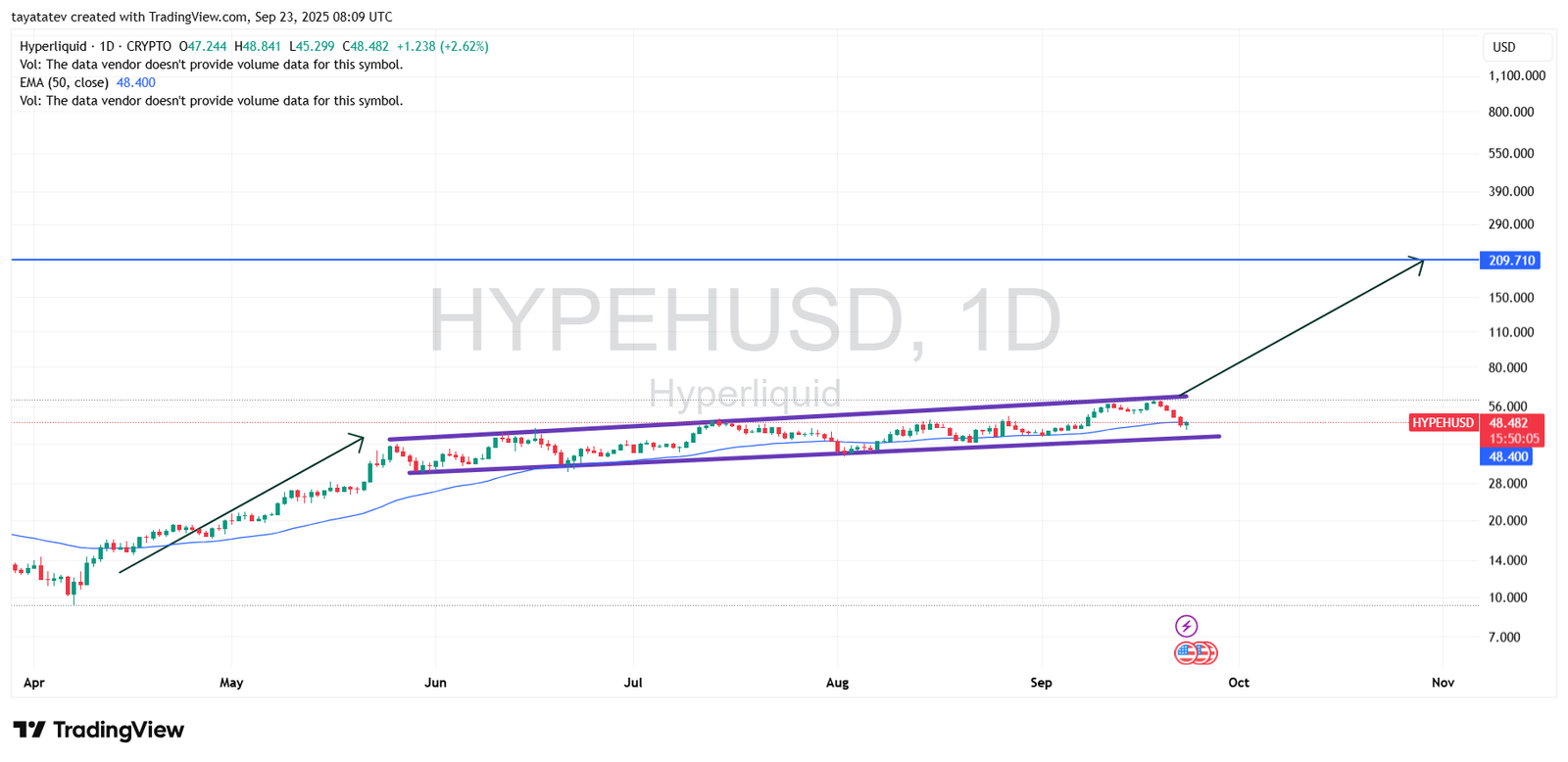
The chart shows a classic rising channel pattern. A rising channel is a sequence of higher highs and higher lows that move between two parallel upward sloping lines, defining support and resistance in an orderly trend. Here, the lower rail has contained dips near the 50 day Exponential Moving Average, while the upper rail rejected pushes above the mid 50s, preserving the channel structure into late September.
If price confirms with a decisive break and daily close above the channel’s top boundary, the projection on the chart points to a measured objective roughly 331 percent above the current level. From 48.48 United States dollars, a 331 percent advance implies about 209.0 United States dollars, in line with the marked target near 209.71 on the chart. Follow-through above the channel and sustained closes back over the 50 day Exponential Moving Average would validate the breakout structure and keep that objective in play.
RSI turns neutral-bearish after sharp drop
The 14-day Relative Strength Index for HYPE sits near 45.71 on Tuesday, September 23, 2025, after a swift fall from the high-60s. Momentum flipped below the 50 midpoint and below the RSI moving average (around 60.91), which signals fading upside pressure and a short-term bearish bias while it remains under 50.
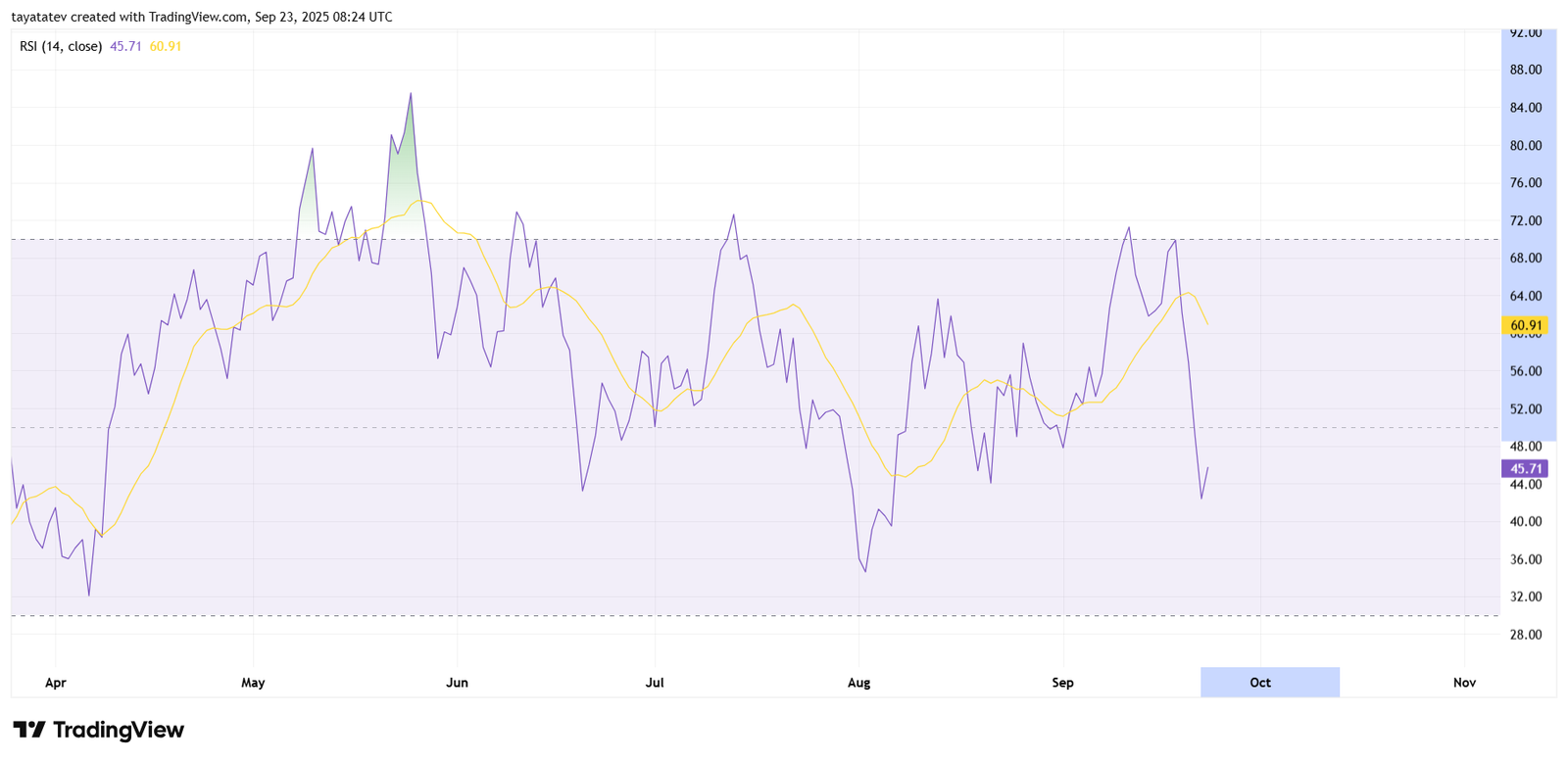
However, conditions are not oversold. The oscillator bounced from the mid-30s area back toward 46, suggesting sellers lost some urgency. If RSI reclaims 50 and holds above its moving average, momentum would shift back to neutral-positive and improve the odds of trend continuation.
Until then, the setup implies range or corrective behavior rather than a confirmed reversal. Continued prints below 45 would reopen risk of a retest of recent price lows, while higher lows on RSI against flat price would hint at bullish divergence to watch.


