



The team behind the MyDoge wallet has proposed an upgrade to Dogecoin Core that would enable the verification of off-chain zero-knowledge proofs. This change would make Dogecoin compatible with zk-rollups, allowing the blockchain to support Layer-2 solutions that improve speed and reduce transaction costs.
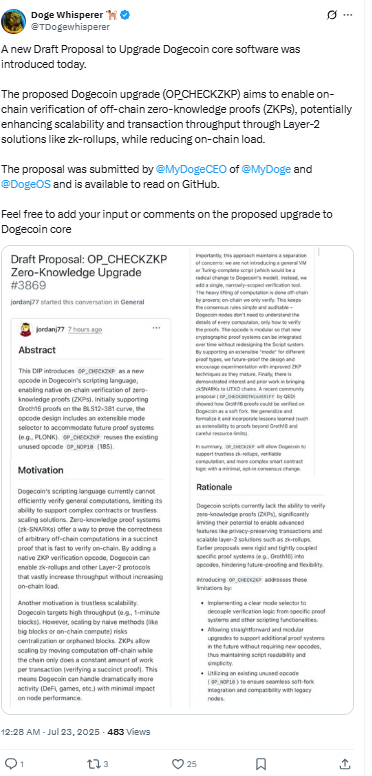
With this upgrade, Dogecoin could gain enhanced scalability and privacy. It would also open the door to building a broader ecosystem of DOGE-based applications, offering new utility that the network has largely lacked.
While validators have not yet approved the proposal, community feedback has been largely positive. If support continues to grow, implementation may follow soon.
Dogecoin Proposes Zero-Knowledge Proof Integration to Expand DeFi and Privacy
The new plan introduces zero-knowledge proof (ZKP) technology to improve scalability and privacy while keeping the network user-friendly. DogeOS CEO Jordan Jefferson leads the proposal, which could shift Dogecoin’s role from a memecoin to a competitive platform for real-world applications and DeFi.
With this upgrade, Dogecoin aims to support advanced use cases without sacrificing simplicity. ZKPs allow transactions to be verified off-chain without revealing sensitive data. As a result, the integration could support privacy-preserving features while reducing the blockchain’s load. According to Jefferson, the goal is to give Dogecoin’s active community the tools to build serious applications. He said,
“This upgrade is about giving them the tools to do even more—turning a beloved currency into a platform that can go toe-to-toe with any chain out there.”
At the same time, the upgrade could attract developers focused on privacy and boost the development of Ethereum-compatible tools. By enabling zk-rollup support, the proposal opens the door to cross-chain compatibility and efficient off-chain execution. These features would help Dogecoin compete with leading networks in the DeFi space.
However, key details remain unclear. The proposal’s funding structure has not been disclosed. The success of the upgrade will depend on developer interest and support from the wider community. Past examples from other blockchains show that similar privacy improvements led to higher total value locked (TVL) in DeFi platforms, but implementation and adoption challenges still apply.
Long term, the move fits broader trends across blockchain development. Privacy and scalability continue to be top priorities for major networks. By adopting ZKP, Dogecoin could position itself as a flexible, scalable infrastructure capable of supporting mainstream apps. The proposal not only enhances Dogecoin’s technology—it also redefines its role in the crypto ecosystem.
Dogecoin Forms Bearish Pattern Despite Uptrend
On July 24, 2025, the Dogecoin DOGE/ USDT daily chart shows the token trading at $0.23488, based on Coinbase data. The chart reveals a well-defined rising channel, but more importantly, it confirms a bearish flag pattern, not bullish.
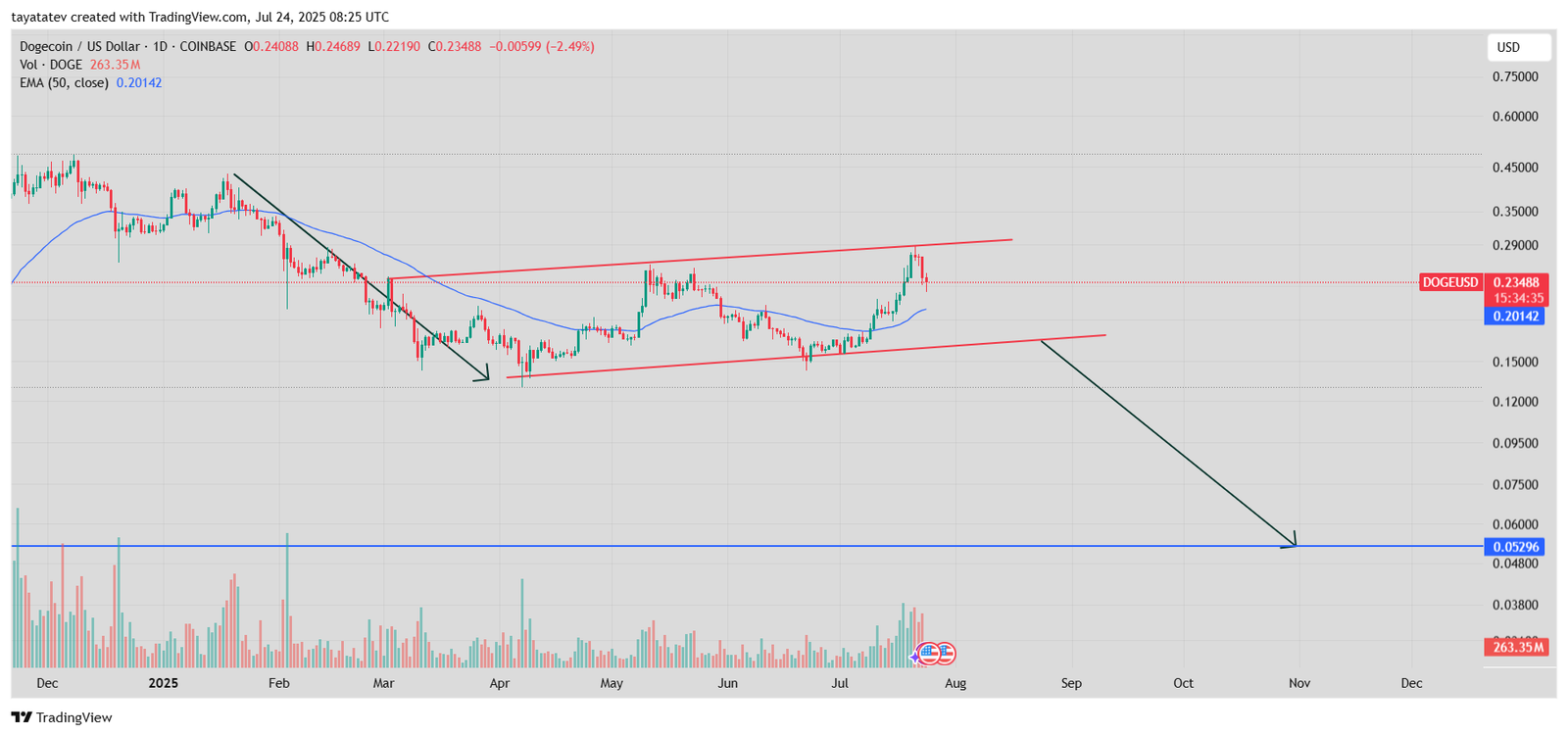
A bullish flag pattern typically forms after a strong price rally, followed by a short consolidation in a downward-sloping channel. If confirmed, it usually signals a continuation of the prior uptrend. In contrast, the current Dogecoin setup displays the opposite — a bearish flag, where the prior trend was downward, followed by a slight upward correction within a rising channel.
This rising channel now appears to be breaking down. If the breakdown confirms, the projected move would follow the same height as the previous drop (flagpole), extending sharply downward.
From the current price of $0.23488, a 77% decline targets a level near $0.05296 — as marked on the chart. The steep diagonal arrow points directly to this support line, which aligns with a major historical demand zone. Volume has already started rising, supporting this potential breakdown scenario.
Therefore, unless Dogecoin reclaims the upper trendline, the flag pattern suggests a risk of continuation to the downside, with a possible move back toward $0.05 in the coming months.
Dogecoin RSI Chart Signals Rejection at Overbought Zone
On July 24, 2025, Dogecoin’s 14-day Relative Strength Index (RSI) chart shows a sharp reversal from the overbought threshold. The RSI touched 70.94 before dropping to 59.84, confirming a failed breakout above the 70 level — a key signal often used by traders to gauge overbought conditions.
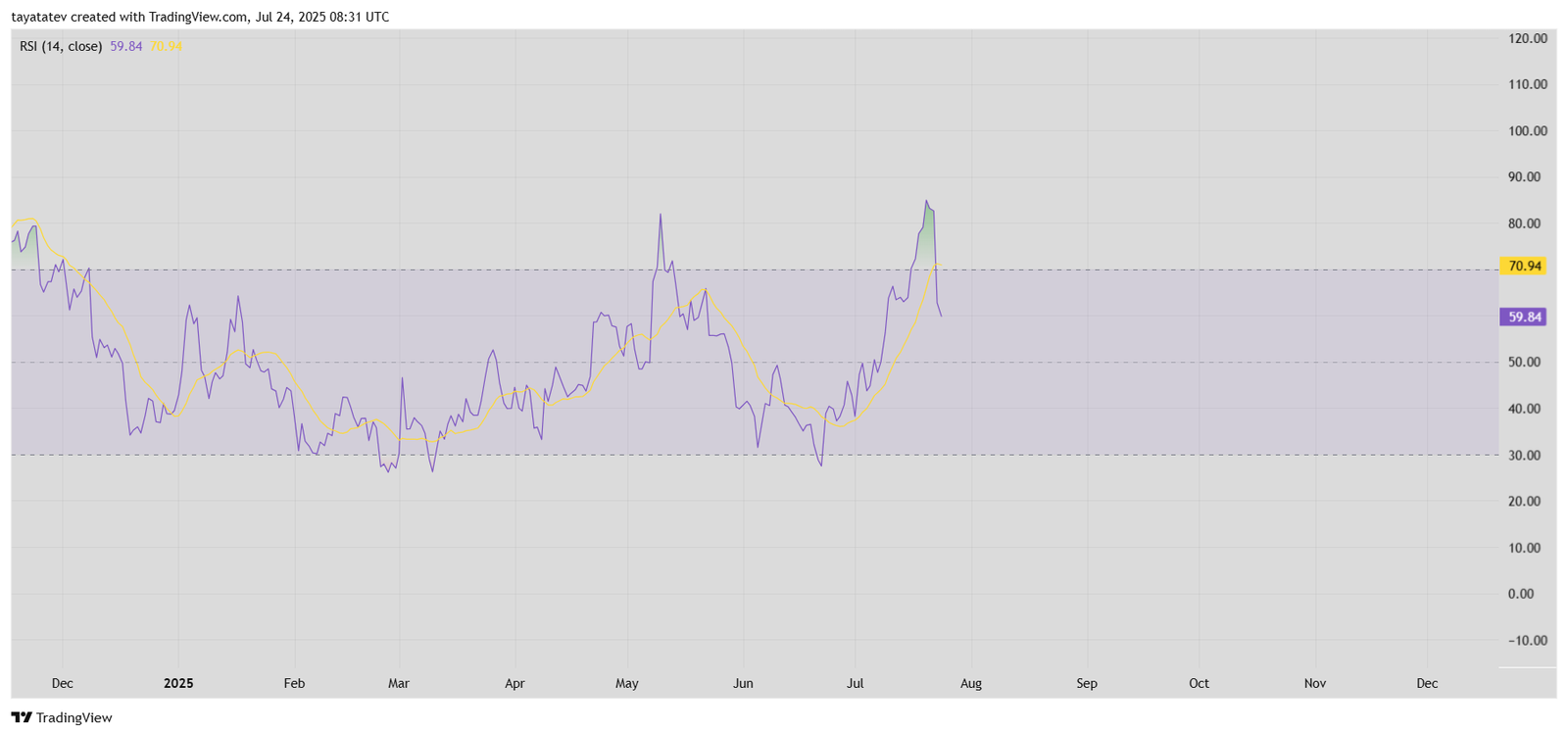
Relative Strength Index (RSI) is a momentum oscillator that measures the speed and change of price movements on a scale from 0 to 100. An RSI above 70 suggests overbought conditions, while values below 30 point to oversold conditions.
Here, the reversal from 70.94 indicates that bullish momentum may be weakening. Additionally, the steep decline in RSI after touching the overbought zone confirms a bearish divergence with price action. This adds further support to the breakdown risk seen on Dogecoin’s main price chart.
If RSI continues to slide toward 50, it would suggest neutral momentum. A drop below 50 could confirm a stronger shift in trend, reinforcing the broader bearish outlook.
Dogecoin MACD Shows Waning Momentum After Bullish Surge
On July 24, 2025, the MACD (Moving Average Convergence Divergence) chart for Dogecoin reveals early signs of a momentum shift. The MACD line (blue) stands at 0.02070, while the signal line (orange) trails slightly behind at 0.01688. The histogram reading is 0.00382, showing reduced distance between the two lines.
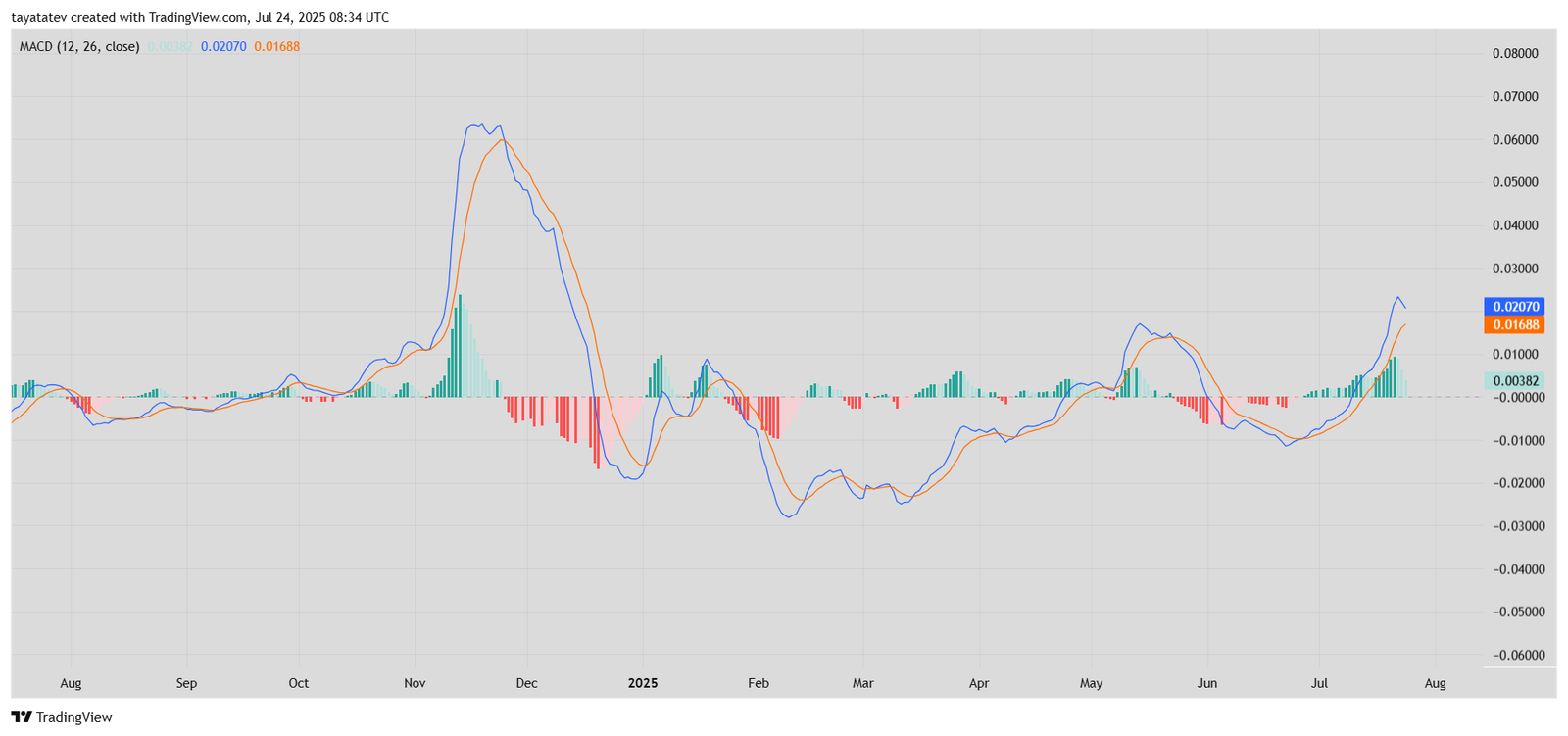
The MACD is a trend-following indicator made up of two exponential moving averages: a fast line (12-day EMA) and a slow line (26-day EMA). A bullish crossover occurs when the MACD line moves above the signal line, and a bearish crossover forms when it moves below.
Recently, Dogecoin confirmed a bullish crossover, with strong upside momentum reflected in multiple green histogram bars. However, the latest histogram bar is shrinking, suggesting that bullish strength is fading.
If the MACD line flattens and crosses back below the signal line, this would confirm a bearish crossover, potentially aligning with RSI weakening and the breakdown shown on the price chart.


