



Ethereum (ETH) now supports the largest stablecoin economy in crypto. The network recently surpassed 750,000 unique weekly users interacting with stablecoins and now holds a combined stablecoin supply of over $134 billion, based on updated on-chain data as of June 2025.
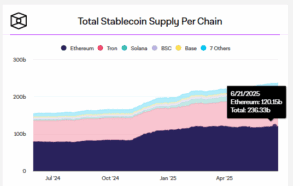
The increase in both users and supply shows that stablecoins have moved beyond trading platforms and are now being used across payments, lending, savings, and decentralized finance (DeFi). Ethereum’s infrastructure makes it easier for users to move dollars on-chain without relying on banks or centralized systems.
Ethereum’s stablecoin market is led by two dominant tokens. Tether (USDT) holds approximately $73 billion in supply, while USD Coin (USDC) has about $41 billion. Together, they account for over 85% of all stablecoins on Ethereum.
Other stablecoins—including DAI, BUSD, and newer tokens like USDe and USDM—make up the remaining $20 billion. Although smaller, these tokens are popular for offering features like built-in yield, reduced gas fees, or real-world asset collateral.
Stablecoins are now being used in more practical ways, supported by Ethereum’s compatibility with wallets, payment apps, and protocols. The steady growth in on-chain activity suggests that more users are relying on them to store, spend, and transfer money without leaving the blockchain.
Why Stablecoin Usage Is Surging on Ethereum
Stablecoin adoption has picked up speed over the past year. Since mid-2024, the number of active users has grown sharply due to a mix of infrastructure readiness, real-world utility, and demand for dollar stability.
Ethereum remains the most widely used network for stablecoins due to its deep liquidity, strong wallet ecosystem, and network effects in DeFi. Fintech firms and payment companies are also integrating Ethereum-based stablecoins to enable low-cost global transactions.
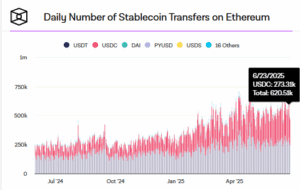
As a result, transfer volumes on Ethereum remain high. Data shows millions of stablecoin transactions per week, with rising frequency and token movement. These patterns show that users are actively using the tokens—not just holding them.
Ethereum-Based Stablecoins Influence U.S. Debt Market
The expansion of Ethereum stablecoins is having effects outside of crypto. Because these tokens are backed by reserves, most issuers place their funds in short-term U.S. Treasuries to maintain a 1:1 dollar peg.
At a recent conference in Boston, State Street Global Advisors CEO Yie-Hsin Hung said about 80% of all stablecoin collateral is currently held in T-bills or repo markets. That equates to roughly $200 billion in demand for U.S. government debt—driven indirectly by stablecoin growth.
With the U.S. Treasury expected to issue more than $1 trillion in new debt this year, stablecoin issuers could help absorb part of that supply. Every time users mint new stablecoins, issuers buy additional Treasuries to support them. The more Ethereum-based tokens circulate, the more reserves are needed.
Central Banks Push Back Against Stablecoin Expansion
Not all financial institutions are comfortable with this trend. The Bank for International Settlements (BIS)—often called the central banks’ central bank—has issued its strongest warning yet on stablecoins.
In a newly released report by Reuters, the BIS said stablecoins lack key features such as settlement guarantees and central backing. It warned that they may weaken national monetary control, especially in smaller economies where local currencies can be quickly exchanged for stable digital dollars.
To address this, the BIS has proposed a unified digital ledger controlled by central banks. This would combine government bonds, central bank money, and commercial bank deposits into a single programmable system. The goal is to maintain sovereign control while offering faster, more secure payments.
Hyun Song Shin, the BIS economic adviser, said the system would avoid reliance on private issuers and create a more stable foundation for digital finance.
WLFI Offers Political Alternative to State-Controlled Digital Currencies
While regulators promote government-issued digital currencies, private firms are building their own alternatives. One of the highest-profile projects is World Liberty Financial (WLFI)—a stablecoin platform backed by Donald Trump.
WLFI announced that its governance token may soon become transferable and confirmed its first audit will be published shortly. The platform also plans to release a mobile app to make stablecoin use easier for everyday users.

Trump reported $57.4 million in income from WLFI in his 2025 financial disclosure and holds over 15 billion tokens in the project. Since launching in late 2024, WLFI has raised $550 million and received investment from Justin Sun and Web3Port. The platform runs on Ethereum and promotes itself as a pro-American response to central bank digital currency models.
Ethereum’s Position in the Digital Dollar Race
Ethereum now processes the majority of all stablecoin activity in crypto. It has become the go-to platform for moving digital dollars due to its flexibility, developer access, and integration across apps and services.
Its growing influence over payment rails, savings tools, and collateral reserves makes it a central part of the future digital money system. But its role is not guaranteed.
The rise of central bank-led platforms, evolving regulations, and competition from other blockchains could alter this position. Still, based on current usage, Ethereum is already where most dollar-denominated value moves in crypto.


