



Ethereum (ETH) price pulled back after the token’s recent ATH near $4,955 on Aug. 24, ceding ground as traders paused to lock in gains. The pullback extended into the low $4,400s before finding footing. ETH price climbed back above $4,500 on Aug. 28, though bearish pressure remained.
Under the surface, though, something more structural is unfolding: sizable inflows are quietly reshaping the landscape. Traditional investment advisors have become top holders of spot ETH ETFs. Meanwhile, thematic players like Ark Invest are layering in exposure—both to ETH and to mining infrastructure.
Advisors Anchor Ethereum ETFs
Ethereum’s correction did not slow institutional accumulation through regulated channels. Data from Bloomberg Intelligence showed that investment advisors became the largest holders of spot ETH ETFs in the second quarter.
Their exposure crossed $1.35 billion, equal to about 539,757 ETH. The figure represented a 68% jump from the previous quarter, underscoring how advisory firms increased allocations despite short-term volatility.
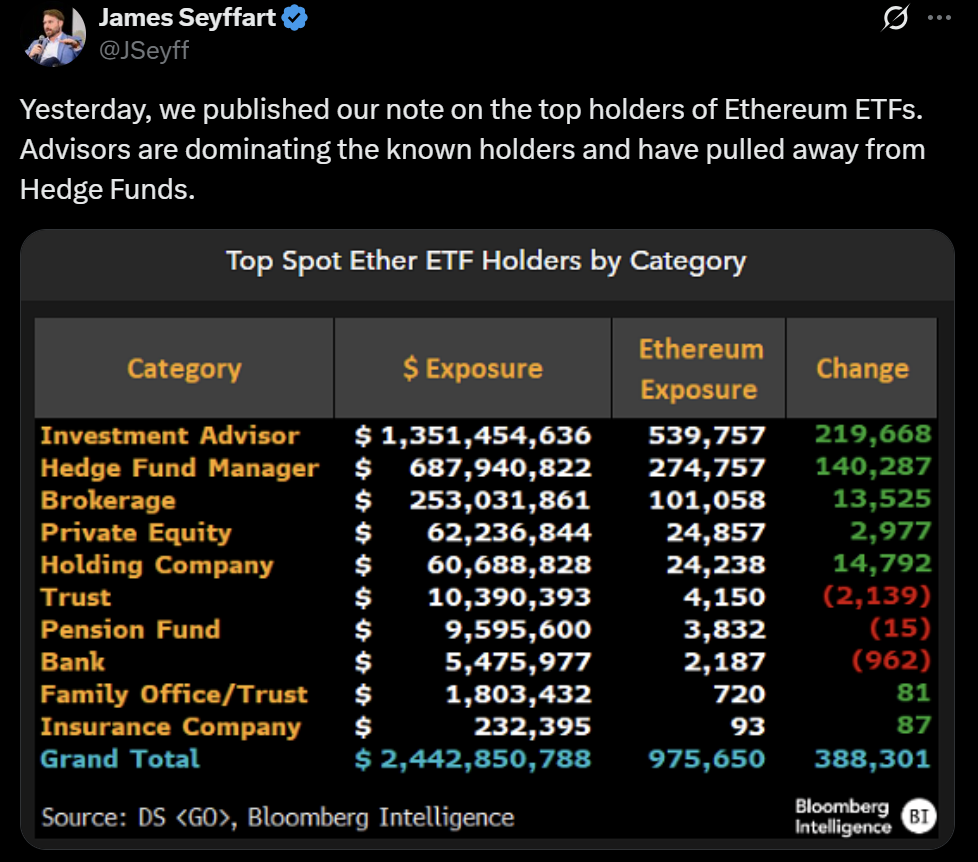
Advisors outpaced hedge funds by a wide margin. Hedge fund managers held roughly $688 million, or 274,757 ETH, about half the volume absorbed by advisors. Other categories, including pension funds and insurance firms, lagged well behind. That shift highlighted a key difference between Bitcoin’s early ETF cycle and Ethereum’s.
Hedge funds and fast-moving players dominated initial inflows to Bitcoin. With Ethereum, advisors set the pace, embedding ETH exposure into diversified client portfolios.
The move mattered because advisors typically control allocations for pensions, retirement accounts, and high-net-worth clients. They rarely chase speculative surges. Instead, they introduce assets slowly, balancing growth potential with regulatory oversight. Their decision to nearly double holdings in one quarter indicated growing comfort with Ethereum as a legitimate allocation.
Rather than retreating after the ETH USD pair recently charted a new peak, advisors increased exposure. The move indicates that major market players view ETH less as a short-term trade and more as a structural addition to long-term portfolios.
Furthermore, the contrast with hedge funds, which trimmed risk during the same period, made the advisor flows even more notable. Institutions signaled that Ethereum’s role shifted from speculative asset to portfolio staple.
Ark Invest Bets on ETH and Bitmine
Institutional activity extended beyond ETFs as Ark Invest added direct exposure to Ethereum and its mining infrastructure. The firm purchased another $15 million worth of ETH, underscoring its conviction in the asset despite the recent correction. Ark also acquired about $15.6 million in Bitmine shares, even as the stock slid more than 10 percent during the week.

Bitmine itself had just executed a large Ethereum purchase. On-chain data showed the firm’s wallets accumulating roughly 42,867 ETH, valued at $198 million. That positioned Bitmine as one of the largest recent buyers, adding to a trend of corporate entities holding ETH alongside their core business models.
Ark’s decision to buy the miner’s equity suggested a two-track strategy: gaining direct exposure to the token and capturing potential upside from the infrastructure tied to Ethereum’s growth.
The move fits Ark’s broader playbook of taking concentrated, high-conviction positions in emerging technology. While advisors diversified across ETFs, Ark leaned into a thematic bet that combined the underlying asset with operational leverage through Bitmine. The timing also stood out. Rather than trimming risk into weakness, Ark scaled up its allocation just after ETH’s pullback from its peak.
This marked another expression of institutional demand. Advisors anchored ETH exposure through ETFs, while Ark amplified it through direct and equity-linked purchases. Both channels pointed to the same conclusion: large managers were steadily deepening their Ethereum stakes.


