



Ether treasury company ETHZilla authorized a $250 million share repurchase program, the firm disclosed on Monday. The board approved the buyback of outstanding common shares, with 165.4 million shares currently in circulation.
This decision comes less than a month after ETHZilla rebranded from 180 Life Sciences and shifted its core strategy to Ether accumulation. The pivot revived its previously declining stock and positioned the company alongside other public firms turning to digital assets as treasury holdings.
Management cited “market conditions,” “management discretion,” and “alternative uses of capital” as reasons for the program. These are traditional justifications often used in repurchase announcements.

ETHZilla’s $403 Million Ether Purchases
ETHZilla revealed it has acquired 102,237 ETH at an average purchase price of $3,948.72, totaling just over $403 million. At current market levels of $4,576 per ETH, the holdings are valued at roughly $489 million.
The company confirmed that its latest Ether acquisitions will be staked with Electric Capital, signaling a focus on generating additional yield from its treasury.
Despite the size of its Ether holdings, ETHZilla has faced financial pressure. In its latest annual report, the firm disclosed an accumulated deficit of $141.5 million in 2023, highlighting weak fundamentals, persistent losses, and shareholder dilution.
Ether Treasuries Across Companies
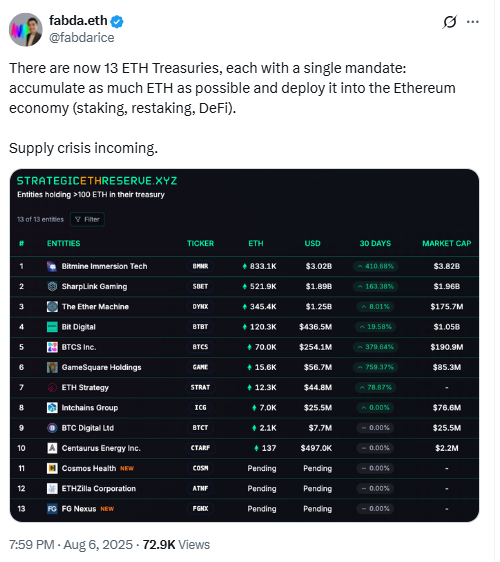
ETHZilla is not the only company building an Ether-focused balance sheet. Firms including BitMine Immersion Technologies, The Ether Machine, SharpLink Gaming, Bit Digital, and Ether Capital Corp. have also disclosed strategic Ether purchases.
Analysts estimate that Ether treasury strategies have collectively absorbed around 3.4% of Ethereum’s total supply, according to Anthony DeMartino, founder and CEO of Sentora Research. This makes Ether one of the most concentrated crypto assets held by corporate treasuries.
Leverage Risks in Ether Treasury Firms
Analysts have raised concerns about leverage risks tied to Ether treasury strategies. Mike Foy, CFO at Amina Bank, said it remains unclear whether corporate crypto-treasury models are sustainable long-term.
“It’s important to determine whether companies are pursuing the approach for speculative gains, signaling purposes or as part of a broader strategic plan,”
Foy said. He added that if such purchases appear unusual, it may signal short-term share price motives rather than lasting strategies.
Kadan Stadelmann, CTO at Komodo Platform, compared Ether treasury companies to spot exchange-traded funds (ETFs), noting a key difference.
“Spot ETFs cannot legally offer staking and DeFi. Ethereum treasury firms offer higher yields,”
he explained.
However, Stadelmann warned of structural risks. “ETH treasury firms have risks, such as overleveraging,” he said. A downturn in Ether’s price could force liquidations and trigger cascading impacts on corporate holdings.
Falling prices could weaken debt-financed treasury strategies, especially for companies that obtained Ether through loans, convertible notes, or equity dilution. Analysts caution that firms using leverage to expand their digital-asset balance sheets may face outsized risks during bear markets.


