


The wait for a Hedera (HBAR) exchange-traded fund (ETF) could soon be over. The U.S. Securities and Exchange Commission (SEC) has pushed back its decision on the Canary HBAR ETF until November 8, 2025, but a major rule change may accelerate the process. The SEC recently approved generic listing standards for crypto ETFs, a move that makes it easier for tokens like HBAR to qualify for a spot listing.
In January 2024, the SEC approved the first spot Bitcoin ETFs that saw massive inflows. That decision opened the door for other cryptocurrencies. If approved, an HBAR ETF would let investors gain exposure to Hedera’s price without holding the token directly. This matters because ETFs trade on regulated stock exchanges, giving both retail and institutional investors easier access.
SEC Pushes HBAR ETF Deadline to November 8
Efforts to launch crypto ETFs have faced years of hurdles. Bitcoin ETF applications were rejected repeatedly until 2024, when the SEC finally approved them after court rulings and heavy pressure from asset managers.
For altcoins, the process has been even slower. Canary, an investment firm, filed to launch an HBAR ETF earlier this year. Grayscale also filed for funds tied to Hedera, Polkadot, Litecoin, and Bitcoin Cash. But the SEC has delayed decisions several times, citing the need for more review.
The current deadline for HBAR is November 8, 2025. These repeated delays have frustrated investors, but they also signal that the SEC is not rejecting altcoin ETFs outright—it is waiting for clearer rules.
What Are These “generic listing standards”?
In September 2025, the SEC introduced “generic listing standards” to make ETF approvals simpler and faster. Under the new rules, a cryptocurrency can qualify for a spot ETF if it has a regulated futures market trading for at least six months. Another path to eligibility comes when an existing ETF already holds large exposure to that same asset, typically at least 40% of its value.
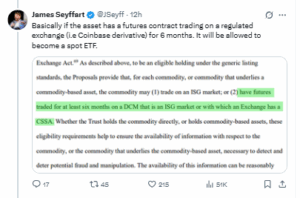
With these standards in place, major exchanges such as Nasdaq and Cboe no longer need to submit each crypto ETF application for lengthy, case-by-case review. Instead, once an asset meets the criteria, exchanges can list the ETF directly.
This change mirrors the “ETF Rule” adopted in 2019 for traditional funds. That earlier reform pushed annual ETF launches from around 117 to nearly 370. Analysts believe crypto ETFs could now see the same kind of acceleration.
Even if approval takes longer, the new generic listing standards mean that the era of altcoin ETFs has already begun. Analysts expect multiple products to follow in 2026, just as traditional ETFs exploded after the 2019 rule.
HBAR Among Few Tokens Likely to Qualify Under New Rules
Hedera is one of the few altcoins positioned to benefit quickly from these rules. Its native token, HBAR, already trades on Coinbase Derivatives, giving it the six-month futures history required by the SEC.
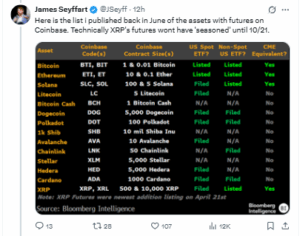
Research from Galaxy Digital identified Hedera (HBAR) as one of only about ten crypto assets that currently qualify under the framework. Bloomberg ETF analysts James Seyffart and Eric Balchunas also described the new rule as a “game changer” for tokens like Hedera, Solana, and Dogecoin, which now have a clearer route to ETF approval.
While the framework is more open, the SEC has not given altcoin ETFs a free pass. Some commissioners warn that altcoins carry unique risks, including market manipulation and low liquidity.
The SEC has emphasized the need for “surveillance-sharing agreements” between exchanges to detect suspicious trading. This is why futures trading history is critical: it provides evidence of transparent price discovery.
In other words, HBAR may qualify on paper, but regulators will still review whether its futures market is deep enough and whether investor protections are strong.


