


Hedera finished its mainnet upgrade to v0.65.1 on Wednesday, September 24, at 17:24 UTC. The status page lists the maintenance as completed and the network operational. The window began at 17:00 UTC and ran as scheduled.
The release advances state management and record handling. Documentation highlights the “Virtual Mega Map,” enforcement of max_custom_fees from HIP-991 for scheduled transactions, and Block Stream improvements. These features target cleaner transaction records and forward-compatibility.
Operations resumed immediately after verification. Nodes report as operational across council hosts, with mirror services up. The upgrade follows earlier testnet work this month.
Testnet moves to v0.66 today
Hedera will upgrade the testnet to v0.66 today, Thursday, September 25, starting at 17:00 UTC. The window is slated for ~40 minutes. The status page flags expected intermittent disruption during the change.
Previewnet already runs v0.66, which signals feature readiness ahead of testnet rollout. Operators can validate tooling and integrations there before pushing to testnet. The page shows previewnet components operational.
Developers should plan for short service interruptions during the maintenance window. Mirror REST and gRPC endpoints typically track testnet state shortly after nodes return. Hedera will post completion on the same status feed.
Hiero marks one year under Linux Foundation Decentralized Trust
Hedera marked one year since donating its codebase to the Linux Foundation’s Decentralized Trust initiative, creating the open Hiero codebase on September 16, 2024. The anniversary post outlines governance and collaboration progress across the stack.
A separate Linux Foundation release today notes new members, Hiero’s graduation track, and a smart-contract privacy project in the program. That announcement situates Hedera’s contribution inside a wider open-source roadmap.

Together, the posts frame the past year as a shift toward vendor-neutral stewardship. Developers gain transparent processes, while enterprises can reference an independent foundation for long-term maintenance.
Brand alignment: Hedera Foundation and Hedera Council
On May 8, the ecosystem unified brand names. The HBAR Foundation became Hedera Foundation, and the Hedera Governing Council became Hedera Council. Both entities remain independent but operate under a clearer, shared brand.
The change followed leadership updates at the foundation that began late 2024 and took effect in 2025. Public posts and releases emphasize role clarity for funding, governance, and ecosystem growth.
The alignment simplifies external messaging for partners and developers. It also keeps accountability distinct: the council runs mainnet governance, while the foundation focuses on ecosystem programs.
Triangle pattern on HBAR: compression and triggers
The HBAR/USD chart shows a symmetrical triangle tightening between descending resistance near $0.24 and rising support around $0.22. Price has printed lower highs and higher lows into late September, which signals crowd compression before a directional move. Therefore, the first decisive close outside the triangle should set the next leg’s path.
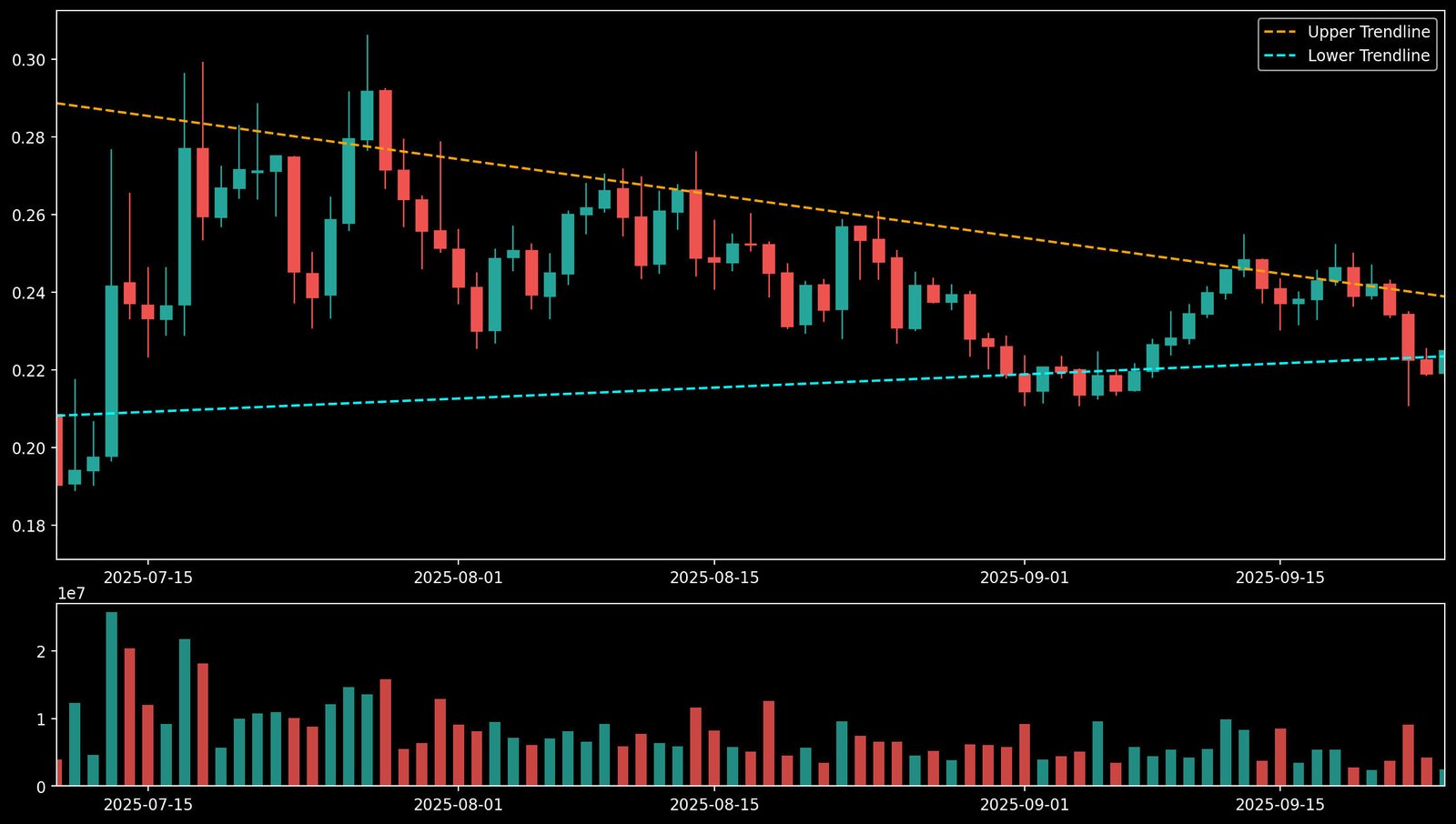
For the upside, a strong daily close above ~$0.24 would mark the breakout. Traders then often project a measured move using the triangle’s initial height. Here, that range sits near $0.08–$0.09, which places an objective around ~$0.31 after an upside break, in line with the post’s target. Follow-through typically improves when volume expands on the breakout and again on any intraday or daily retest of the former ceiling as support.
For the downside, a daily close below ~$0.22 would invalidate the rising base and confirm a break lower. Using the same height method, the projection lands near ~$0.14, matching the author’s roadmap. In that path, failed rebounds back into the triangle often act as continuation signals, while shrinking volume on bounces can warn that sellers remain in control.
In both cases, confirmation matters more than the first wick. Therefore, watch for a clean candle close beyond the boundary, an accompanying volume surge, and—ideally—a successful retest. Until that sequence appears, the pattern remains a coil, and noise inside the band carries limited informational value.
HBAR slips below key averages; watch the double-bottom zone and 0.16 risk
HBAR now trades under the 50-day and 100-day moving averages after several daily closes. That posture signals weakening momentum and tighter risk tolerance for longs. Moreover, price sits inside a broad contracting range with descending resistance overhead and rising support beneath. The next sessions will show whether buyers can defend the current shelf and force a rebound back above the averages.
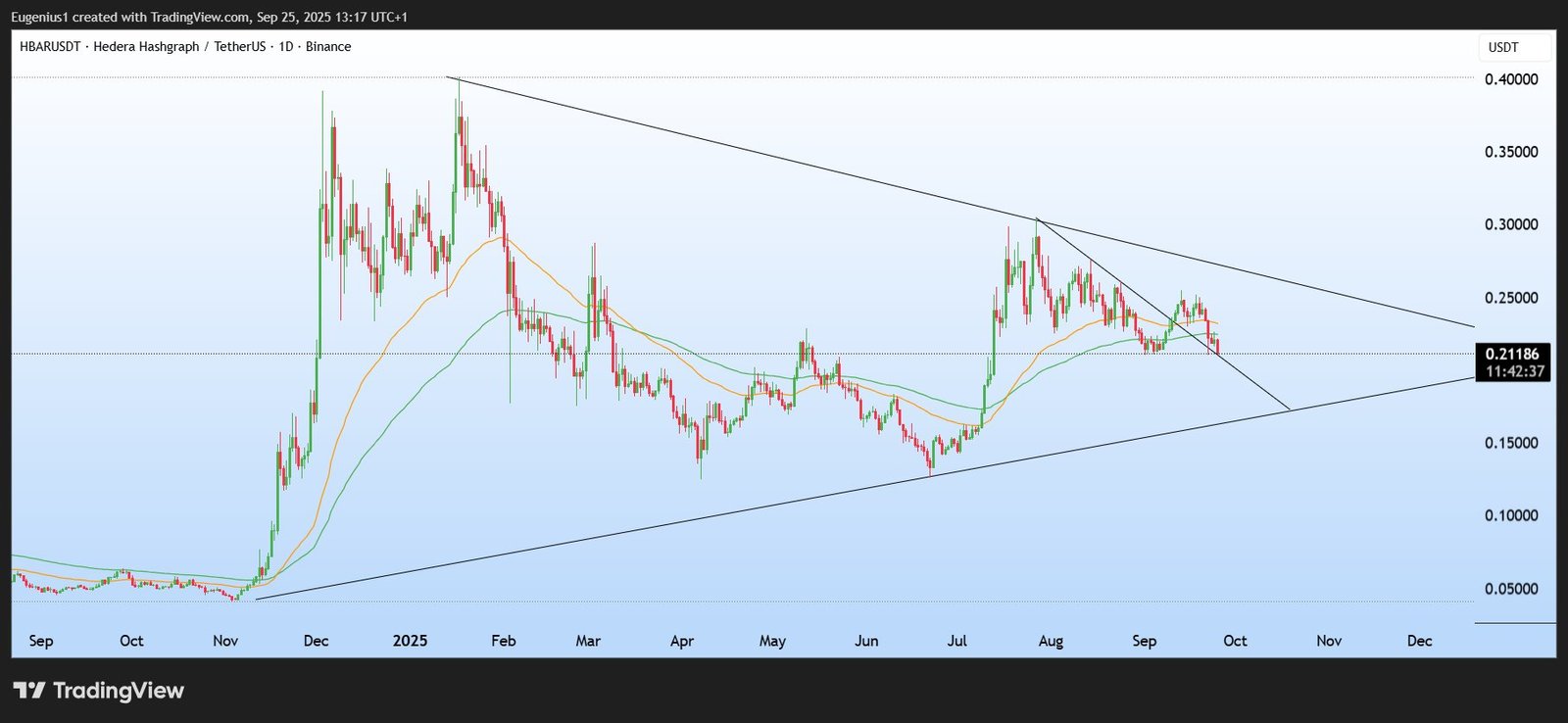
A textbook double bottom needs a firm hold near the prior trough and then a push back through the mid-range neckline. Therefore, bulls first need a clean daily close back above the 50-day, then the 100-day, to reset trend strength. If that reclaim occurs, pullbacks into those averages often turn into support and confirm accumulation. Until then, rallies into the moving averages face supply.
However, failure to stabilize invites a sweep of the recent lows. A decisive break of the base opens room toward the analyst’s cited 0.16 area, which aligns with the lower boundary of the long-running range. In that case, watch for expanding volume on the breakdown and weak bounces back into the lost averages. As always, Bitcoin’s direction can accelerate or negate these signals, so correlation risk remains high.
MACD slips below signal; momentum stabilizes near zero
HBAR’s daily MACD sits below the signal line and under the zero axis. The histogram has just turned slightly red again, near −0.00036, after a brief green bounce. This placement shows a weak bearish bias, yet the downside pressure is easing as bars shrink toward the baseline.
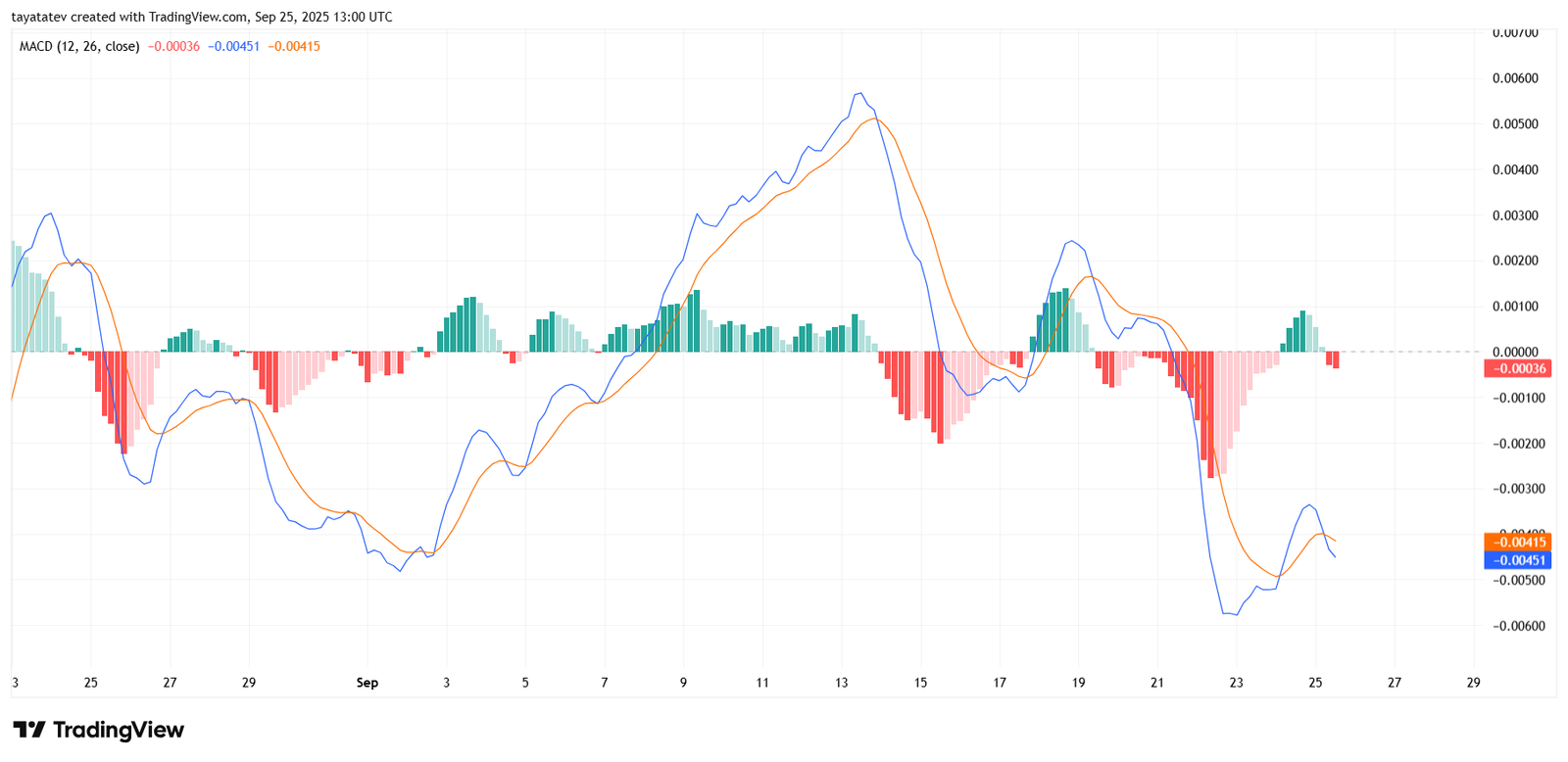
Over the past week, momentum whipsawed. The MACD flipped positive around Sept. 19, then reversed sharply on Sept. 22–23 with deep red bars. Since then, both the MACD (≈ −0.00451) and signal (≈ −0.00415) have curled higher, narrowing their gap. Therefore, sellers no longer dominate like they did earlier in the week.
From here, watch the sequence. A clean MACD cross back above the signal would confirm renewed positive momentum. A subsequent push through the zero line would strengthen that shift. However, if the MACD rolls over and the histogram expands red again, bears regain control and the September rebound attempt likely fades.


